Gates · Dallas, Texas
What Drives the Cost of an Automatic Driveway Gate?
Size, material, hardware type, motor rating, access control and site work, how each one moves the number on your quote.
 By Jack Johnson, owner of Park Cities Fence & Deck · 8 min read · 1,686 words
In short
Automatic gate cost is driven by six things: the gate’s size and weight, the material and level of custom design, swing versus slide hardware, the operator’s rating, the access-control package, and site work, trenching, electrical and masonry columns. Each is a dial you can turn. A free site-visit quote is how the dials become a number.
In this guide
- Gate size and weight set the baseline
- Material and design: the widest cost range
- Swing vs. slide: the hardware gap
- The operator: rating, duty cycle and resilience
- Access control: good, better, estate
- Site work: the invisible line items
- Masonry columns and lighting: the estate layer
Need this done? See gates & gate motors.
Ask what an automatic driveway gate costs and any honest answer starts with “it depends”, because a simple single-swing cedar gate with a keypad and a full estate entrance with masonry columns, custom iron and video intercom are different projects that happen to share a category. What we can do is show you exactly what the number depends on, so a quote reads like an itinerary instead of a mystery.
These are the six factors that move the price on every automatic gate installation we quote across DFW, roughly in order of impact, with honest notes on which upgrades earn their keep and which are mostly cosmetic. When you want actual numbers for your driveway, the site visit and quote are free, usually within 24 hours.
Gate size and weight set the baseline
Everything scales from the opening. A wider driveway means a longer gate; a longer gate means more material, heavier framing, beefier hinges or rollers and a stronger operator. The relationship is not linear, a leaf half again as long must resist considerably more twisting and wind load, so its frame is built heavier per foot, and the hardware jumps a class.
Height adds cost the same way, and tall gates catch more wind, which pushes the design toward stiffer framing and larger operators. This is why two quotes for “an automatic gate” can sit far apart while both being fair: one is moving a modest panel, the other a small wall.
The practical takeaway: keep the gate as short and low as the site and your design goals allow. A gate sized to the driveway rather than to ambition saves money at every layer above it, material, hardware and motor alike.
Material and design: the widest cost range
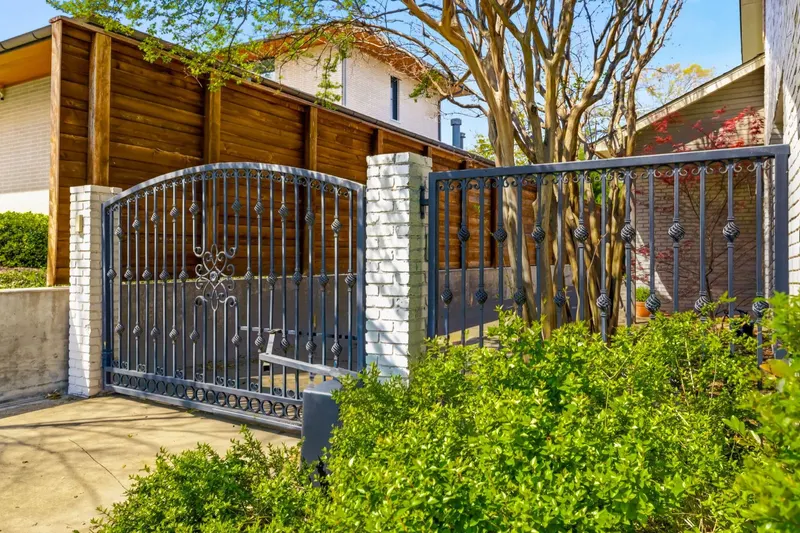
Material choice moves cost more than any other design decision. A cedar-and-steel-frame gate matching your fence sits at the accessible end. Standard-pattern powder-coated ornamental steel, the workhorse of Dallas driveway gates, occupies the broad middle, durable and handsome without custom fabrication. Fully custom ironwork with scrollwork, arches and finials sits at the top, priced as the one-off metalwork it is.
Within steel, detail is the multiplier. A flat-top gate from stock pickets is efficient to build. Add an arched top line, a decorative ring course or custom lettering and you are paying for fabrication hours, not just material. None of that is wasted money on a street-facing entrance, it is precisely what makes a gate read as architecture, but it should be a conscious choice.
Solid-panel privacy gates deserve a note: cladding a frame in wood or metal panels adds weight and wind load together, which often bumps the operator class too. Privacy at the driveway is achievable and popular; it simply costs more than the see-through version at every layer.
Swing vs. slide: the hardware gap
For the same opening and material, a slide gate usually carries a modest premium over a swing gate. The panel must be built longer than the opening, half again longer for a cantilever design that keeps the driveway free of tracks, and the roller, guide and drive hardware adds up against a swing gate’s hinges and arm.
But the comparison flips easily on site conditions. If a swing layout would require regrading a sloped driveway or relocating landscaping to clear the arc, the slide gate becomes the economical answer even with its longer panel. This is the clearest example of why gate pricing is site pricing: the cheap option on paper is whichever one your lot was shaped for. Our guide to choosing between swing and slide covers the decision in depth.
Dual-swing entrances split the difference in an interesting way: two shorter leaves need two operators, but each leaf is lighter, and the format avoids both the slide gate’s long panel and the single swing’s sweeping arc. On wide estate openings, dual swing is often the balanced choice.
The operator: rating, duty cycle and resilience
Operators are priced by capability: how much gate they can move, how many cycles per hour they sustain, and how gracefully they handle Texas conditions. Sizing the motor with margin above the gate’s actual weight costs somewhat more upfront and pays for itself in lifespan, an operator loafing below its rating survives August; one straining at its limit does not.
Battery backup and safety photo-eyes are part of every package we install, so on our quotes they are not line items to economize on. Where real choice exists is in tier: standard residential operators cover most homes; heavier-duty units earn their premium on oversized gates, solid-panel designs and high-traffic households where the gate cycles all day.
Underground swing operators, the invisible kind, buried at the hinge point, are the luxury option. They cost meaningfully more than arm operators because of the foundation boxes and drainage they require, and they buy pure aesthetics: nothing visible but the gate. On a showpiece entrance, that is often exactly the point.
Access control: good, better, estate
Access control is the most modular part of the budget, a ladder you can climb later rather than a decision locked in concrete.
The practical advice: wire for more than you install. Running spare conduit to the gate during construction costs little; opening the trench again in three years to add a video intercom costs real money. We rough-in generously for exactly this reason.
- Good: Keypad plus remotes. Covers family and regular visitors; the entry point for most single-family installations.
- Better: Add phone-app control and a vehicle exit sensor, open from anywhere, share temporary codes, and the gate opens itself for departing cars.
- Estate: Video intercom, guest management with time-limited codes, and integration with home automation. Standard on larger properties and gated frontages.
Site work: the invisible line items
The parts of a gate project you cannot see from the street are often the parts that separate two quotes. Power must reach the gate, and the trench from the house, across lawn, beds, or under a walkway, is priced by distance and difficulty. A long run to a back-of-lot gate costs more than a short one beside the garage; boring under existing concrete costs more than trenching through turf.
Foundations are the other buried cost. Gate posts carry more load than any fence post, so ours are set in concrete with engineered footings below the clay movement zone, the layer of North Texas soil that swells and shrinks with the seasons. Skimping here is how gates end up sagging against their motors, and it is the corner we will not cut at any price.
Slope and drainage work the same way: a driveway that needs grading correction, or an underground operator pit that needs proper drainage, adds site cost that a flat, dry lot never sees. None of it is padding, it is the difference between a gate that works in year one and a gate that still works in year twelve.
Masonry columns and lighting: the estate layer
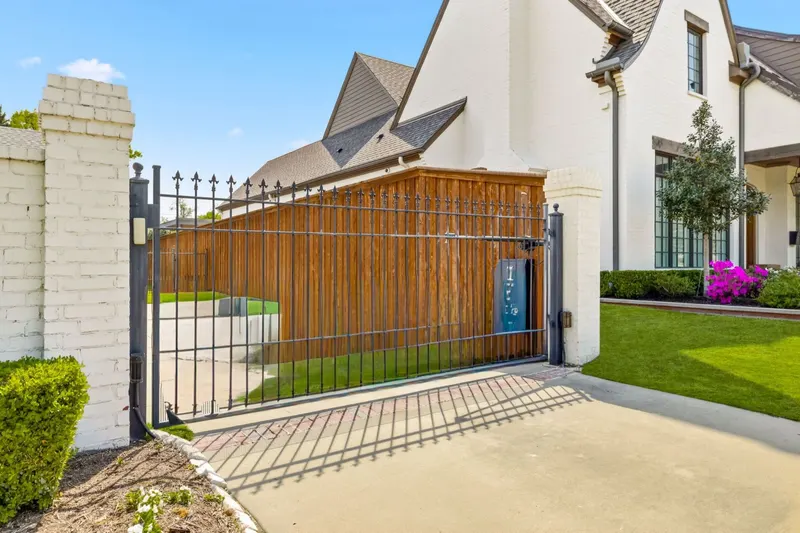
Brick or stone columns flanking the gate are the single biggest optional add, real masonry on real footings, priced accordingly, and also the upgrade with the most curb-appeal leverage per dollar. They frame the entrance, carry hinges far better than steel posts, and host the lighting, intercom and address plaque that finish a composition. Our masonry crews build them to match or deliberately complement the house.
Entrance lighting, column caps, gate uplights, path illumination, rides the same electrical run as the operator, so adding it during construction is far more economical than as a later project. For street-facing entrances in Preston Hollow, we consider it part of the design, not decoration.
Stack these choices and you can see why the honest answer to “what does a gate cost” is a range as wide as housing itself. The good news: every factor above is visible on a site visit, which is why our quotes are free, itemized and usually back to you within 24 hours. You will see exactly which dials are set where, and which ones you can turn.
How Park Cities Fence & Deck helps
Jack Johnson comes out himself, looks at your property and gives you a free written estimate with a timeline. Wood, iron and masonry are all built in-house, so the advice fits the property. Related services: gates & gate motors, masonry fencing. We work in Dallas and Preston Hollow and across Dallas.
Questions people ask next
What is the single biggest driver of automatic gate cost?
Gate size and material together. A wider, taller or solid-panel gate needs heavier framing, stronger hardware and a higher-rated operator, so one design decision cascades through the whole budget. Custom iron fabrication is the widest single variable within materials.
Is a slide gate more expensive than a swing gate?
Usually a modest premium for the same opening, because the panel is longer and the roller and drive hardware adds up. But if your driveway slopes or the swing arc would require regrading or landscape changes, the slide gate often becomes the cheaper total project.
Do safety features add much to the price?
Photo-eyes and battery backup are included in every operator package we install, so they are not upgrades to weigh. The safety layer worth budgeting deliberately is guarding and alignment work on slide gates, which we itemize as part of the installation rather than as an option.
Can I add cameras or an intercom later?
Yes, access control is the most upgradeable part of the system, especially if conduit is roughed in during construction. We deliberately wire for growth so adding a video intercom or guest-code system later is a device swap, not a new trench across your yard.
How do I get an actual price for my driveway?
A site visit. Slope, opening width, power distance and foundation conditions all live on your lot, not in a price sheet. We measure, talk through design and access options, and deliver a free itemized quote, usually within 24 hours. Call (214) 755-8100 or reach us through the contact page.