Gates · Dallas, Texas
Swing vs. Slide: Choosing the Right Automated Driveway Gate
Driveway slope, available space and the look you want decide which gate automation setup fits your property.
 By Jack Johnson, owner of Park Cities Fence & Deck · 8 min read · 1,766 words
In short
Swing gates suit level driveways with room for the gate to arc open, they are quieter, simpler and the classic estate look. Slide gates win on sloped driveways and tight frontages, trading the arc for a run of clear space along the fence line. Slope and space decide; style breaks the tie.
In this guide
- How a swing gate works, and why it is the default
- How a slide gate works
- The slope question decides more gates than anything else
- Space, setback and how cars actually arrive
- Hardware, noise and long-term upkeep
- Style: what the street sees
- Our rule of thumb
Need this done? See gates & gate motors.
Every automated driveway gate we build in Dallas starts with the same fork in the road: does this gate swing, or does it slide? Get that one decision right and everything downstream, the motor, the hardware, the columns, the daily experience of coming home, falls into place. Get it wrong and you fight the gate for as long as you own it.
The good news is that the answer is rarely a matter of taste alone. Your driveway’s slope, the space inside your property line and the way cars approach from the street usually make the decision for you. Here is how we walk homeowners through it on our automatic gate installations, and the trade-offs that matter once the gate is opening thirty times a day.
How a swing gate works, and why it is the default
A swing gate operates exactly like a door. One leaf (or a pair of leaves) hangs on hinges from posts or masonry columns, and an operator arm pushes it through an arc, usually opening into the property. Because the motion is simple, the hardware is simple: heavy-duty hinges, an articulated or linear arm, and a motor that only has to rotate the leaf, not drag its full weight along the ground.
That simplicity is the swing gate’s quiet superpower. There are no rollers to wear, no track to keep clear of leaves and gravel, and no chain rattling along the fence line. A well-hung swing gate is nearly silent, which matters more than people expect when the gate sits thirty feet from a bedroom window and the first departure of the day is at 6 a.m.
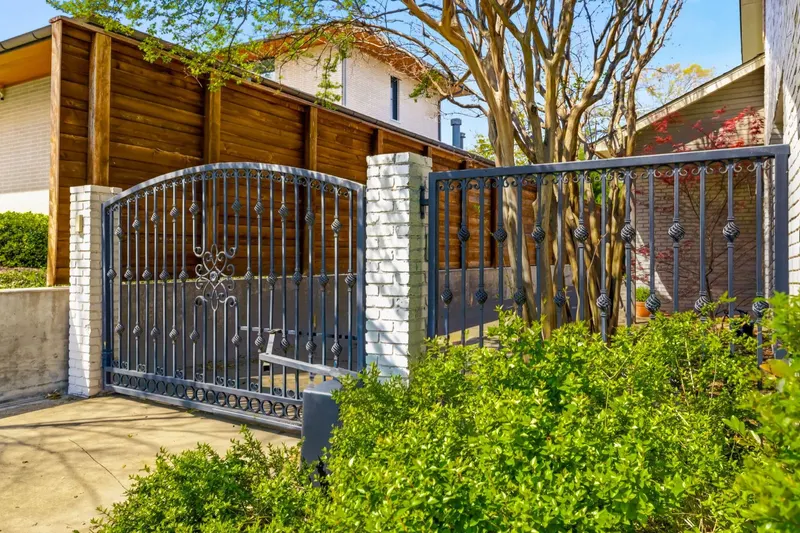
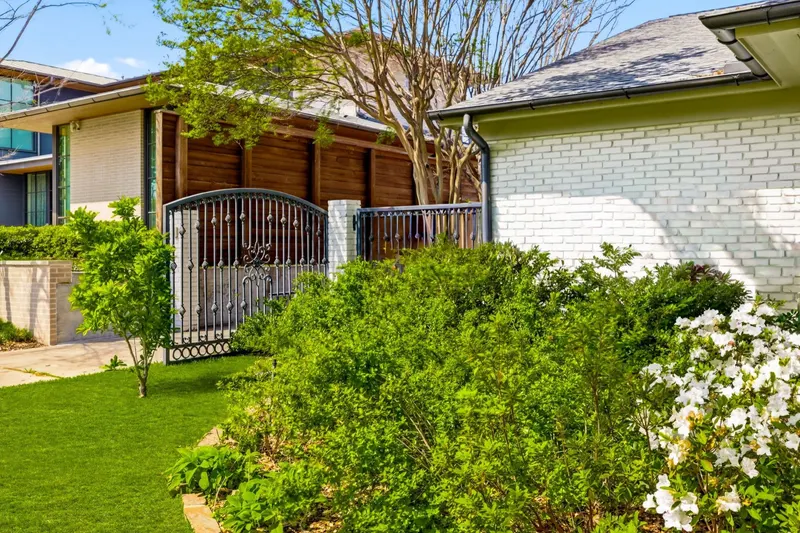
Aesthetically, the swing gate is the classic. A pair of powder-coated steel leaves meeting at the center of a driveway is the look most of our Highland Park and Preston Hollow clients picture when they say “driveway gate.” The double-leaf format also halves the arc each leaf needs, which helps on shorter driveways.
How a slide gate works
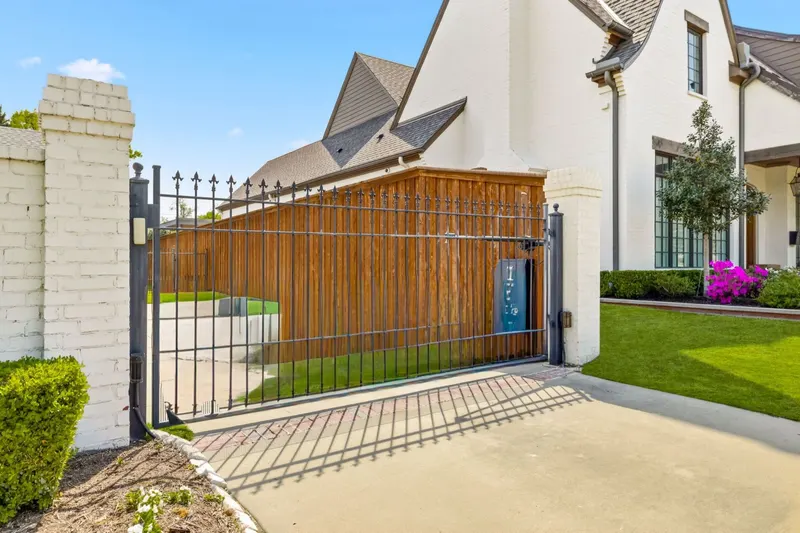
A slide gate is a single rigid panel that travels sideways, parallel to your fence or wall, until the driveway is clear. There are two common builds. A track-mounted gate rolls on wheels along a ground track set into the driveway. A cantilever gate floats above the ground on rollers mounted to posts, counterbalanced by an extra length of gate frame, no track in the pavement at all.
In North Texas we lean toward cantilever designs for residential work. Ground tracks collect live oak leaves, mud and ice, and every obstruction becomes a service call. A cantilever gate clears all of it because nothing touches the driveway surface. The trade-off is that the gate frame must be roughly half again as long as the opening to carry the counterbalance, which increases the clear space you need beside the driveway.
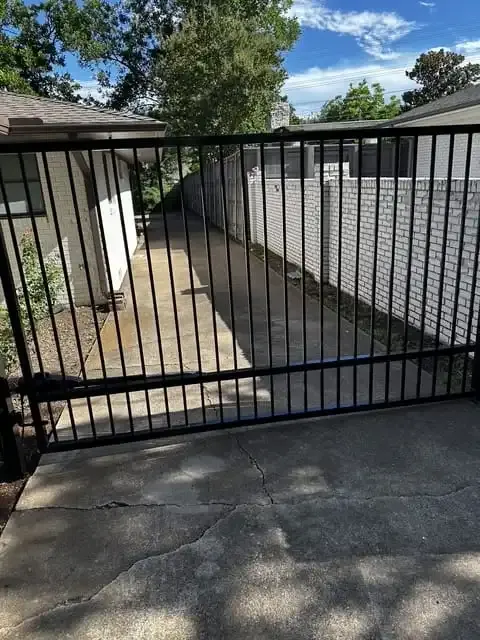
That clear run is the slide gate’s defining requirement: a straight, level stretch along the inside of your fence line, slightly longer than the driveway opening itself, kept free of trees, meters, gates and structures. If your side yard has it, a slide gate is a beautiful solution. If it does not, no motor on earth will create the space.
The slope question decides more gates than anything else
Here is the test we run on every site visit: stand at the gate line and look up the driveway. If the pavement rises as it enters the property, an inward-swinging gate will ground out, the bottom rail hits the pavement before the leaf finishes its arc. You can raise the gate to clear the slope, but then the gap under the closed gate grows large enough to wave a dog through, and the proportions look wrong from the street.
Sloped driveways are common across Dallas, especially where homes sit above street level for drainage. On those lots a slide gate is usually the honest answer, because the panel travels across the slope rather than through it. The alternative, swinging the gate outward toward the street, is rarely allowed and never wise, since the leaf would sweep across the sidewalk and apron where pedestrians and cars sit.
There is a middle path worth knowing about: on gentle grades, we can sometimes set the hinge axis slightly out of plumb so the leaf rises as it opens. It works within limits and only with the right hardware, and it is exactly the kind of judgment call a site visit exists to make. This is why we never quote swing-versus-slide from a satellite photo.
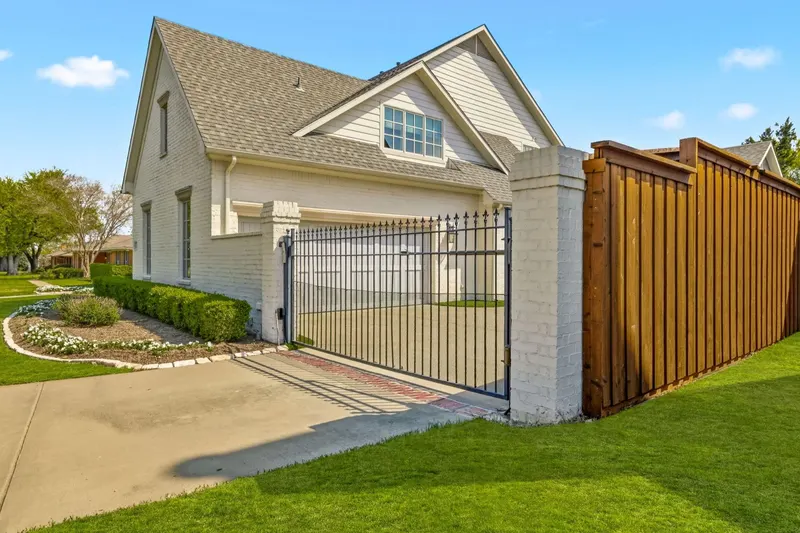
Space, setback and how cars actually arrive
Beyond slope, think about geometry. A swing gate needs its arc: a quarter-circle of clear space with a radius equal to each leaf’s length. Parked cars, landscaping, trash-can pads and basketball goals all live in that arc more often than owners realize. Walk it with a tape measure before you fall in love with the swing look.
Just as important is setback, the distance between the street and the closed gate. A car turning in off the street needs somewhere to stand while the gate opens, or it stops in the traffic lane. On deep Park Cities lots this is easy. On shallower frontages in Plano and Frisco, a slide gate mounted close to the front fence line often preserves more usable stacking room than a swing gate placed deep enough to accommodate its arc.
- Swing needs: Level ground at the gate line, a clear quarter-circle for each leaf, and enough setback for a car to wait off the street.
- Slide needs: A straight, clear run beside the driveway slightly longer than the opening, half again longer for cantilever designs.
- Both need: Power to the gate, a safe line of sight to the street, and safety photo-eyes protecting the path of travel.
Hardware, noise and long-term upkeep
Over a decade of daily cycles, the two systems age differently. Swing hardware concentrates wear in the hinges and the operator arm, both easy to inspect, lubricate and service. Slide gates spread wear across rollers, guide wheels and the drive mechanism, and they are simply busier machines: more moving parts, more adjustment points, a little more noise on every cycle.
Neither choice is fragile when built correctly. We hang swing gates on posts set in concrete, with steel post options and engineered footings that reach below the clay movement zone, because a leaning post ruins gate geometry faster than any motor failure. Slide gates get the same foundation discipline plus careful roller alignment, since a gate that binds even slightly forces the motor to work against friction all day in Texas heat.
Every operator we install includes safety photo-eyes that stop and reverse the gate if anything crosses its path, and battery backup so an outage never locks you in or out. Those are not upgrades in our book; they are the baseline for a gate your family walks past every day.
Style: what the street sees
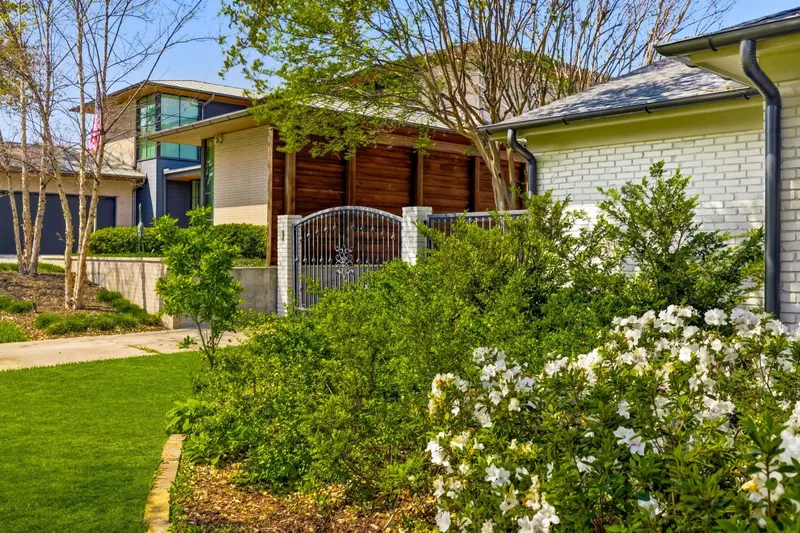
From the curb, a double swing gate reads residential and gracious, it is the gate equivalent of a front door. A slide gate can read commercial if it is designed carelessly, but it does not have to. Matching the slide panel’s picket pattern, finials and top line to the fence, and framing the opening with brick or stone columns from our masonry work, produces a slide gate that belongs on an estate street.
One honest note on symmetry: a slide gate stacks to one side, so the composition of your entrance is inherently asymmetric. If the formal, centered look matters to you, and on many Park Cities facades it should, that alone can justify solving a slope problem with grading or hardware rather than switching to a slide.
Our rule of thumb
Choose a swing gate when the ground at the gate line is level, the arc is clear and you want the quietest, simplest, most classic result. Choose a slide gate when the driveway slopes up from the street, the frontage is tight, or cars need to stack close to the gate. When either would work, we usually recommend the swing for homes and reserve slides for the lots that truly need them.
If you are not sure which side of the line your property falls on, that is what the site visit is for. We measure the slope, walk the arc and the run, and give you a free quote, usually within 24 hours, for the setup that will actually work on your lot, not the one that happens to be on a brochure.
How Park Cities Fence & Deck helps
Jack Johnson comes out himself, looks at your property and gives you a free written estimate with a timeline. Wood, iron and masonry are all built in-house, so the advice fits the property. Related services: gates & gate motors, iron / metal fencing. We work in Highland Park and Plano and across Dallas.
Questions people ask next
Can a swing gate work on a sloped driveway?
Sometimes. On gentle grades we can set the hinges so the leaf rises slightly as it opens, or regrade the first stretch of driveway. On steeper slopes the leaf grounds out or leaves an oversized gap when closed, and a slide gate is the honest answer. A site visit settles it quickly.
Which is more reliable, swing or slide?
Both are reliable when built and aligned correctly. Swing gates have fewer moving parts and concentrate wear in serviceable hinges. Slide gates have more components, rollers, guides, drive hardware, and need occasional alignment. Installation quality and a properly sized motor matter far more than the format.
Do slide gates need a track across the driveway?
Not necessarily. Track-mounted gates roll on a ground rail, which collects leaves and debris. We usually recommend cantilever slide gates, which hang from rollers beside the opening and never touch the pavement, at the cost of needing a longer clear run along the fence line.
Can both types open automatically for guests and deliveries?
Yes. Swing and slide gates pair with the same operators and access controls, keypads, remotes, phone apps and vehicle exit sensors. Safety photo-eyes and battery backup are included on every motor we install, regardless of gate type.
Which costs more, a swing or a slide gate?
For the same opening and materials, slide gates usually carry a modest premium, the frame is longer, and the roller and drive hardware add up. Site work can flip the comparison either way, which is why we quote from a site visit rather than a formula. Quotes are free.