Gates · Dallas, Texas
How Should a Fence Line, Entry Columns and Gates Be Lit at Night?
Light the columns and the gate, not the whole fence. Warm, shielded, low, and planned before the concrete is poured.
 By Jack Johnson, owner of Park Cities Fence & Deck · 8 min read · 1,730 words
In short
Light the entry, not the entire fence. Put warm, shielded fixtures on the columns, a soft wash on the gate and keypad, and only a few accents along the fence line. Keep levels low, aim light down, and run it on a photocell or timer. Plan the conduit before columns and gate footings are built.
In this guide
- What should be lit first: the columns, the gate or the fence?
- How bright and what color should the light be?
- Which lighting technique works where?
- Why does lighting have to be planned before the columns are built?
- Low voltage, line voltage or solar: what should power it?
- How should the lights be controlled?
- Do cities and HOAs regulate fence and gate lighting?
Need this done? See gates & gate motors.
Good entrance lighting does three things. It tells guests where the driveway is, it lets you see the keypad and whoever is standing at the gate, and it makes the stone and iron look as good at nine at night as at noon. Bad lighting does the opposite: glare in the driver’s eyes, a flat white wall and an annoyed neighbor.
The fixtures are the easy part. What decides the result is planning the wiring before the columns go up and the gate footings are poured. This guide covers what to light, how bright, and what to settle with your fence builder and electrician before anyone digs.
What should be lit first: the columns, the gate or the fence?
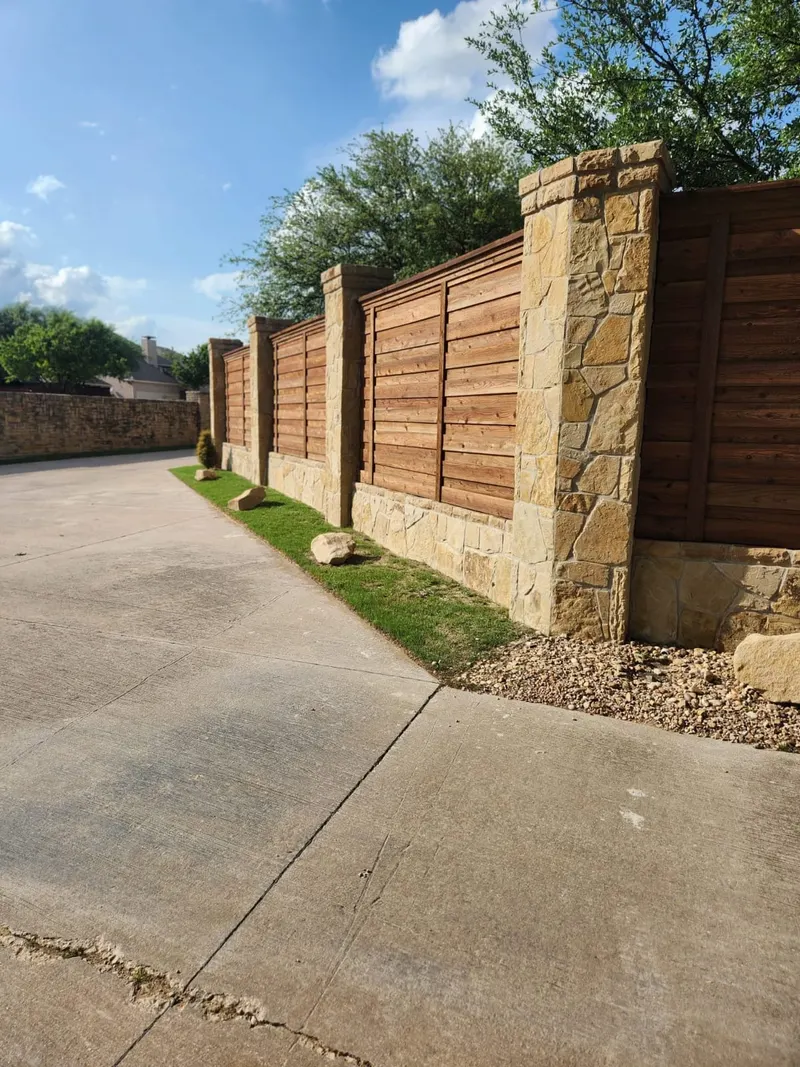
Start with the columns that flank the driveway. They mark the opening from the street, they are the heaviest architectural element, and stone or brick takes light beautifully. A lantern on top, or a small fixture washing down the face, is often all an entrance needs.
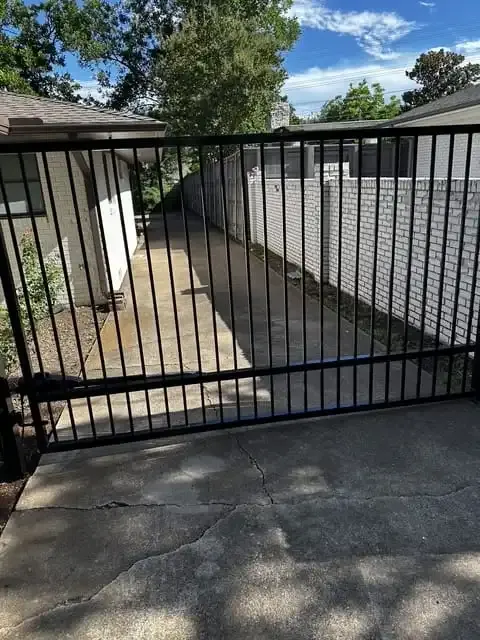
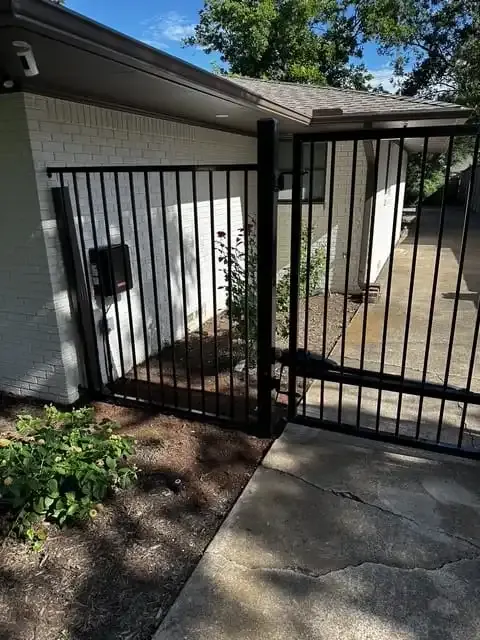
The gate comes second. The point is to see the gate, the keypad and a visitor’s face without shining light into a windshield. Soft light from the side or from above works. A spotlight aimed up the driveway does not.
House numbers deserve a mention. A delivery driver or an ambulance crew has to find the address in the dark, so a small downlight on the number plaque is one of the most useful fixtures on the whole property.
The fence line comes last and needs the least. A long run of evenly spaced lights tends to look like a runway. A few accents where the fence meets a corner column, a specimen tree or a walk gate reads as intentional. Our guide to designing an estate entrance shows how these pieces fit together.
How bright and what color should the light be?
Lower and warmer than most people expect. The U.S. Department of Energy has published five principles for responsible outdoor lighting, agreed between the Illuminating Engineering Society, the International Dark-Sky Association and the National Park Service. They ask whether a light is useful, targeted, no brighter than needed, controlled and warm in color.
For a residence that translates into a simple brief. Use warm white lamps so limestone looks like limestone and not like a parking lot. Choose fixtures that hide the bulb and send light down or across a surface. Use several small sources at low output instead of one bright one. Eyes adjust to darkness, and a softly lit entrance next to a dark street looks brighter than you think.
Brightness is also a neighbor issue. Light that spills over the property line or into a bedroom window across the street is the fastest way to turn a handsome entrance into a complaint. Shielded, aimed fixtures solve most of it before it starts.
Which lighting technique works where?
Each part of an entrance responds to a different technique. The table sums up the ones we see work on Dallas properties, and what to watch for with each.
Lighting techniques for columns, gates and fence lines
| Technique | Best used on | Watch for |
|---|---|---|
| Column-top lantern | Entry columns at the driveway and walk gate | Scale: too small looks lost, bare bulbs glare |
| Downlight under the column cap | Brick and stone faces, house numbers | Needs a cap detail and conduit planned before the masonry |
| Grazing light from the ground | Textured stone walls and long masonry runs | Fixtures get hit by mowers and buried by mulch |
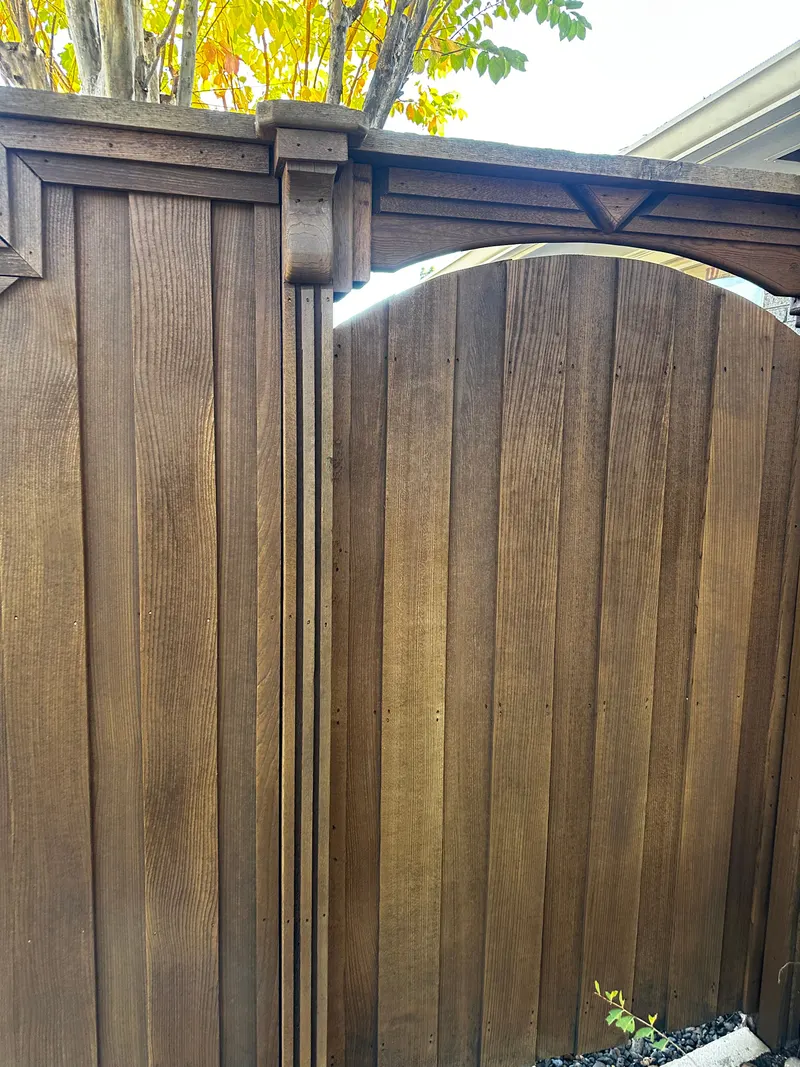
| Soft wash on the gate | Iron and wood driveway gates, keypad area | Aim away from drivers and from the street |
| Accent at intervals | Corners, walk gates and trees along the fence | Too many evenly spaced lights look like a runway |
| Tree-mounted downlight | Driveway aprons under mature oaks | Must be mounted without harming the tree |
What this means for you: Pick two or three of these for the entrance and repeat them, instead of trying one of everything.
Why does lighting have to be planned before the columns are built?
Because a finished masonry column is solid. Getting a wire to the top of it afterward means surface conduit on the stone or cutting into new work. When the lighting plan is known up front, the conduit runs up through the core of the column while it is being built, and a box is set where the fixture will mount. Nothing shows.
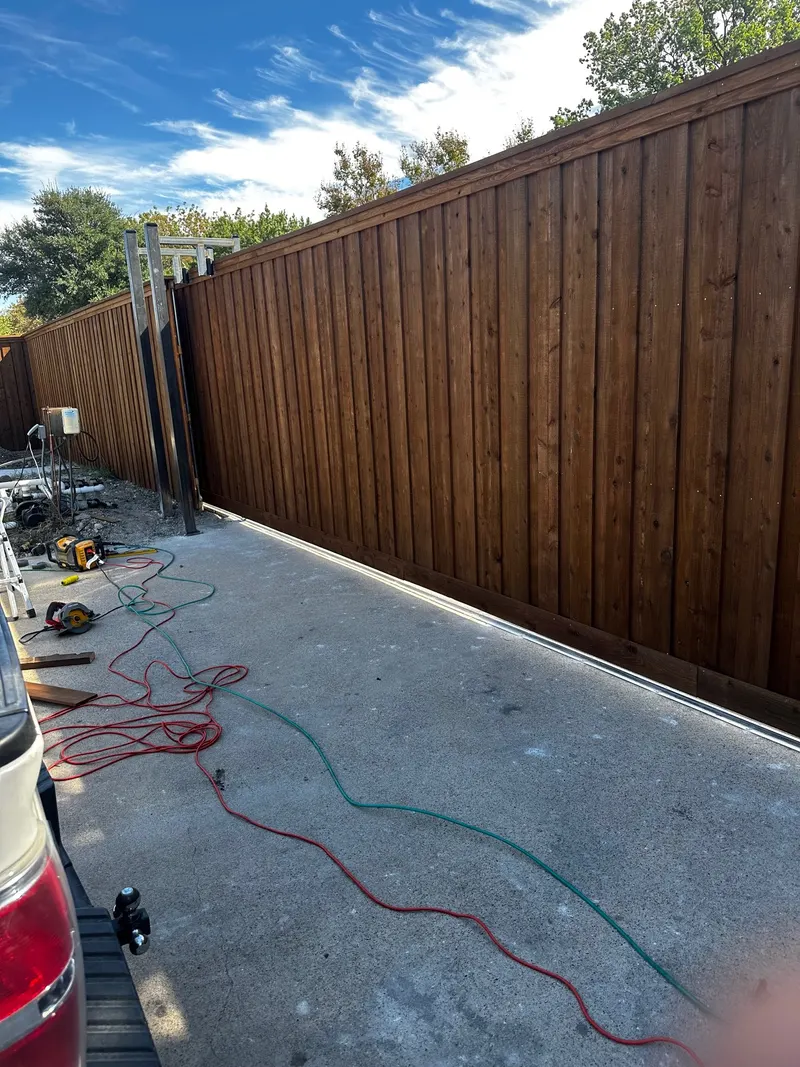
The same goes for the ground. A gate entrance already needs trenches for operator power and for the keypad or intercom. Lighting circuits can share that trench work if they are planned together, and sleeves can be laid under the driveway before the paving or the gate track goes in. Adding a sleeve under a finished driveway is a much bigger job.
This is one reason we ask about lighting at the first meeting, even when the electrician comes later. If you are working with a designer, our article on building with an architect or landscape architect explains how the drawings get coordinated. For new columns, see matching brick and limestone columns to the house.
Low voltage, line voltage or solar: what should power it?
Most fence and landscape accents run on low-voltage LED systems fed from a transformer. The cable is easier to route, fixtures are small, and the system is forgiving to adjust later. Column lanterns are often line voltage, like a porch light, and that work belongs to a licensed electrician under the city’s electrical permit rules.
Solar cap lights are tempting because they need no wiring. They are fine as a marker on a back fence. At a front entrance they tend to be dim, cool in color and inconsistent from one post to the next, and they fade under the tree canopy common in the Park Cities. For anything you want to look deliberate, plan on wired fixtures.
Any trenching for cable needs utility locates first. The Railroad Commission of Texas states that anyone planning to dig deeper than 16 inches is required by Texas law to call 811, and it recommends calling before any digging regardless of depth. Our guide to permits, HOAs and 811 locates explains how that works on a fence project.
How should the lights be controlled?
Lighting that someone has to remember to switch on will not get used. A photocell or an astronomical timer turns the entrance on at dusk without attention. Many owners run the column and gate lights from dusk until late evening, then drop to a lower level or switch most of it off overnight.
A dimmer is worth adding to each group of fixtures. Entrances are almost always set too bright on installation day, and the right level only becomes clear after a week of driving in at night. Being able to turn the columns down a step costs little and fixes most complaints.
Motion sensing has a place at the keypad and the walk gate, where a brighter light when someone approaches helps both the visitor and the camera. It works less well as the main entrance lighting, since lights snapping on and off draw more attention than a steady low glow.
Gate operators can also trigger lights. Many systems can switch a circuit when the gate opens, so the driveway brightens as you pull in. If that appeals to you, it belongs in the gate specification. Our gate motors guide and the overview of driveway gate security features cover what the operator and access controls can do.
Do cities and HOAs regulate fence and gate lighting?
Often, yes, though the details vary. Cities may regulate glare and light trespass, fixture height, and electrical work. HOAs and deed restrictions sometimes control fixture style and finish on anything visible from the street. Column height, which includes a lantern in some communities, can be limited in front yards.
We do not guess at these. We confirm the rules with the city or town and prepare the drawings the HOA asks for before the build, as described in HOA and deed restrictions for fence and gate design. Treat this section as general information and check the specifics for your address.
Park Cities Fence & Deck builds the columns, fencing and iron gates, and coordinates the conduit path with your electrician or lighting designer so the wiring is hidden. Owner Jack Johnson, a former custom home builder, attends every consultation. Request a free written estimate and bring your lighting ideas to the first meeting.
How Park Cities Fence & Deck helps
Jack Johnson comes out himself, looks at your property and gives you a free written estimate with a timeline. Wood, iron and masonry are all built in-house, so the advice fits the property. Related services: gates & gate motors, masonry fencing, iron / metal fencing. We work in Highland Park and Preston Hollow and across Dallas.
Questions people ask next
Should every fence post or column have a light?
No. Lighting every column flattens the entrance and usually reads as too much. Light the pair at the driveway, perhaps the walk gate and a corner, and leave the rest dark. The contrast is what makes the lit columns stand out, and it keeps the property from glowing into the neighbors’ windows.
Can lighting be added to existing brick or stone columns?
It can, with compromises. Without conduit inside the column, wire has to run on the surface, through a mortar joint that is cut and repointed, or up from the ground behind the column. A low-voltage fixture washing the face from the ground or from an adjacent fence post is often the cleanest retrofit.
What color temperature looks best on stone and iron?
Warm white. It flatters limestone, brick and cedar, and it is the direction recommended in the five principles for responsible outdoor lighting published through the U.S. Department of Energy. Cool white tends to make stone look gray and gives the entrance a commercial feel. Keep every fixture the same color so the entrance reads as one design.
Does Park Cities Fence & Deck install the lighting?
We build the columns, fences and automatic gates and plan the conduit path and mounting points during that work. The lighting circuits and fixtures are installed by your licensed electrician or lighting contractor. Deciding this before the masonry starts is what keeps the wiring hidden.
Will lighting interfere with the gate’s safety sensors or cameras?
It should not if it is aimed properly. Avoid pointing fixtures straight at a camera lens or a photo-eye, and avoid a strong backlight behind visitors at the keypad. Soft light from the side or above gives cameras a usable picture of a face and leaves the gate’s safety sensors alone.
Sources and further reading
- U.S. Department of Energy: Next Steps, Five Principles for Responsible Outdoor Lighting
- Railroad Commission of Texas: Pipeline Damage Prevention Program (811 before digging)
General information, not legal advice. Rules change: we confirm the current requirements with your city or HOA before we build.