Gates · Dallas, Texas
Wood, Iron, Steel or Aluminum: What Is the Best Material and Size for a Driveway Gate?
Material, width, height and opening room decide how a driveway gate looks, lasts and automates.
 By Jack Johnson, owner of Park Cities Fence & Deck · 9 min read · 1,881 words
In short
For most Dallas homes, a powder-coated steel or iron frame is the best base for a driveway gate, with open pickets for a view or cedar infill for privacy. Aluminum suits wide or lightweight spans. Size the gate to the driveway, the vehicles and the room it has to open, then choose the opener.
In this guide
- Which material is best: wood, iron, steel or aluminum?
- How wide should a residential driveway gate be?
- Is a single gate leaf better than a double gate?
- Are wood driveway gates too heavy to automate?
- How tall should a driveway gate be?
- Can a driveway gate include a separate pedestrian gate?
- How much room does a driveway gate need to open?
Need this done? See gates & gate motors.
A driveway gate is a structure first and an automated product second. The material decides its weight, the weight decides the hinges, posts and opener, and the layout of the lot decides whether it can swing or has to slide. Getting those decisions in the right order is what separates a gate that works quietly for years from one that fights its motor.
This guide covers the choices to settle before automation: material, width, one leaf or two, height, pedestrian access and opening room. For the choice between layouts, see swing versus slide driveway gates, which has its own guide.
Which material is best: wood, iron, steel or aluminum?
Steel is the best all-round frame material, iron gives the most traditional detail, aluminum is the lightest and will not rust, and wood gives full privacy and warmth. The right answer depends on whether you want to see through the gate and how wide the opening is.
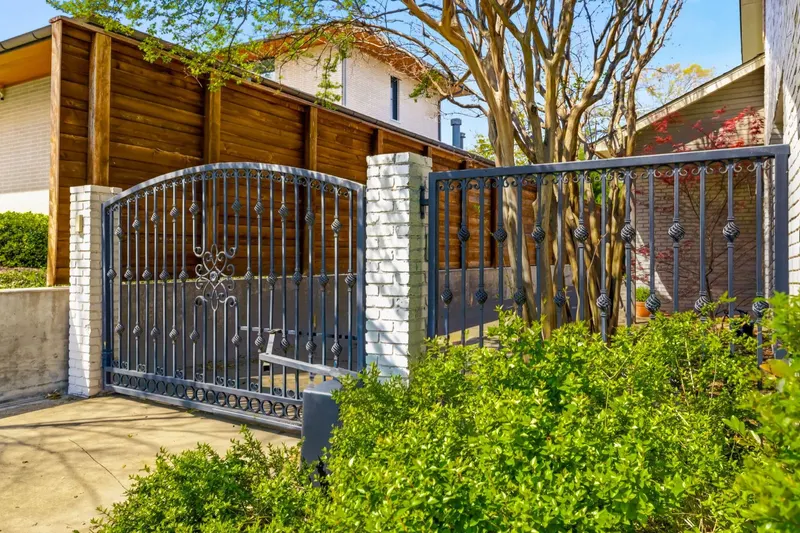
In practice most custom gates are hybrids. A welded steel frame carries the load and keeps the gate square, and the face is whatever suits the house: pickets and scrollwork, flat bar in a modern pattern, or cedar boards for a solid look. We build gates to match powder-coated wrought iron, ornamental steel and aluminum fencing and cedar fencing, so the gate reads as part of the fence line and not as an add-on. Our comparison of wrought iron, steel and aluminum goes deeper on the metals.
Driveway gate materials compared
| Material | Weight | Upkeep | Best suited to |
|---|---|---|---|
| Wood on a steel frame | Heavy | Stain every few years | Full privacy and a warm, residential look |
| Wrought iron | Heavy | Watch the finish for chips and rust | Traditional estates and custom detail |
| Ornamental steel | Moderate to heavy | Low with intact powder coat | Most homes, strong and clean-lined |
| Aluminum | Light | Lowest, does not rust | Wide spans, pool areas, simple designs |
| Wood on a wood frame | Moderate, prone to sag | Highest | Narrow manual gates only |
What this means for you: Weight drives everything downstream: hinge size, post footing, opener rating and how the gate behaves in wind.
How wide should a residential driveway gate be?
A driveway gate should be at least as wide as the paved drive, with comfortable clearance on each side for mirrors and for the angle a vehicle takes when it turns in. Residential openings commonly fall somewhere between twelve and sixteen feet, and the right figure for your lot comes from measuring, not from a chart.
Think about the largest vehicle that will ever need to get through: a moving truck, a trash or delivery truck if they enter the drive, a boat trailer, a landscape crew’s rig. Think about the approach too. A gate set close to a narrow street forces a sharp turn, and a sharp turn needs a wider opening than a straight shot. Some cities and fire departments set minimum widths for gated access to certain properties. Those rules vary, so we confirm them with the city before the build. Our guide to driveway gate setback, permit and safety rules covers what to ask.
- Largest vehicle: Measure for the widest thing that will ever enter, mirrors and trailer included, not the family car.
- Angle of approach: A tight turn from a narrow street or alley needs more width than a straight entry.
- Columns and posts: The clear opening is measured between the posts or columns, so their size comes off the total.
- City and fire access: Ask whether your city sets a minimum clear width for a gated drive at your property.
Is a single gate leaf better than a double gate?
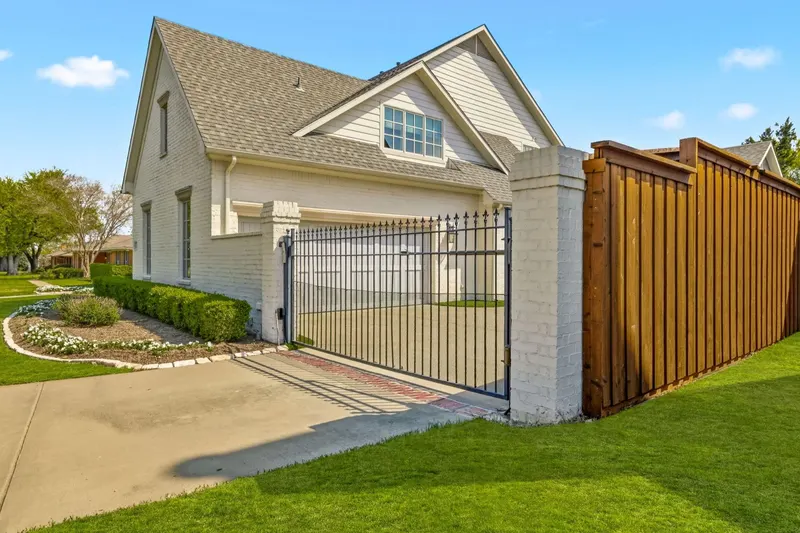
A double gate is usually better for a swing layout on a standard driveway, because two short leaves put far less load on each hinge post than one long leaf. A single leaf makes sense for narrow openings and is the norm for slide gates.
The physics is leverage. A leaf twice as long does much more than double the pull on its hinges and post, and it sweeps a much larger arc across the driveway. Two leaves halve the arc, meet in the middle and look balanced on a symmetrical house. The trade is cost and complexity: two operators, two sets of hinges, and a center stop or latch point that must stay aligned as the soil moves.
A single swing leaf can still be the right call when one side of the drive has no room for a leaf to open, or when the opening is modest and you want one operator and fewer parts. On a sloped drive the rules tighten further. ASTM F2200 requires that an automated gate not be set in motion by gravity, so a leaf cannot be hung where it wants to roll or swing downhill on its own.
Are wood driveway gates too heavy to automate?
No. Wood driveway gates are automated every day, but they need a steel frame, properly sized hinges and posts, and an opener rated for the real weight and length of the leaf.
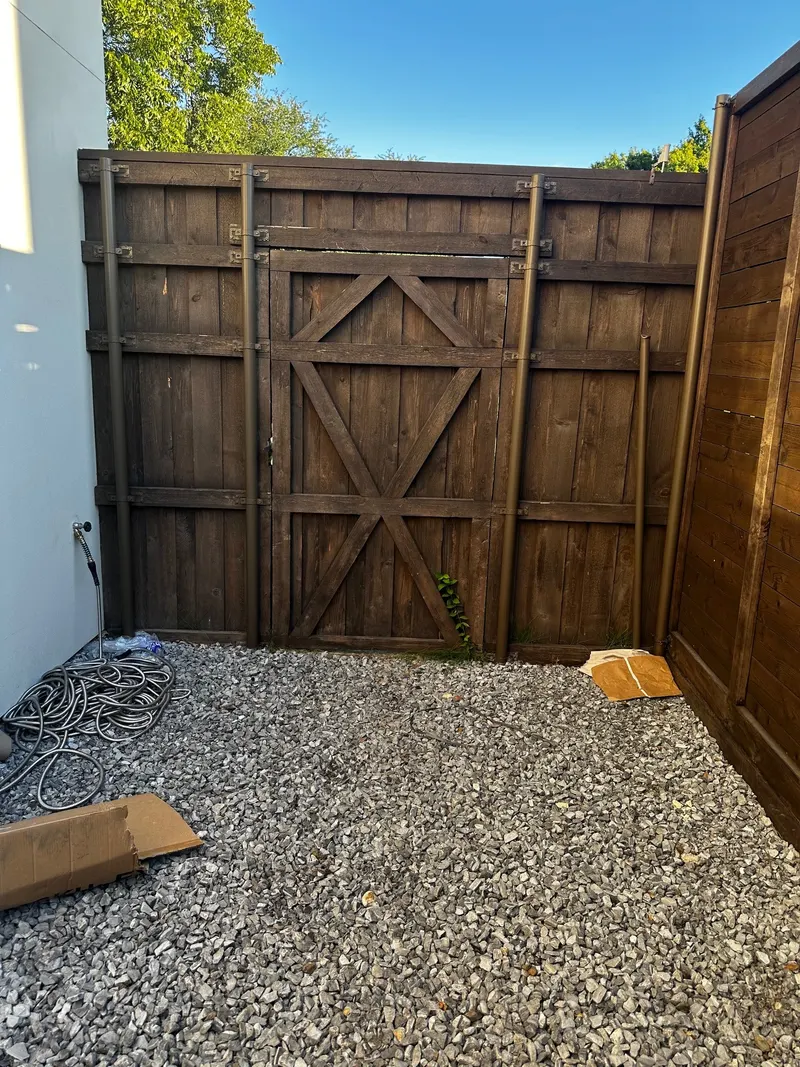
The mistake is building a wide wood gate on a wood frame and then asking a motor to swing it. Wood moves with moisture, a wide wood frame sags, and a sagging gate drags until the opener’s safety system stops it. A welded steel frame with cedar boards fastened to it solves the structure. Kiln-dried cedar keeps the weight and the movement down compared with wet lumber.
A solid wood gate is also a sail. In a North Texas thunderstorm a board-faced leaf takes a wind load that an open picket gate never sees, and the hinges, posts and operator all have to be chosen for it. If your goal is privacy, our guide to adding privacy to an iron fence or gate shows options between fully open and fully solid.
How tall should a driveway gate be?
A driveway gate should generally match the height of the fence or wall it joins, or rise slightly above it with an arched or peaked top. A gate that is much taller or shorter than its fence looks like it belongs to a different property.
The upper limit is not a design choice. Cities limit fence and gate heights, front yards are usually stricter than side and rear yards, and HOAs and deed restrictions add their own limits. See fence height rules in Dallas and the Park Cities and front yard fence heights in Preston Hollow and the Park Cities. We check the rule for your address before we draw the gate.
Height also adds weight and wind area. Every extra foot on a solid gate increases the load on the hinges and the opener, so tall privacy gates are where a slide layout often starts to make more sense.
Can a driveway gate include a separate pedestrian gate?
Yes, and it should. People need their own way through, so they are never tempted to slip past a moving vehicle gate.
This is a safety point, not a convenience. The industry’s summary of the UL 325 standard states that vehicular gate operators are for vehicular gates only, never pedestrian gates, and that separate pedestrian access must be provided where pedestrian access is likely. Mail carriers, guests, children walking home and landscape crews all count.
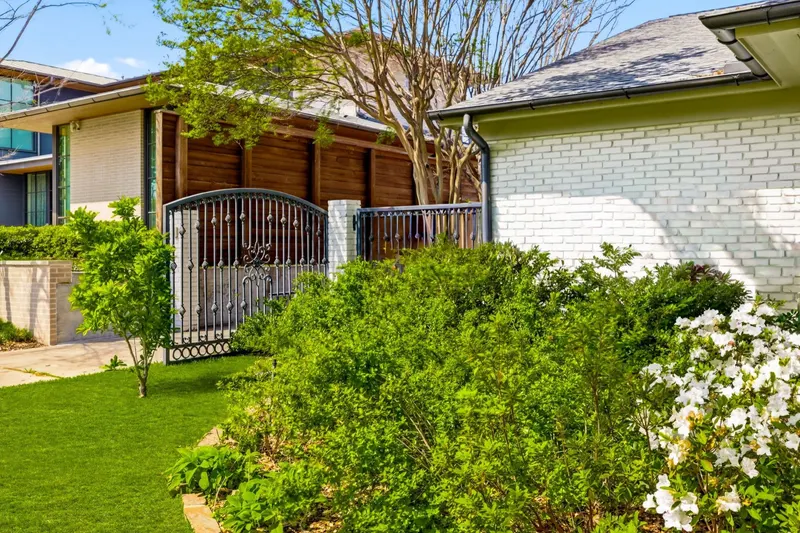
The best place for the walk gate is beside the driveway gate but clear of its swing arc or slide path, in the same material and height, with its own latch or keypad. We build matching walk gates as part of the entrance, often between brick or stone columns. For how columns, lighting and access controls come together, see designing an estate entrance.
How much room does a driveway gate need to open?
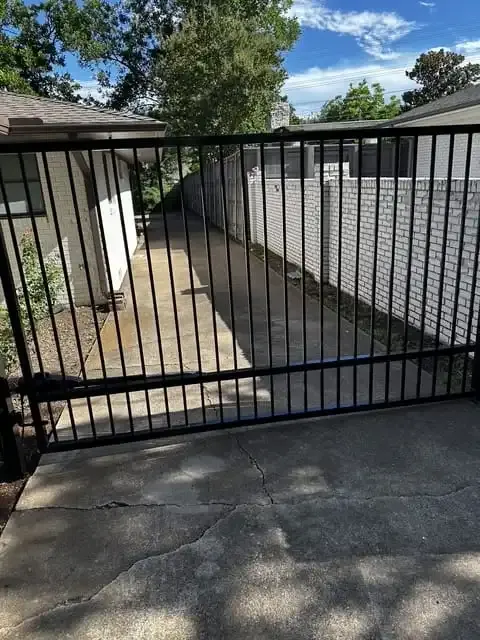
A swing gate needs a clear arc equal to the full length of each leaf, on ground that does not rise into the gate. A slide gate needs a straight, level run beside the opening at least as long as the gate itself, plus room for the tail and the operator.
Walk the arc before you commit to a swing gate. Parked cars, a rising driveway, planting beds, a basketball goal and the turn into the garage all compete for the same space. Tight spots beside the swing matter for safety as well: the gate construction standard treats a narrow gap between a swing gate and a wall or other fixed object as an entrapment zone that must be designed out or protected.
For a slide gate, look along the fence line. Trees, gas meters, air conditioning units and the property corner are the usual obstacles, and the track or the cantilever posts need a solid footing the whole way. Controls need thought too. The same summary calls for gate controls to sit at least six feet from the gate so nobody can reach through to operate it. To have your entrance measured and drawn, request a free written estimate for an automatic driveway gate.
How Park Cities Fence & Deck helps
Jack Johnson comes out himself, looks at your property and gives you a free written estimate with a timeline. Wood, iron and masonry are all built in-house, so the advice fits the property. Related services: gates & gate motors, iron / metal fencing.
Questions people ask next
Can a driveway gate be solid for full privacy?
Yes. A solid gate is usually cedar boards or metal panels on a welded steel frame. Plan for the added weight and wind load: larger hinges, deeper post footings and an opener rated for the leaf. Check your city’s height rules and any HOA limits on solid gates facing the street. A slide layout often suits tall, solid gates better than a swing.
How far back from the street does a driveway gate have to sit?
It depends on the city and sometimes on the street. Many jurisdictions want enough depth for a vehicle to pull fully off the road while the gate opens, and some apply visibility rules near the driveway. We do not quote a single distance because it varies. We confirm the setback for your address with the city before the gate is designed.
What size gate opener do I need for a heavy iron or wood gate?
Openers are rated by the maximum weight and length of the leaf they can move and by how many cycles a day they are built for. Give your installer the real figures, including cedar infill and any solid panels that catch wind, and choose a unit with margin above them. An opener working at its limit wears quickly and trips its safety system often.
Can a driveway gate open outward toward the street?
Usually not. A gate that swings outward can sweep across a sidewalk, an alley or the public right-of-way, and many cities do not allow it. Even where it is possible, the arc has to stay entirely on your property and clear of pedestrians and traffic. If the drive rises steeply inside the gate, a slide gate is normally the better answer.
How do exit loops and free-exit sensors work on a driveway gate?
A free-exit device opens the gate automatically for a vehicle leaving the property. The common type is a wire loop cut into the driveway that detects the metal mass of a car. Others use a buried probe or a beam. They are placed far enough inside the gate that it is open by the time you reach it, and they respond to vehicles, not people.
Sources and further reading
- DASMA: An Installer’s Guide to ASTM F2200
- DASMA Technical Data Sheet 353: Vehicular Gate Operators and the ANSI/CAN/UL 325 Standard
General information, not legal advice. Rules change: we confirm the current requirements with your city or HOA before we build.