Local Rules · Dallas, Texas
How Far Back Must a Driveway Gate Sit, and What Permits and Safety Rules Apply?
Gate setback, permits, emergency access and the UL 325 and ASTM F2200 safety standards, explained for DFW homes.
 By Jack Johnson, owner of Park Cities Fence & Deck · 9 min read · 1,886 words
In short
There is no single setback for a driveway gate in the DFW area. Each city sets its own rule through fence height limits, visibility triangles and right-of-way lines, so the distance is confirmed for your address. What applies everywhere is safety: a UL 325 listed operator with two entrapment protections and a gate built to ASTM F2200.
In this guide
- How far back from the street does a driveway gate have to sit?
- Do driveway gate rules differ in Plano, Frisco and Fort Worth?
- Does an automatic gate need an electrical permit?
- How do firefighters and police get through my automatic gate in an emergency?
- What is UL 325, and does my gate have to comply?
- What does ASTM F2200 require of the gate itself?
- Is an older automatic gate without safety sensors a liability?
Need this done? See gates & gate motors.
A driveway gate is a fence, a machine and an electrical installation at the same time, so three sets of rules meet at one opening. The city decides where it can stand and how tall it can be. The electrical code governs the power feeding it. Two national safety standards govern how it moves.
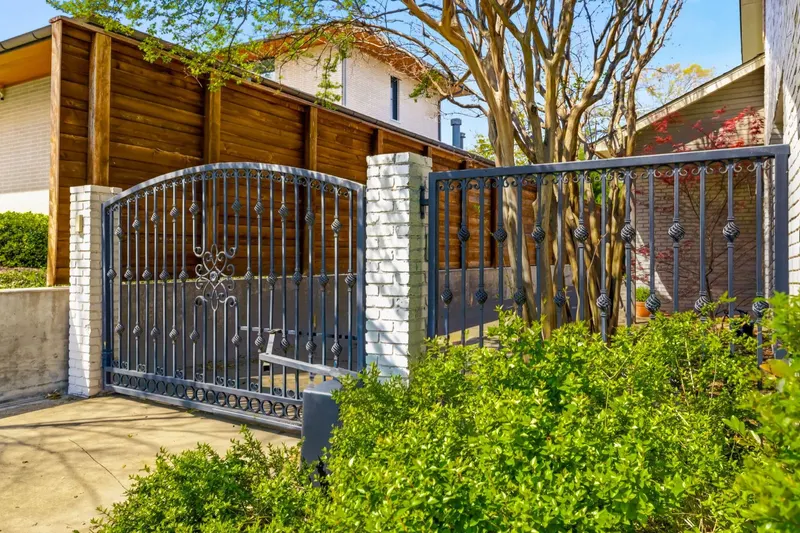
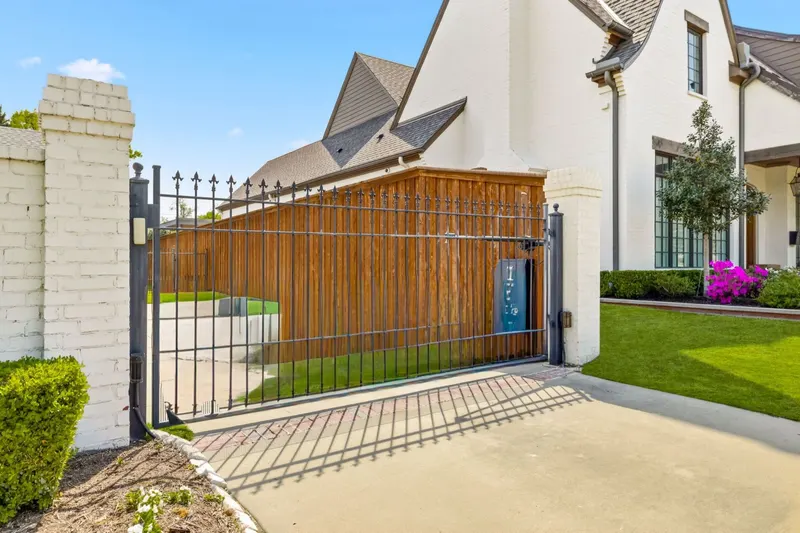
Park Cities Fence & Deck builds swing and slide driveway gates with motors, keypads, remotes, phone-app access, safety photo-eyes and battery backup. This guide explains the rules we check on every gate, with city details taken from each city’s own page and the safety standards from the industry association that publishes guidance on them. It is general information, not legal advice.
How far back from the street does a driveway gate have to sit?
It depends on the city and the zoning district, and most cities do not publish one residential number. A gate is treated as part of the fence, so it has to respect the front yard height limit, stay out of visibility triangles and stay off the public right-of-way.
In Dallas, the fence standards cap a fence in the required front yard of a single-family lot at 4 feet unless the Board of Adjustment grants a special exception. The only gate distance written into those standards is for taller front fences in multifamily districts, where a vehicle gate may not be less than 20 feet from the back of the street curb. On estate lots the required front yard can be deep. In the one-acre R-1ac(A) district, common in Preston Hollow, the minimum front yard is 40 feet. A full-height gate therefore either sits behind that line or goes to the board, as our guide to front yard fence height explains.
Code aside, there is a practical setback. A car should be able to pull fully off the street and wait while the gate opens. We measure for that on the first visit and mark it on the site plan the city asks for.
Do driveway gate rules differ in Plano, Frisco and Fort Worth?
Yes. Each city handles gates through its own fence rules, and the differences show up most on alley driveways and corner lots. The table lists what each city’s page says about gates.
In Plano, a sliding gate must sit inside the fence line and not on the alley side, and a fence with a rolling gate needs a trash cart pad set back 4 feet from the edge of the alley. In Fort Worth, only an open picket design up to 4 feet is allowed in a front yard or a projected front yard, which rules out a tall solid gate at the street. Frisco limits front yard fences to 48 inches and no more than 50 percent opaque. Where one of these pages gives no gate distance, the answer is to confirm with the city.
What each city’s published rules say about driveway gates
| City | Gate placement rule | Setback from the street |
|---|---|---|
| Dallas | Gates shown on the site plan with driveways and visibility triangles; 4 foot limit in a single-family front yard | Confirm with the city for single-family lots |
| Plano | Sliding gates inside the fence line, not on the alley side; nothing in the right-of-way | Trash cart pad 4 feet from the alley edge; street setback: confirm with the city |
| Frisco | Front yard fences no taller than 48 inches and no more than 50 percent opaque | Confirm with the city |
| Fort Worth | Open picket design up to 4 feet in a front yard or projected front yard | Confirm with the city |
| Garland | A gate may not swing over city right-of-way or a public easement | 20 feet from the property line on non-residential property only |
| Coppell | Automatic closers need an approved stop-and-reverse mechanism; fences 5 feet from alley paving | Fences not allowed in front yards |
What this means for you: No city here prints a simple residential gate setback. The distance for your driveway comes from the front yard rule, the corner rule and the right-of-way line for your lot, which we confirm before the gate is drawn.
Does an automatic gate need an electrical permit?
Often yes, when new electrical work is run to the operator, but the trigger is set by each city. The gate itself usually falls under the fence permit, and the wiring is handled separately.
The city pages we read point the same way. Coppell lists an electrical inspection among the typical inspections when a fence has automatic gate controls, and it requires automatic closers on driveway gates to have an approved stop-and-reverse mechanism. Fort Worth says that changing, moving or repairing electrical equipment requires an electrical permit. A low-voltage or solar setup can change the answer, which our guide to solar gate openers and power covers. We confirm the electrical requirement with the city along with the fence permit.
How do firefighters and police get through my automatic gate in an emergency?
Through an emergency access method agreed with your local fire department, plus a manual release that works without power. What a city requires on a single-family driveway varies, so confirm it with the fire marshal’s office for your address.
The city pages we read set the baseline. Dallas requires every fence to keep firefighting access to the side and rear yards. Coppell notes that the fire department may require additional inspections for commercial gates. On our gates the motor has battery backup, so the gate still opens in a power outage, and we show you the manual release at the walkthrough. Our guide to driveway gate security features covers the access hardware in more detail.
What is UL 325, and does my gate have to comply?
UL 325 is the safety standard for gate operators. It is a voluntary standard, not a national law, but it is referenced in the International Building, Fire and Residential Codes, so building and fire inspectors check installations against it. A home driveway gate uses a Class I operator, the class for a residence of one to four families.
The heart of the standard is entrapment protection. The points below come from the technical data sheets published by DASMA, the door and access systems industry association. Our guide to gate motors, keypads and safety sensors shows what these parts look like on a real gate.
- Two protections per zone: Each entrapment zone needs two independent means of protection, such as an inherent sensor plus a photo-eye or a contact edge.
- Monitored sensors: External sensors are checked every cycle. If one is missing or faulty, the gate will not run automatically.
- Fast reversal: After sensing an obstruction, reversing must begin within 2 seconds.
- Controls kept back: User controls sit at least 6 feet from any moving part of the gate.
- People use another gate: Vehicle operators are for vehicle gates, with separate pedestrian access and at least two warning signs.
What does ASTM F2200 require of the gate itself?
ASTM F2200 is the construction standard for the gate, where UL 325 covers the operator. It applies to new automated gates, to an existing manual gate that is being automated and to a gate whose old operator is being replaced.
The general rules are simple to picture. A gate must not fall more than 45 degrees from vertical if it comes off its hardware. It must not start moving by gravity when disconnected from the operator. Bottom edges must be smooth, and a manual latch comes off when a gate is automated. On a slide gate, weight-bearing rollers lower than 8 feet above grade must be guarded, openings are screened so a 2¼ inch sphere cannot pass up to 6 feet above the ground, and positive stops limit travel at both ends. On a swing gate, the standard looks for at least 16 inches between the open gate and any fixed object, or added entrapment protection where that is not possible. Our guide to swing versus slide gates shows how these rules shape the choice.
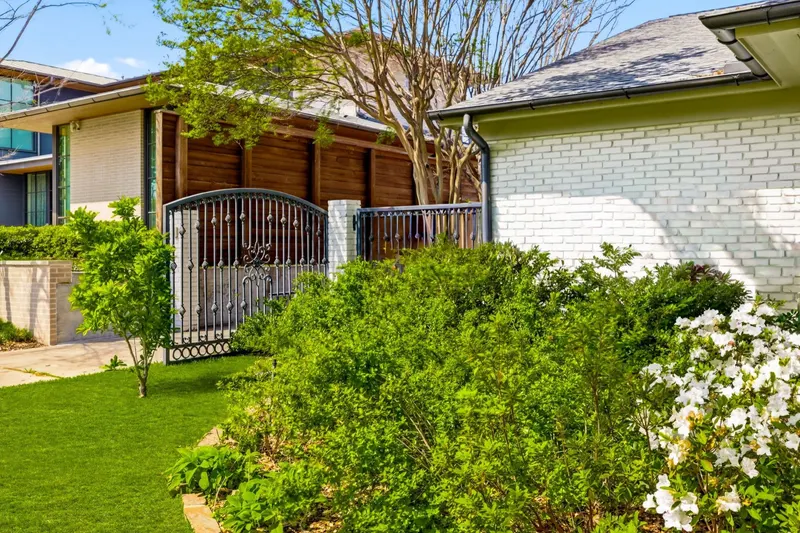
Is an older automatic gate without safety sensors a liability?
It can be. UL 325 is not retroactive, so no one is required to upgrade an existing operator, but DASMA notes the potential for liability when a gate system does not meet the standard and recommends replacing any operator made before 2000.
The reason is practical. Two means of entrapment protection have been required in each entrapment zone since 2000, and an operator older than that may have no way to connect them. A heavy gate with no sensor does not know that a child, a pet or a car is in its path. We never disable or bypass a safety device, and we will not repair a gate in a way that leaves one out. If your gate is in this group, read our guides on gate maintenance and a gate that will not open or close, then ask for a free written estimate. Jack Johnson attends every consultation and will tell you whether the gate needs sensors, a new operator or a rebuild.
How Park Cities Fence & Deck helps
Jack Johnson comes out himself, looks at your property and gives you a free written estimate with a timeline. Wood, iron and masonry are all built in-house, so the advice fits the property. Related services: gates & gate motors. We work in Dallas and Preston Hollow and across Dallas.
Questions people ask next
Do I need a Knox box or a siren sensor on a residential gate?
It depends on your city and fire department, and the city pages we read do not state a rule for single-family driveways. Requirements are more common on gated communities, apartments and commercial sites. Call the fire marshal’s office for your address and ask what emergency access it expects on an automatic gate. We build to that answer, and every motor we install has battery backup and a manual release.
Can a driveway gate open outward toward the street?
Not over public property. Garland states that a gate may not swing over city right-of-way or a public easement, and Plano allows no fence or gate to reach into the right-of-way. Check the same point with any other city before a gate is drawn. On most lots a swing gate therefore opens inward. Where the driveway rises behind the gate, a slide gate solves the problem.
How do exit loops and free-exit sensors work on a driveway gate?
A free-exit device senses a vehicle approaching from inside the property and opens the gate without a remote or code. A common version is a wire loop set in or under the driveway that detects the metal of the car. It is a convenience device, not a safety device, so it works alongside the photo-eyes and edges that UL 325 requires, never in place of them.
How do I test the safety sensors on my gate?
Follow the test steps in your operator’s manual, and use an object, never a person. For a photo-eye, block the beam while the gate is closing: the gate should stop or reverse. On operators made since 2016 the sensors are monitored, so a failed one keeps the gate from running automatically. If a test fails, stop using the gate and call for service.
What access control works best for a gated community or an apartment gate?
A system that separates residents, guests and emergency responders, on an operator rated Class II, the UL 325 class for multifamily housing of five or more units. Keypads, card readers and phone-based entry are all common. In Texas, the Department of Public Safety says a gate operator tied to an alarm system, or one that logs who enters and leaves, requires a licensed installer.
Sources and further reading
- City of Dallas Ordinance No. 30198, amending Development Code Section 51A-4.602 (fence standards)
- City of Dallas: Fence Permit, Pool Barrier and Retaining Wall Checklist
- City of Dallas Current Planning: R-1ac(A) Single Family District regulations
- DASMA Technical Data Sheet 353: Vehicular Gate Operators and the ANSI/CAN/UL 325 Standard
- DASMA Technical Data Sheet 356: UL 325 and Gate Installations, Frequently Asked Questions
- DASMA: An Installer’s Guide to ASTM F2200
- Texas Department of Public Safety, Private Security: Gate Operators and Garage Door Openers
- City of Plano: Residential Fence Permit Requirements (PDF)
- City of Frisco Code of Ordinances, Chapter 18, Article IX: Fences
- City of Fort Worth: Residential Permitting (fences and electrical permits)
- City of Garland Building Inspection: Fence Requirements (PDF)
- City of Coppell: Fence Permits (PDF)
General information, not legal advice. Rules change: we confirm the current requirements with your city or HOA before we build.