Local Rules · Dallas, Texas
How Tall Can a Fence Be in Plano, and When Do You Need a Permit?
Plano caps fences at 8 feet, 40 inches in the front yard, and requires a permit beyond small repairs.
 By Jack Johnson, owner of Park Cities Fence & Deck · 9 min read · 1,783 words
In short
A fence in Plano may be up to 8 feet tall. In the required front yard the limit is 40 inches, and the fence must be at least 50% open. The city requires a permit to build or alter a fence, with one exemption: repairs that stay within 25% of the fence area in a 12-month period.
In this guide
- How much of my fence can I repair in Plano without a permit?
- Can I have a front-yard fence in Plano?
- What fence materials are allowed and not allowed in Plano?
- What are the rules for corner lots and fences along streets or alleys in Plano?
- How do I apply for a Plano fence permit, and how long does it take?
- Which way does the finished side of a fence have to face in Plano?
- What should a Plano homeowner check before signing a fence contract?
Need this done? See wood fencing.
Those numbers come from the City of Plano Building Inspections handout for residential fence permits, which we read again before writing this guide. The handout is the working document the permit counter uses, and it covers height, the front yard, corner lots, alleys, materials and inspections on a few pages.
Below is what it says, what it leaves out, and how the permit runs from application to final inspection. Where the handout is silent we say so, and we confirm the point with the city before we build. This is general information, not legal advice. For how we work in the city, see our Plano fence page.
How much of my fence can I repair in Plano without a permit?
Up to 25% of the area of the fence within a 12-month period. The city handout states that a permit is not required for repairs to existing fences that do not exceed that share. Past it, or when you build a new fence or alter an existing one, a residential fence permit applies.
Note that the rule measures area, not length, and that it counts everything done in the same 12 months. Two small repairs in one year add together. During the free estimate we measure the damaged share and tell you which side of the line the job falls on, and our guide to repair versus replacement explains when a repair is worth doing at all.
One more rule catches owners who plan to build beside an old fence. When a new fence goes up parallel to and within three feet of an existing fence on the same lot, the existing fence must be removed. Where a shared fence is staying, the handout calls for a three foot separation so the gap can be maintained. Our fence repair service covers pickets, rails, posts and gates.
Can I have a front-yard fence in Plano?
Yes, a low and open one. In the required front yard a fence may not exceed 40 inches in height and must be at least 50% open. A solid privacy fence belongs behind the front building line.
That rule points to a picket design or to ornamental iron, both of which meet the openness test when the spacing is right. The permit checklist asks directly whether the fence will be built beyond the front build line, so the reviewer will look at it. If you want more screening at the front of the house, our guide to privacy when fence height is limited covers planting and layout options that do not depend on a taller fence.
What fence materials are allowed and not allowed in Plano?
Plano prohibits products manufactured for other uses. The handout names plywood, corrugated steel, barbed wire and fiberglass panels as materials that are not allowed as fencing.
Cedar, ornamental iron and masonry are all standard. Masonry carries extra paperwork. For a masonry fence or a fence with masonry columns, drawings showing the footing construction must be included, and the handout says masonry fences, brick columns and retaining walls over four feet must be designed, signed and sealed by a Texas registered engineer. The city also publishes a standard masonry detail that may be used in place of that engineering.
We build cedar privacy fences and brick and stone columns in-house, so one set of drawings covers the whole fence. The handout also tells applicants to contact their homeowners association about deed restrictions, which often narrow the material list further.
What are the rules for corner lots and fences along streets or alleys in Plano?
Fences must stay out of the visibility triangles, and gates on an alley have their own rules. These are the points most often marked up on a Plano permit plan.
Where an alley meets a street, no fence or plant taller than 30 inches may stand inside a triangle measured eight feet along each property line. Where two streets meet, the triangle is formed by extending the two curb lines 45 feet from the intersection, or the property lines 30 feet where there are no curbs, and vision must stay clear between 30 inches and nine feet above the street. On a corner lot with two front yards, the second front yard may be fenced like a side yard next to a street, with a corner clip that ends at least 15 feet from the lot line.
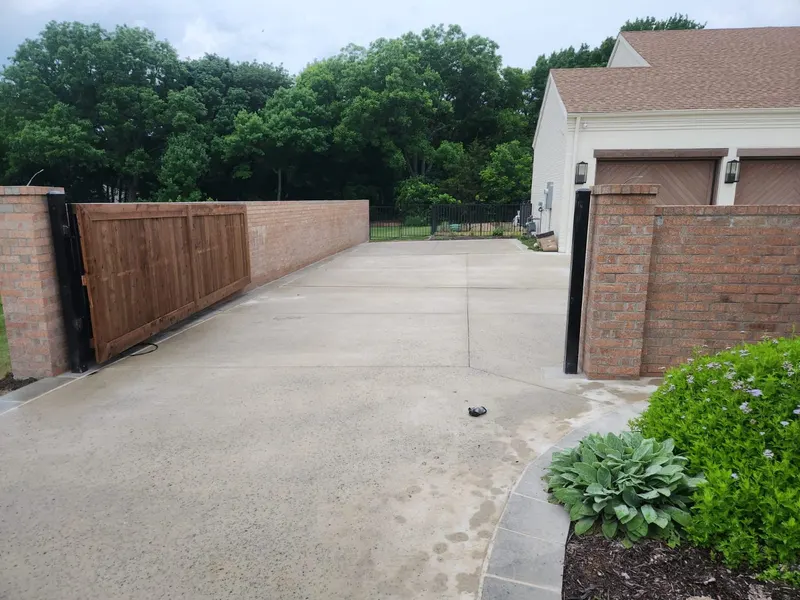
On alleys, sliding gates must be installed inside the fence line and not on the alley side, and no fence or gate may encroach on city right-of-way. A fence with a rolling gate also needs a trash service pad: one space ten feet by four feet, or two spaces five feet by four feet, set back four feet from the edge of the alley. See driveway gate setback and permit rules.
How do I apply for a Plano fence permit, and how long does it take?
You submit a completed application to Building Inspections with a site plan that shows where the fence sits on the lot. The handout does not publish a review time, so we do not quote one. We tell you the current turnaround when we submit.
The table shows the steps in order. Fees come from the city fee schedule and are itemized on the permit. When we build the fence we prepare the plan, submit it and request the inspections, and the permit, HOA and 811 guide explains how the three approvals fit together.
Plano residential fence permit, step by step
| Step | What the city asks for | Who handles it with us |
|---|---|---|
| 1. Check deed restrictions | The handout tells applicants to contact their HOA | You approve, we prepare the details |
| 2. Prepare the plan | Site plan with the fence location, fence elevations and the permit checklist | We do |
| 3. Add masonry drawings | Footing sections and details for masonry fences or columns | We do, when masonry is included |
| 4. Submit and pay | Completed application to Building Inspections, fees per the fee schedule | We submit |
| 5. Build to the approved plan | Height, visibility triangles and gate position as drawn | Our own crews |
| 6. Inspections | Footing inspection if applicable and a final fence inspection | We request them |
What this means for you: The permit holder is responsible for requesting the required inspections.
Which way does the finished side of a fence have to face in Plano?
The Plano handout we read does not set a rule for which side faces out, so we confirm it with the city before we build. We do not guess at it.
In practice the question is usually settled by three things: your HOA's standards, what the neighbor on the other side expects, and what the street sees. On an alley or a street side, most owners want the smooth face out. A board-on-board fence with a cap and trim looks finished from both sides, which removes the argument. Our guide to neighbor fence questions and the finished side covers how to agree on it.
What should a Plano homeowner check before signing a fence contract?
Check that the contract matches what the city will approve. A fence drawn to the wrong height or across a visibility triangle gets corrected at your expense.
Pools deserve a second look. The city's pool handout says that where the pool and the fence both exist and only the fence is being replaced, the new fence has to comply with the pool barrier requirements. It also requires a relay timer on a gate used for automobiles when that gate is part of the pool barrier. Our guide to the best pool fence for families explains the design choices.
Once the permit, the HOA approval and the locate are in hand, most wood and iron fences take one to three days after materials arrive. Masonry and gates take longer. Estimates are free and in writing, and Jack Johnson attends every consultation.
- Height on the plan: No more than 8 feet, and no more than 40 inches and 50% open in the required front yard.
- Corner and alley clearances: Visibility triangles drawn, sliding gates inside the fence line and the trash pad shown.
- Pool on the lot: A fence that encloses a pool or spa needs a separate permit and must meet the pool barrier rules.
- HOA approval: Written approval in hand before materials are ordered.
- Utility locate: The city page says to call before you dig. We request the free 811 locate for you.
How Park Cities Fence & Deck helps
Jack Johnson comes out himself, looks at your property and gives you a free written estimate with a timeline. Wood, iron and masonry are all built in-house, so the advice fits the property. Related services: wood fencing, fence rehab / repair. We work in Plano and across Dallas.
Questions people ask next
Does Plano inspect a fence after it is built?
Yes. The City of Plano handout states that a final fence inspection is required, along with a footing inspection where one applies, such as for masonry columns. The permit holder is responsible for requesting the inspections. When we hold the permit, we schedule them and meet the inspector, and Jack Johnson walks the finished fence with you as well.
Who maintains the screening wall behind my Plano home?
The handout we read does not answer this, so we do not state a rule. Responsibility depends on where the wall sits on the recorded plat and on your HOA declaration, and it differs from one subdivision to the next. Check the plat, ask your association, and call the city. We confirm ownership before we quote any wall repair.
What are the pool fence requirements in Plano?
A pool or spa fence needs its own permit. The city's pool barrier handout requires the top to be at least 48 inches above grade on the side facing away from the pool, no more than 2 inches of clearance at the bottom, and openings that will not pass a 4 inch sphere. Pedestrian gates must open outward, close by themselves and latch by themselves.
Can I get a variance for a taller fence?
The fence handout does not describe a variance for fence height. It mentions the Board of Adjustment only for golf nets taller than 8 feet, and it lets the Traffic Engineer vary visibility requirements where streets meet at an odd angle. If you need more than 8 feet, we ask the city what applies to your lot before designing anything.
Which Dallas suburbs require a permit just to replace an old fence?
Plano and Frisco both do. Plano requires a permit to construct or alter a fence, exempting repairs within 25% of the fence area in 12 months. Frisco's ordinance requires one to construct, repair or replace a fence, with a partial repair exemption. Fort Worth ties its building permit to height. Other suburbs differ, so check the city before assuming a replacement is exempt.
Sources and further reading
- City of Plano: Outdoor Improvements (fence permit resources)
- City of Plano: Residential Fence Permit Requirements (PDF)
- City of Plano: Swimming Pool and Spa Permit Requirements, pool barriers (PDF)
General information, not legal advice. Rules change: we confirm the current requirements with your city or HOA before we build.