Local Rules · Dallas, Texas
Pool Fence Requirements by City: What Do Plano, Frisco, Fort Worth and Other DFW Cities Require?
Pool barrier height, gaps, gates and latches for eight DFW cities, each taken from that city’s own document.
 By Jack Johnson, owner of Park Cities Fence & Deck · 9 min read · 1,842 words
In short
Every DFW city we read that publishes a number requires a pool barrier at least 48 inches tall, with gates that close and latch by themselves. The details differ: Frisco caps the barrier at 96 inches and bans chain link, Coppell wants latches at least 54 inches above grade, and Richardson limits openings to 4 inches.
In this guide
- What are the pool fence requirements in Plano?
- What are the pool fence requirements in Frisco?
- What are the pool fence requirements in Fort Worth?
- What are the pool fence requirements in Richardson, McKinney and Allen?
- What are the pool fence requirements in Garland and Coppell?
- Can a driveway gate or a wood privacy fence be part of the pool barrier?
- Does a pool fence need to be inspected before the pool is filled?
Need this done? See iron / metal fencing.
A pool fence is the one fence where an inch decides whether you pass inspection. The cities around Dallas mostly start from the same model code, then add their own rules about latches, climbable rails, chain link and driveway gates. A fence that passes in one city can fail next door.
This guide gives one block per city, with each number taken from that city’s own document, listed at the end. Dallas has its own article, the Dallas pool fence code. Where a city’s page gives no dimensions, we say to confirm with the city. Park Cities Fence & Deck builds pool-code iron and aluminum fencing and confirms the rule before every build. This is general information, not legal advice.
What are the pool fence requirements in Plano?
Plano requires the top of the barrier to be at least 48 inches above grade, measured on the side facing away from the pool, with no more than 2 inches of clearance at the bottom. Openings may not let a 4 inch sphere pass, and the pool side of the barrier must stand at least 20 inches from the water’s edge.
Climbability drives the rest. Where horizontal rails are less than 45 inches apart, they must sit on the pool side and the gaps between vertical members may not exceed 1¾ inches. Where the rails are 45 inches or more apart, the vertical gaps may be up to 4 inches. Plano also asks for a 36 inch clear zone between the outside of the barrier and anything that could be climbed, such as pool equipment. A fence around a pool in Plano needs its own permit, and when only the fence is replaced at an existing pool, the new fence has to comply.
What are the pool fence requirements in Frisco?
Frisco requires a barrier at least 48 inches tall and no more than 96 inches, with a maximum 2 inch gap under it, and it prohibits chain link as part of a pool enclosure. Fencing must be at least 20 inches from the water’s edge.
The rail rules mirror Plano: rails spaced less than 45 inches apart go on the pool side with vertical gaps of no more than 1¾ inches, and with rails 45 inches or more apart a 4 inch sphere may not pass between pickets. Frisco allows one non-pedestrian yard gate at most, and it must stay locked when the pool area is not in use. No permanent structure may stand within 36 inches of the barrier. In Frisco the city fence ordinance and most HOAs point the same way, toward ornamental iron, as our Frisco fence ordinance guide explains.
What are the pool fence requirements in Fort Worth?
Confirm the dimensions with the city. The City of Fort Worth states that all pools must comply with the 2018 International Swimming Pool and Spa Code and the city’s amendments to it, and that a swimming pool requires a building permit. The submittal document we read does not print the barrier height, gap or latch numbers.
That means the rule exists and is enforced, but the measurements live in the adopted code and its local amendments, not on a homeowner handout. We do not print numbers we have not read on the city’s own page. Before a pool fence goes up in Fort Worth, we confirm the current barrier requirements with Development Services and build to that answer. Our Fort Worth fence rules guide covers the zoning limits that apply to the same fence.
What are the pool fence requirements in Richardson, McKinney and Allen?
Richardson and Allen both require at least 4 feet with self-closing, self-latching gates, and McKinney requires pool fences to meet its barrier requirements and pass inspection. The table below sets all eight cities side by side.
Richardson adds that no opening may be greater than 4 inches in any direction and that the closing and latching devices sit in the upper quarter of every gate. Allen puts the latching device on the pool side at least 4½ feet from the ground. McKinney’s fence page does not print dimensions, so confirm those with the city. Our guide to Richardson, McKinney and Allen fence rules has the ordinary fence limits for the same three cities.
Residential pool barrier rules as published by each city
| City | Minimum height | Gates and latches | Also on the city page |
|---|---|---|---|
| Plano | 48 inches | Open away from the pool, self-closing, self-latching | 2 inch bottom gap; barrier 20 inches from the water |
| Frisco | 48 inches, 96 inches maximum | Open away from the pool, self-closing, self-latching | No chain link; 2 inch bottom gap |
| Fort Worth | Confirm with the city | Confirm with the city | 2018 pool and spa code with city amendments applies |
| Richardson | 4 feet | Self-closing, self-latching, devices in the upper quarter of the gate | No opening greater than 4 inches |
| McKinney | Confirm with the city | Confirm with the city | Pool fences must meet barrier rules and be inspected |
| Allen | 4 feet | Self-closing, self-latching, latch on the pool side at least 4½ feet up | Final inspection before the pool is put into operation |
| Garland | 48 inches | Open away from the pool, self-closing, self-latching, lockable | No opening a 4 inch sphere can pass; 2 inch bottom gap |
| Coppell | 48 inches | Open away from the pool, self-closing, latch at least 54 inches above grade | 2 inch bottom gap; no driveway gate in the barrier |
What this means for you: A fence built to 48 inches with a 2 inch bottom gap and outward-opening, self-latching gates meets the common ground. The latch height and the rail layout are where cities differ, so those are confirmed before we fabricate.
What are the pool fence requirements in Garland and Coppell?
Both require a fence at least 48 inches tall with no more than 2 inches between grade and the bottom of the barrier, and pedestrian gates that open away from the pool and close and latch by themselves. Each city then adds rules of its own.
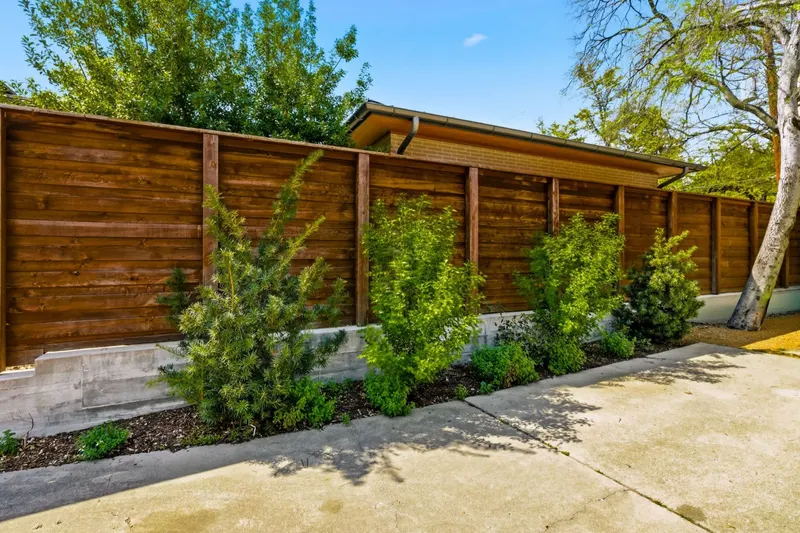
Garland bars any opening that lets a 4 inch sphere through and requires horizontal members that face outward to be beveled so they cannot be climbed. A temporary 48 inch fence is required during construction. Coppell is stricter on wood. Posts and rails must be on the pool side, the outside face may not have a horizontal step lower than 45 inches, and horizontal board-on-board is not allowed. On an iron fence in Coppell the vertical members must be less than 4 inches apart and the horizontal rails at least 45 inches apart. Our guide to iron fence heights and picket spacing shows how those numbers shape the design.
Can a driveway gate or a wood privacy fence be part of the pool barrier?
A wood privacy fence usually can, and a driveway gate often cannot. Coppell says vehicle gates cannot be part of the pool barrier system, and Richardson says an electric sliding gate does not satisfy the requirement to enclose the pool.
Other cities allow a vehicle gate with conditions. Plano requires a relay timer on gates used for automobiles when the gate is part of the pool barrier. Frisco notes that separation fencing may be required when automatic gates are present. Garland exempts a motor-powered driveway gate from its locking rule. If your pool yard includes an automatic driveway gate, the usual fix is a short run of pool-code fence between the driveway and the pool.
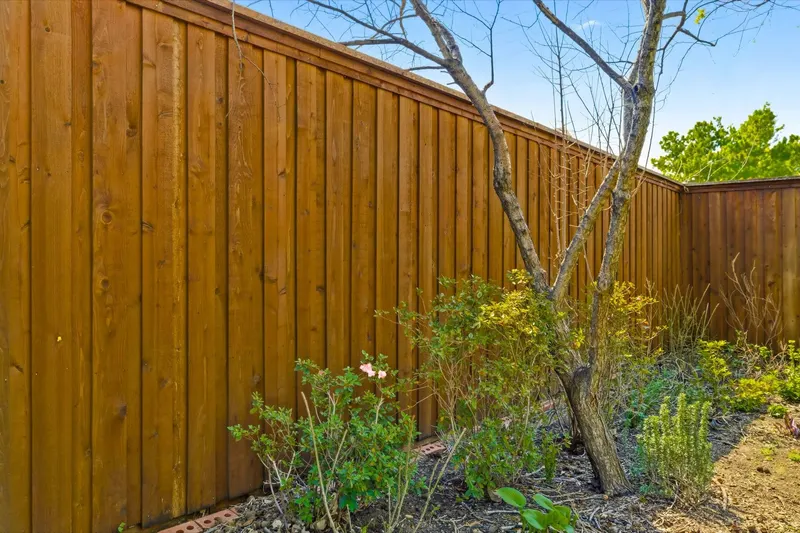
For wood, the smooth side faces out and the rails face the pool, so there is nothing to climb. Our guides to the best pool fence for families and glass versus iron pool fencing compare the materials.
- Rails toward the pool: Keeps the climbable side away from children outside the yard.
- No horizontal styles in Coppell: Horizontal board-on-board, lapped or staggered pickets are not allowed there.
- Separate the driveway: A pool-code fence and walk gate between the cars and the water.
- Keep climbables back: Plano and Frisco want 36 inches clear of equipment and structures.
Does a pool fence need to be inspected before the pool is filled?
In the cities we read, the barrier is inspected before the pool is finished or used. Plano states that the pre-plaster inspection cannot be done unless the swimming pool barrier has been approved, which in practice means before the pool is filled.
Frisco requires temporary fencing until the pre-plaster inspection, when the permanent fence is to be up. Allen requires a final city inspection before the pool is placed into operation. Garland inspects the safety fence and self-closing gates at the final inspection, and all inspections must be approved before the pool can be used. The lesson is to order the fence early. Pool builders often leave it to the homeowner, and a fence that arrives late holds up the plaster crew. We schedule the cedar or iron build around that inspection.
How Park Cities Fence & Deck helps
Jack Johnson comes out himself, looks at your property and gives you a free written estimate with a timeline. Wood, iron and masonry are all built in-house, so the advice fits the property. Related services: iron / metal fencing, wood fencing. We work in Plano and Frisco and across Dallas.
Questions people ask next
Do doors and windows that open to the pool need alarms?
Where the house wall is part of the barrier, the cities we read want protection on the doors. Plano and Garland accept a powered safety cover, a door alarm or another approved means of equal protection. Garland’s alarm must sound for at least 30 seconds, with the deactivation device at least 54 inches above the threshold. Allen’s certification form also covers low operable windows.
How high does the latch on a pool gate have to be?
It depends on the city. Coppell requires the latch at least 54 inches above grade. Allen requires the latching device on the pool side at least 4½ feet from the ground. Plano, Frisco and Garland allow a release lower than 54 inches only if it sits on the pool side, at least 3 inches below the top of the gate. Richardson says the upper quarter.
My pool gate no longer closes or latches by itself. How is that fixed?
Usually by correcting what moved, not by replacing the gate. Clay soil shifts posts, which throws the latch out of line, and self-closing hinges lose tension over time. We reset or replace the post, adjust or replace the hinges and realign the latch so the gate closes and catches from any position. Until then, keep the gate locked.
Will a pool fence be checked when I sell my house?
The city pages we read tie pool fence inspections to permits, such as a new pool or a replaced fence, and none describes a city inspection at sale. A buyer’s home inspector may still test the gate and measure the fence. Plano does state that when only the fence is replaced at an existing pool, the new fence must meet the barrier requirements.
What is the best latch for a pool gate?
The best latch is one that catches by itself every time and has its release where your city requires it. We do not name a brand here. What matters is a self-latching design that accepts a lock, hinges that close the gate from any open position, and a release placed at the height the city checks, which is 54 inches in several of the cities above.
Sources and further reading
- City of Plano: Swimming Pool and Spa Permit Requirements, pool barriers (PDF)
- City of Frisco: Swimming Pool and Spa Enclosure Requirements (PDF)
- City of Fort Worth Development Services: Residential Accessory and Pool Submittal Requirements (PDF)
- City of Richardson Building Inspection: Fence Construction
- City of McKinney Building Inspections: Fence Permits
- City of Allen Building and Permitting: Residential Fence Guideline (PDF)
- City of Allen Building and Permitting: Residential Swimming Pool and Spa Guideline (PDF)
- City of Garland Building Inspection: Fence Requirements, swimming pools (PDF)
- City of Garland: Swimming Pool, Hot Tub and Spa
- City of Coppell: Fence Permits, pool barrier requirements (PDF)
General information, not legal advice. Rules change: we confirm the current requirements with your city or HOA before we build.