Iron & Masonry · Dallas, Texas
What Iron Fence Style, Height and Picket Spacing Should I Choose?
Top style, height, picket spacing, color and construction: the five choices that define an iron fence.
 By Jack Johnson, owner of Park Cities Fence & Deck · 8 min read · 1,753 words
In short
Choose the top style to suit the house, the height to suit the job, and the picket spacing to suit who you are keeping in. A flat top is the safest and most modern, spear points and finials are traditional. Four feet suits a front yard, five to six feet suits a backyard or a large dog.
In this guide
- Should an iron fence have a flat top, spear points or finials?
- How far apart are the pickets on an iron fence?
- Is a 4-foot, 5-foot or 6-foot iron fence best for a front yard or a backyard?
- Does an iron fence come in colors other than black?
- Are iron fence panels welded on site or bolted together, and does it matter?
- Is a hollow tube iron fence as strong as solid bar?
- How do you put these choices together for your house?
Need this done? See iron / metal fencing.
An iron fence is five decisions: the top, the height, the spacing between pickets, the color and the way it is built. Get those right and the fence looks like it was drawn with the house. Get one wrong and you have a tall fence your terrier walks through, or spear points beside a play area.
We build powder-coated wrought iron, ornamental steel and aluminum fences in-house, so every one of these choices is open to you. This guide walks through each decision in the order we cover it at a consultation. The pool-specific rules have their own guide: Dallas pool fence code.
Should an iron fence have a flat top, spear points or finials?
Pick a flat top if children, pets or deer are around the fence, or if the house is modern. Pick spear points or finials if the house is traditional and the fence is on show from the street. Both are equally strong; the difference is look and risk.
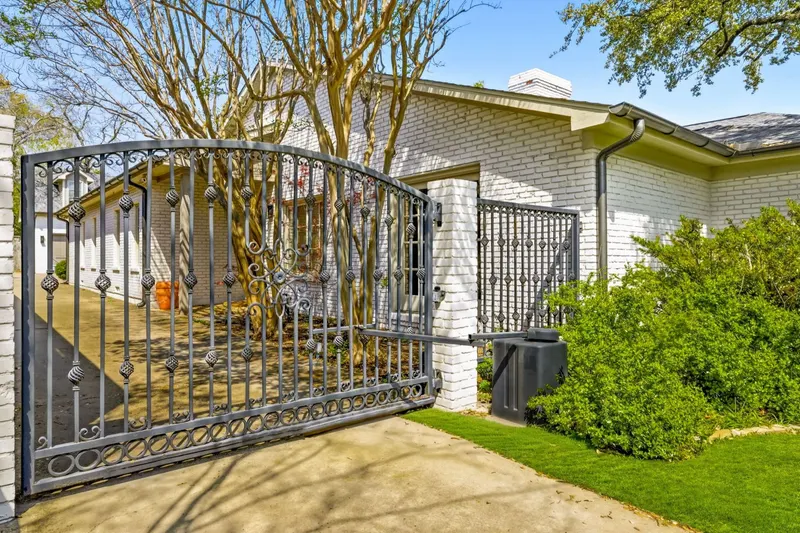
A flat top finishes the pickets under a smooth top rail. Nothing projects, so there is nothing to catch a hand, a ball or an animal trying to jump. It is also the easiest top to keep painted. Spear points and finials extend the pickets above the rail. They read as classic Dallas ironwork and they discourage climbing, but any pointed top deserves thought beside a pool, a trampoline or a swing set.
There are middle paths. An extended flat top carries the pickets above the rail and finishes them square. A double top rail with rings or scrolls between the rails adds detail with no points. Our guide to fence styles for Tudor, Georgian, Mediterranean and modern homes shows which top suits which architecture.
- Flat top: Smooth rail over the pickets. Clean, modern, the safest choice around children and pools.
- Spear or pressed point: Pickets rise past the top rail to a point. Traditional and harder to climb.
- Finials: Cast tips such as a fleur-de-lis or ball fixed to each picket. The most formal look, best on front elevations and gates.
How far apart are the pickets on an iron fence?
On a standard ornamental fence the clear gap between pickets is a little under four inches. That figure is not an accident. The federal CPSC pool barrier guidelines recommend that openings in a barrier not allow a four-inch sphere to pass, a size based on a young child's head and chest, and much of the industry builds to it everywhere.
Tighter spacing is the answer for small dogs. A gap that stops a child will not stop a Yorkie or a determined dachshund. The usual fix is a "puppy picket" section: short extra pickets added between the main ones along the bottom of the panel, which halves the gap where a small dog would try it. Our guides to fencing for small dogs and wildlife and fencing for large dogs cover the details.
Around a pool, spacing can be stricter than four inches depending on how the rails are arranged, and the city's adopted code decides. We confirm the current pool barrier requirement with your city before we build.
Is a 4-foot, 5-foot or 6-foot iron fence best for a front yard or a backyard?
Four feet is the usual front-yard height and five or six feet is the usual backyard height. In Dallas the front-yard number is also the legal limit in most residential districts: the city's fence ordinance says a fence in the required front yard may not exceed four feet above grade.
Rules differ by city and by neighborhood, and deed restrictions can be tighter than the city. Highland Park and University Park have their own limits, compared in our guide to front-yard fence height in Preston Hollow and the Park Cities. The general picture is in fence height rules in Dallas. We confirm the limit for your lot before the build.
The table matches height to purpose.
Choosing an iron fence height by purpose
| Height | Where it fits | What it does well | What to check |
|---|---|---|---|
| 4 feet | Front yards, garden borders, pool enclosures | Marks the boundary and keeps the house visible | City front-yard limit and pool barrier rules |
| 5 feet | Side and back yards, pools | Harder to climb, contains most dogs | HOA or deed restriction height caps |
| 6 feet | Backyards, estates, driveway gates | Security and containment for athletic dogs | Whether front-yard rules apply to a corner lot |
| Iron on a low wall | Front elevations and slopes | Adds height and presence with a masonry base | Total height is measured to the top of the iron |
What this means for you: Height limits vary by city, zoning district and deed restrictions. We confirm the rule for your address with the city before building.
Does an iron fence come in colors other than black?
Yes. Powder coating is available in a wide range of colors, and black is simply the most popular because it recedes visually and suits almost every house. Dark bronze is the common second choice in Dallas, and it sits well beside limestone, stucco and warm brick.
Satin or matte black hides dust and water spots better than high gloss. Bronze and deep green blend into planting. White is striking on a traditional home but shows every rust freckle and needs the most upkeep. Whatever the color, we recommend choosing it against the trim, the gutters and the light fixtures of the house, not from a small chip indoors.
Color does not change how the coating performs. Preparation does: clean steel, a primer layer and a full coat on every surface, including the inside of the rails where the pickets pass through. Our guide to powder coating versus paint explains what to expect in Texas sun.
Are iron fence panels welded on site or bolted together, and does it matter?
Both methods are sound when the posts are right. Welded fences are rigid and custom. Bolted or bracketed panels protect the factory finish and are simpler to repair. The choice depends on the site and the design more than on strength.
Field welding lets the fence follow a slope exactly, turn odd angles and meet brick or stone columns cleanly. The cost of that freedom is the finish: each weld burns the coating and must be ground, primed and painted on site. Bracketed panels arrive fully coated and attach to the posts with hardware, which keeps the finish unbroken but limits how much a panel can rake on a hill.
On a custom job we often use both: shop-welded panels built to your measurements, finished before delivery, then attached on site. Posts set in concrete carry the fence either way.
Is a hollow tube iron fence as strong as solid bar?
For a home fence, good tube steel is strong enough, and most ornamental fences built today use it. Solid bar is heavier and tougher against impact, and it is the traditional choice for hand-forged work and heavy gates.
Strength is a matter of section size and wall thickness, not just solid versus hollow. A fence with larger pickets, heavier-wall rails and full welds will outperform a thin, lightly built one of either type. Ask what gauge the tube is and how large the pickets and rails are, and compare bids on those numbers. Our article on what drives the cost of a custom iron fence lists the specifications to ask for.
Tube has one weakness: water inside it. Open ends and unsealed joints let moisture sit where you cannot see it, and the fence rusts from the inside out. Capped ends, sealed welds and a full coating prevent that. The differences between the metals are in our wrought iron, steel and aluminum comparison.
How do you put these choices together for your house?
Start with the job the fence has to do, then choose the look. Decide what you are keeping in or out, check the height you are allowed, and only then pick the top style and color that suit the architecture.
Owner Jack Johnson spent years as a custom home builder in Preston Hollow, and he attends every consultation. He reads the roofline, the brick and the windows before suggesting a pattern. You can see finished ironwork in our project gallery, and a free written estimate sets out the picket size, spacing, height, finish and gate hardware line by line.
How Park Cities Fence & Deck helps
Jack Johnson comes out himself, looks at your property and gives you a free written estimate with a timeline. Wood, iron and masonry are all built in-house, so the advice fits the property. Related services: iron / metal fencing.
Questions people ask next
Can an iron fence be mounted on top of a low brick or stone wall?
Yes, and it is one of the best-looking combinations on a front elevation. The iron posts are anchored into the wall or into columns that rise through it. The wall needs a proper footing because it now carries the fence. Cities generally measure height to the top of the iron, so the combined height has to stay within the limit.
Are spikes, barbed wire or electric fences legal on a home in Dallas?
Barbed wire and razor ribbon are prohibited fence materials in Dallas residential districts other than the agricultural district, under the city's fence ordinance. Decorative spear tops are a common part of ornamental iron. For electric fencing or any anti-climb spikes, rules vary, so we confirm with the city and your HOA before building. This is general information, not legal advice.
Is a privacy fence or a see-through fence better at deterring burglars?
Each helps in a different way. A see-through iron fence gives an intruder nowhere to hide once inside, and it is hard to climb quietly. A solid privacy fence hides what you own but also hides anyone who gets over it. Many homes use iron at the front and solid cedar at the back, with locked gates and lighting.
Does a wood fence or an iron fence look better from the street?
Iron usually suits the front of a house because it frames the architecture without hiding it. Cedar suits side and back lines where privacy matters. On many Dallas homes the best answer is both: iron with masonry columns at the front, board-on-board cedar behind. The house style and the neighboring fences should guide the choice.
Is a 4-foot fence tall enough for a dog?
For small and calm dogs, usually yes, provided the picket spacing is tight enough at the bottom. For athletic or large breeds, no. A motivated shepherd, husky or pointer can clear four feet. Five or six feet is safer for those dogs, with a flat top so nothing can catch a jumping animal.
Sources and further reading
- U.S. Consumer Product Safety Commission: Safety Barrier Guidelines for Residential Pools (Publication 362)
- City of Dallas Ordinance No. 30198, amending Section 51A-4.602 (fence standards)
General information, not legal advice. Rules change: we confirm the current requirements with your city or HOA before we build.