Iron & Masonry · Dallas, Texas
What Drives the Cost of a Brick or Stone Fence and Columns in Dallas?
Footings, height, material and format set the price of a masonry fence. Here is where the money goes.
 By Jack Johnson, owner of Park Cities Fence & Deck · 8 min read · 1,746 words
In short
A brick or stone fence in Dallas is priced by its footing, its height and length, the masonry material, the number of columns and site access. The foundation built for expansive clay is often the largest single share. Full walls cost more than columns with iron or cedar between them. Exact figures come from a free written estimate.
In this guide
- What drives the cost of a brick or stone fence?
- How much do brick or stone fence columns cost?
- Is a stone wall more expensive than a brick wall?
- Is a brick fence worth the money compared with a wood fence?
- Is stone veneer over concrete block as good as solid stone or brick?
- Why does the footing make up so much of the cost of a masonry wall?
- Are precast concrete fence walls a cheaper alternative to brick?
Need this done? See masonry fencing.
Masonry is the most expensive fence material per foot and the longest lived. Most of what you pay for is labor and concrete: a mason lays a wall one unit at a time, and before the first brick goes down a footing has to be dug, reinforced and poured.
Park Cities Fence & Deck builds brick and stone fences, columns and combination walls in-house. We do not publish prices. This guide shows what drives a masonry estimate in Dallas and Highland Park, where the cost can be trimmed without hurting the wall, and where it cannot.
What drives the cost of a brick or stone fence?
Footing, height, length, material and format. Format is the biggest lever you control: a solid wall end to end, or masonry columns with iron or cedar panels between them.
Height counts twice, because a taller wall needs more masonry and a heavier foundation to resist wind. It also brings paperwork. The City of Dallas fence permit checklist requires a permit for fences over 4 feet in a front yard or over 6 feet elsewhere, sets the maximum height at 9 feet, and asks for a scaled site plan showing easements and visibility triangles. Our Dallas fence permit guide walks through the process.
What moves a masonry fence estimate
| Factor | Lower cost | Higher cost |
|---|---|---|
| Format | Columns with iron or cedar infill | Solid wall for the full length |
| Height | Low wall or standard columns | Tall wall with a heavier footing |
| Material | Standard brick in a simple bond | Cut or natural stone and custom caps |
| Footing | Stable, level ground | Deep piers, slopes, roots or drainage work |
| Matching | New design with readily stocked units | Matching older brick, stone and mortar |
| Access | Open street or alley frontage | Hand-carried materials and tight side yards |
What this means for you: Ask each bidder to state the footing design, the reinforcement and the cap detail in writing. Those three lines explain most price gaps between masonry bids.
How much do brick or stone fence columns cost?
Columns are priced each, and the price depends on height, footprint, the facing material, the cap and the footing under it. Because every column needs its own foundation, the count matters as much as the size.
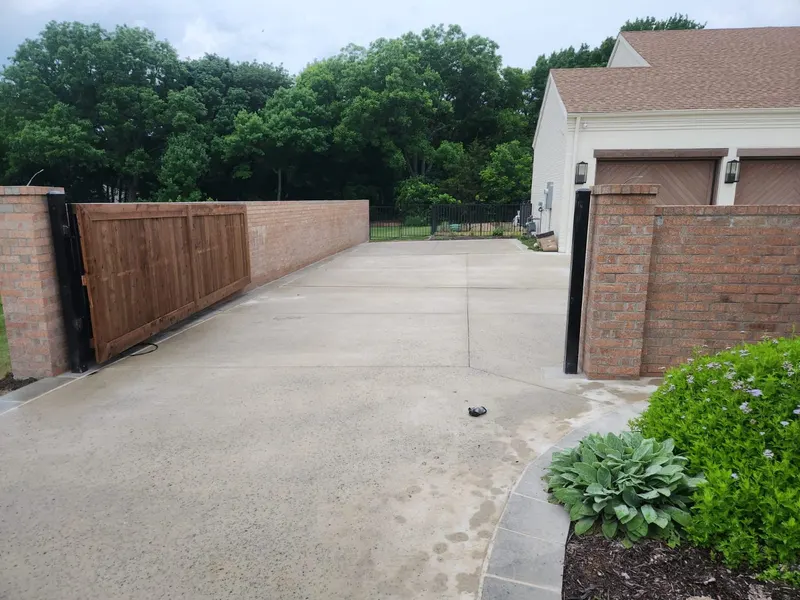
Spacing sets the count. Columns placed closer together look richer and cost more. Wider bays cut the number but need infill panels strong enough to span them. Gate columns are a separate case: they carry the weight and movement of a gate, and often conduit for an operator or lights, so they are built heavier than line columns.
A column-and-panel fence is the classic way to get the look of masonry for less than a full wall. The Brick Industry Association describes pier-and-panel garden walls as economical for a related reason: foundations are required only under the piers. For design and resale questions, see our guide to what masonry columns add to a fence line.
Is a stone wall more expensive than a brick wall?
Usually, yes. Natural stone costs more to buy and takes longer to lay than brick, because each piece is selected, trimmed and fitted.
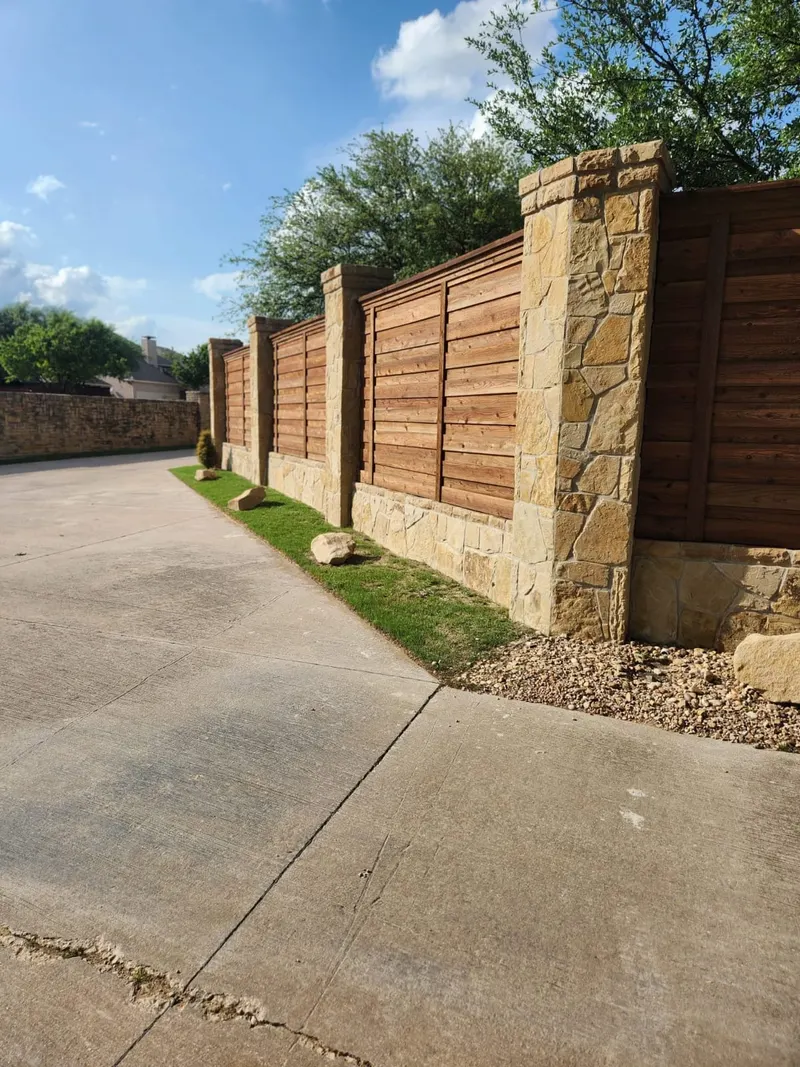
Brick is a uniform unit, so a mason works at a steady pace and waste is low. Stone varies by type and cut. Sawn limestone with tight joints, chopped stone in courses and irregular fieldstone each lay at a different speed, and the tighter the joint, the more hours go into it. Caps, corners and curves widen the gap.
The exception is matching. If your house is built of a brick that is no longer made, finding or blending a match can cost more than a readily available stone. We cover that in matching existing brick or limestone for new columns.
Is a brick fence worth the money compared with a wood fence?
It is worth it if you plan to stay, want the fence to last for decades and value privacy, quiet and a permanent look. It is not the economical choice for a simple backyard line.
Cedar typically lasts 15 to 20 years in North Texas and needs stain every few years. A properly founded masonry wall outlasts several wood fences and asks for little beyond inspection and occasional joint repair. Over a long horizon the gap narrows, though masonry rarely becomes the cheaper option on cost alone. See what drives cedar fence cost for the other side of the comparison.
What masonry buys is different: mass that blocks traffic noise better than boards, no rot, and a front that matches the house. Many owners split the budget, with masonry and powder-coated iron at the street and cedar along the back and sides.
Is stone veneer over concrete block as good as solid stone or brick?
Built correctly, yes. A reinforced concrete block core faced with stone or brick is a standard way to build a strong wall, and it is often stronger than an unreinforced solid one.
The core carries the structure and holds the steel. The veneer gives the look. The method saves money on facing material and lets the wall be reinforced and grouted. What matters is execution: the veneer tied to the core, the joints fully filled, and the top closed with a cap that sheds water. The Brick Industry Association recommends copings that project past the face of the wall with a drip, so water does not run down the masonry.
Thin manufactured stone adhered to a wall is a different product from full-depth natural stone veneer. It can look good and cost less, but it depends entirely on the bond and on keeping water out from behind it. Ask which one a bid describes. Our brick and stone wall planning guide covers water management in more depth.
- Core: What is behind the face: reinforced block, solid brick or a poured wall.
- Veneer: Full-depth natural stone or brick, or a thin adhered product.
- Cap: The material, the overhang and how the joints in the cap are sealed.
Why does the footing make up so much of the cost of a masonry wall?
Because the footing is a second structure built underground, and in Dallas clay it has to be built well. Excavation, steel, concrete and hauling away the soil all happen before any visible work.
Masonry is rigid. Wood and iron tolerate a little soil movement, but brick and mortar crack when the support under them shifts. The Brick Industry Association notes that garden wall footings sometimes do not receive proper attention because the wall carries only its own weight, and it recommends foundations in undisturbed earth, reinforced where soils are active. North Texas clay is active soil: it swells when wet and shrinks when dry.
So the footing is designed for the site. Slopes, drainage paths and large trees all change it. Where a wall also holds back soil, the Dallas checklist requires retaining wall plans sealed by a Texas-licensed professional engineer. Our guide to fences on slopes and retaining walls explains when that applies. A footing is the wrong place to save money, because a leaning wall is fixed only by rebuilding it.
Are precast concrete fence walls a cheaper alternative to brick?
Generally, yes. Precast concrete panels are cast in a plant, often with a brick or stone texture, and set between posts on site, so there is far less mason labor.
They suit long perimeter runs such as subdivision and commercial boundaries, where speed and uniformity matter. The trade-offs are the appearance up close, visible panel joints, a repeating pattern, and repairs that mean replacing a whole panel. Access for the equipment that sets the panels is also a factor on a residential lot.
We build brick and stone, not precast. If budget is the concern, the options we would put beside precast are masonry columns with cedar or iron between them, or a cedar fence with masonry accents at the gate. In the Park Cities, where the towns review fences closely, read the Highland Park and University Park permit guide before settling on a design. To price your line, request a free written estimate or call (214) 755-8100.
How Park Cities Fence & Deck helps
Jack Johnson comes out himself, looks at your property and gives you a free written estimate with a timeline. Wood, iron and masonry are all built in-house, so the advice fits the property. Related services: masonry fencing. We work in Dallas and Highland Park and across Dallas.
Questions people ask next
Can a leaning brick fence column be straightened, or must it be rebuilt?
In most cases it must be rebuilt. A column leans because its footing has moved or was too small, and pushing rigid masonry back upright cracks the joints without fixing the cause. The reliable repair is to take the column down, build a proper footing and relay it, reusing the original brick or stone where it is sound so the rebuilt column matches its neighbors.
Should a brick fence be sealed or pressure washed?
Usually neither is needed. The Brick Industry Association states that properly built brickwork resists water without coatings, and that only breathable water repellents such as silanes and siloxanes should be used, never film-forming coatings. They can help on exposed tops and caps. Clean with water and a stiff fiber brush first. High pressure can erode mortar joints, so keep any washing gentle.
Are masonry columns stronger in wind than steel posts?
They resist wind differently. A masonry column is heavy and stiff, and it stays put as long as its footing does. A galvanized steel post is light and flexes slightly, then returns. Either holds a fence in a North Texas storm when it is sized and founded for the height. The common failure in both cases is below ground: a footing too small for the load.
Can an iron fence be mounted on top of a low brick or stone wall?
Yes. Iron or ornamental steel on a low masonry wall, usually between taller columns, is one of the most common estate fence designs in Dallas. The posts are set into the wall or anchored to it with plates, and the wall needs a footing and cap designed for that. Total height still has to meet the city or town limit, which we confirm before the build.
What causes the white powder on a brick fence, and how is it removed?
It is efflorescence: salts left on the surface when water moving through the masonry evaporates. The Brick Industry Association advises finding and fixing the water source first, or the deposits return. They are usually water soluble and come off by natural weathering, dry brushing, or scrubbing with a stiff fiber brush and water. Stubborn cases need a cleaner made for brickwork, used carefully.
Sources and further reading
- City of Dallas, Planning & Development: Fence Permit, Pool Barrier and Retaining Wall Checklist
- Brick Industry Association: Technical Note 29A, Brick in Landscape Architecture, Garden Walls
- Brick Industry Association: Technical Note 46, Maintenance of Brick Masonry
General information, not legal advice. Rules change: we confirm the current requirements with your city or HOA before we build.