Planning · Dallas, Texas
Which Fence Cuts Traffic Noise Along Busy Streets Like Preston Road or Northwest Highway?
Noise goes through gaps and over the top. The fence that helps is solid, heavy, sealed at the ground and tall enough.
 By Jack Johnson, owner of Park Cities Fence & Deck · 8 min read · 1,753 words
In short
The fence that cuts traffic noise is solid, heavy, free of gaps and tall enough to block your view of the road. A masonry wall does this best. A capped board-on-board cedar fence with a sealed bottom is the best wood option. Open iron and spaced pickets do almost nothing. No fence removes traffic noise completely.
In this guide
- What makes a fence block sound at all?
- Which fence types work, and which do not?
- Is a masonry wall worth it over cedar for noise?
- How should a cedar fence be built when noise is the goal?
- How tall does it need to be, and how tall is allowed?
- What about the gate, the driveway and the ends of the fence?
- How much quieter will the yard really be?
Need this done? See masonry fencing.
If your lot backs onto Preston Road, Northwest Highway, Hillcrest or the Tollway, you already know the sound: tire hum all day, trucks braking, a motorcycle at eleven at night. A fence can take the edge off it. Whether it does depends on physics more than on price or looks.
The Federal Highway Administration has studied noise barriers for decades, and its findings apply to a backyard fence as much as to a highway wall. This guide translates them into choices you can make on a residential lot, and is honest about how much quieter you should expect the yard to be.
What makes a fence block sound at all?
Three things: it has to be solid, it has to be heavy enough, and it has to stand between your ears and the tires. The FHWA says a barrier earns its first real benefit when it is tall enough to break the line of sight from the road to the listener. If you can see the traffic over or through the fence, you are hearing it directly.
Mass matters next. The FHWA’s guidance is that the barrier material must be rigid and sufficiently dense, and that once it reaches that density, all material types perform equally well acoustically. In other words, a heavy solid wall of brick, stone, concrete or thick timber works about the same. A light or leaky one does not.
Then gaps. Sound behaves like water and finds every opening. The FHWA is blunt that openings in a noise barrier for driveways or cross streets destroy its effectiveness. On a fence, that means spaces between pickets, a gap under the bottom rail and a loose-fitting gate.
Which fence types work, and which do not?
Ranked by how well they meet those three tests, the common fence types on Dallas lots fall into a clear order. The table below compares them in plain terms.
How common fence types handle traffic noise
| Fence type | Effect on traffic noise | Where it makes sense |
|---|---|---|
| Brick or stone wall | Best: heavy, solid and gap-free | Lots directly on an arterial, where height is allowed |
| Combination wall: masonry base and columns with solid infill | Very good when the infill is solid and sealed | Where a full masonry wall is more than the budget or the rules allow |
| Capped board-on-board cedar with a sealed bottom | Good: overlapping boards stay closed as the wood dries | Most backyards one lot or more from the road |
| Side-by-side cedar privacy fence | Fair at first, weaker as boards shrink and gaps open | Privacy first, noise second |
| Shadowbox or spaced picket | Poor: sound passes through the openings | Looks and airflow, not noise |
| Open iron or aluminum | Essentially none | Views and security, away from the noise source |
What this means for you: If noise is the reason you are building, choose from the top three rows and spend the effort on height and sealing the gaps.
Is a masonry wall worth it over cedar for noise?
On a lot that sits right on a busy street, usually yes. A brick or stone wall has far more mass than any wood fence, it has no joints that open with the seasons, and it will perform the same in twenty years as on the day it is finished. It also brings privacy and security that match its acoustic benefit.
It is a different class of project. A masonry wall needs an engineered footing set below the zone where North Texas clay moves, it almost always needs a permit, and it takes longer to build. Our guide to planning a brick or stone fence wall walks through that. A middle path is a combination wall, with a masonry base and columns and a solid infill between them.
One or two lots back from the road, the gap between masonry and good cedar narrows, because distance and the houses in between are already helping. There, a well-built wood fence often gives most of the improvement for a more modest investment.
How should a cedar fence be built when noise is the goal?
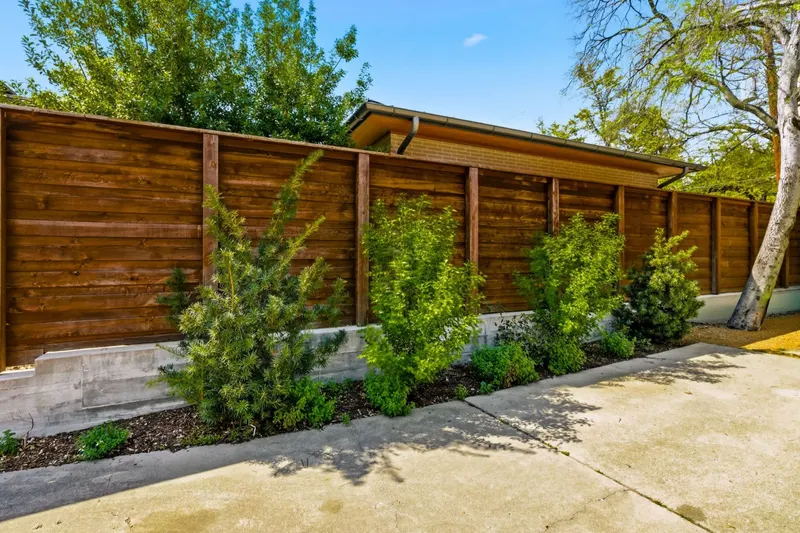
Wood can work, with one warning from the FHWA’s design handbook: wood barriers are prone to develop openings from shrinkage, warping, splitting and weathering. A fence that is tight on day one can leak sound a couple of summers later. The build has to anticipate that.
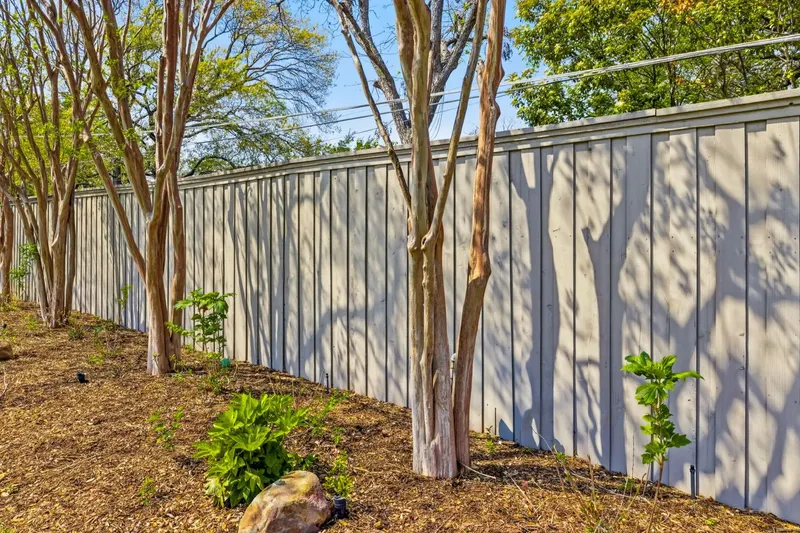
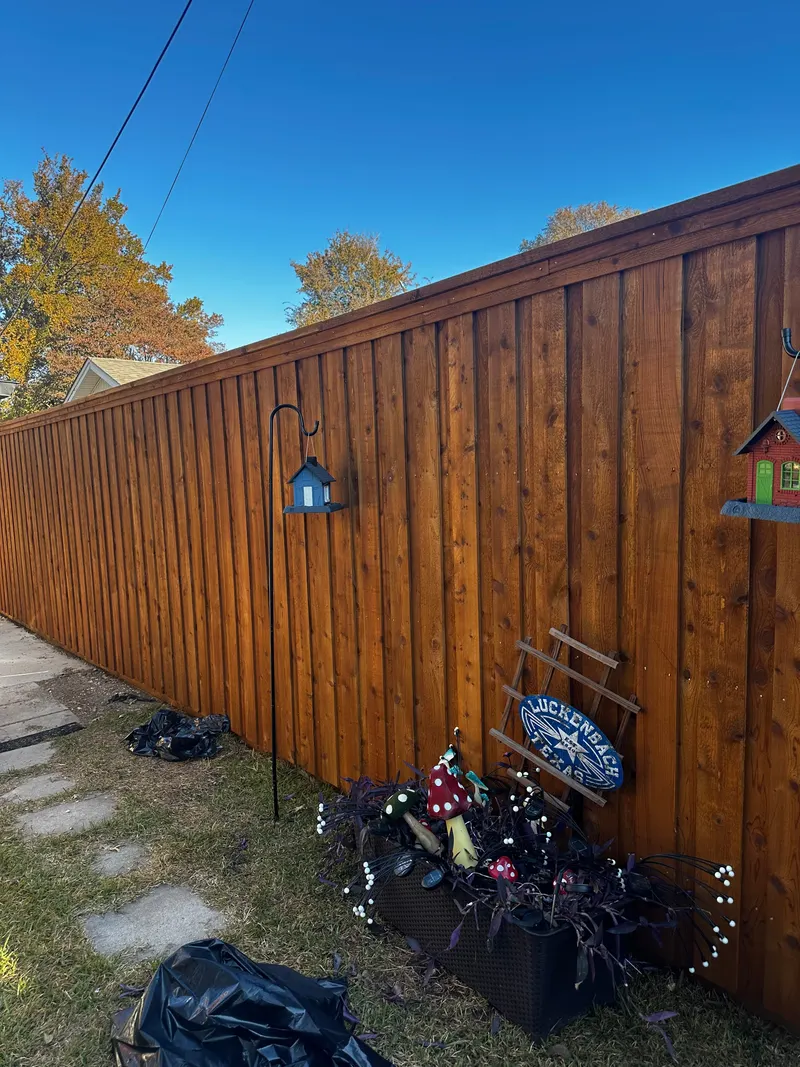
Board-on-board is the answer. Two overlapping layers of pickets stay closed even as each board shrinks, and the overlap adds mass. Our comparison of board-on-board vs. side-by-side shows the difference. A cap and trim at the top stiffen the fence and close the upper edge.
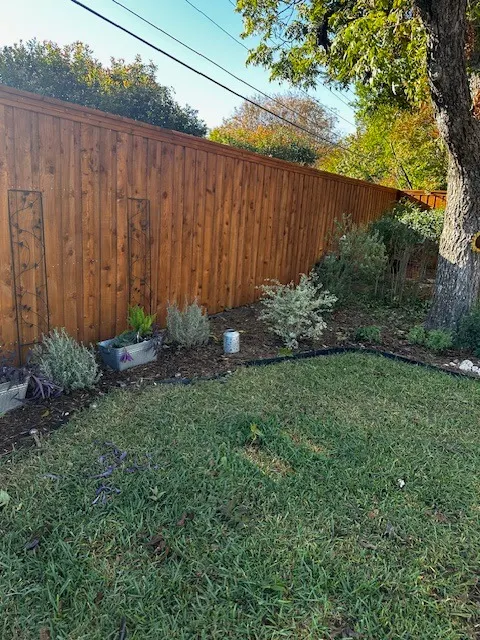
The bottom is where most wood fences fail acoustically. A pressure-treated kickboard set tight to grade closes the gap under the pickets. Steel posts in concrete keep the line straight so gaps do not open as the fence ages. And keeping the wood sealed with stain every few years, typically two to four depending on sun exposure, slows the shrinking and cracking. See our wood fencing page for the options, or the guide to cedar, hardwood and composite privacy fences.
How tall does it need to be, and how tall is allowed?
Taller is better, because of the line-of-sight rule. Stand on the patio and at the bedroom window that bothers you most. If the fence hides the tires and the sides of the vehicles from those spots, it is doing most of what a fence can do. A second-story window that looks over the fence will get little benefit from it.
How tall you may build is a legal question, and the answer changes by city, by which yard the fence is in, and sometimes by the street it faces. Lots that back onto major roads are sometimes treated differently from interior lots. HOAs and deed restrictions add their own limits. We confirm the allowed height with the city or town before the design is final, and prepare what is needed if a taller fence requires special approval.
For background, read fence height rules in Dallas and the Park Cities and, for front and corner lots, front yard fence height in Preston Hollow and the Park Cities. Both are general information, not legal advice.
What about the gate, the driveway and the ends of the fence?
A sound barrier is only as good as its weakest opening. An open iron driveway gate in an otherwise solid wall lets noise pour through. If the driveway faces the busy street, consider a solid or wood-clad automatic gate that closes tight against its posts, and keep it closed.
Length matters too. Sound bends around the ends of a short wall. The FHWA’s rule of thumb for highway barriers is a length of at least eight times the distance from the listener to the barrier. Few residential lots allow that, so the practical version is to return the solid fence along the side property lines instead of stopping at the back corners.
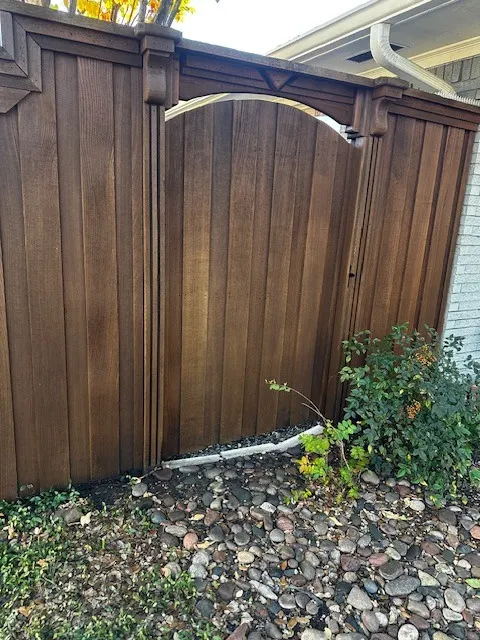
Walk gates deserve the same care: a solid gate, a tight fit at the latch post and a small gap at the ground. These details cost little during the build and are hard to fix later. If you already have an open iron fence on the noisy side and want to keep it, our guide to adding privacy to an iron fence covers the options, with the caveat that light screening does far less for sound than a solid wall.
How much quieter will the yard really be?
Expect a noticeable softening, not silence. For engineered highway barriers, the FHWA says effective walls typically reduce noise by 5 to 10 decibels, and that barriers do not block all noise. A residential fence is shorter than a highway wall and limited by height rules, so the honest expectation is the lower part of what a solid barrier can do. We do not promise a number.
Planting helps how the yard feels more than what a meter reads. The FHWA notes that vegetation is useful for psychological relief but would need to be very deep and dense to physically lower noise. A hedge in front of a solid fence hides the road and softens the wall. A small fountain near the seating area can mask what is left.
If road noise is the main reason for your project, tell us at the first visit. Owner Jack Johnson attends every consultation in Preston Hollow, University Park and across Dallas, and will show you where the sound is getting in. Request a free written estimate or call (214) 755-8100.
How Park Cities Fence & Deck helps
Jack Johnson comes out himself, looks at your property and gives you a free written estimate with a timeline. Wood, iron and masonry are all built in-house, so the advice fits the property. Related services: masonry fencing, wood fencing, gates & gate motors. We work in Preston Hollow and University Park and across Dallas.
Questions people ask next
Will a regular cedar privacy fence reduce road noise?
A little, mainly by blocking the direct path from the tires to your ears. A side-by-side fence loses much of that as the boards dry and gaps open. A capped board-on-board fence with a kickboard tight to the ground holds up far better, because the overlapping boards stay closed and the bottom gap is sealed.
Do sound-absorbing panels or mats on the fence help?
Adding dense, continuous material to a fence can raise its mass, which is one of the things that matters. It only helps if the fence is already solid, sealed at the ground and tall enough. We would fix the gaps and height first. We do not quote decibel improvements for any add-on product.
Do trees and hedges block traffic noise?
Not much by themselves. The Federal Highway Administration notes that vegetation must be very tall, wide and dense before it physically lowers noise, far more than a residential hedge. Planting is still worthwhile: hiding the traffic changes how loud it feels, and greenery in front of a solid wall softens the look.
Can I build a taller fence because my lot backs onto a major road?
Possibly. Some cities treat lots along major thoroughfares differently, and some allow extra height through a special approval. The rule depends on your city, your zoning and your HOA. We check with the city before designing the fence and do not build above the approved height. Treat this as general information and confirm it for your address.
Which is better for noise: one tall fence or two shorter ones?
One tall, solid, heavy barrier. A second fence adds little unless it also blocks the line of sight to the traffic. Put the investment into a single wall or fence that is as tall as allowed, continuous along the noisy side, wrapped around the corners and sealed at the ground and at the gates.
Sources and further reading
- Federal Highway Administration: Keeping the Noise Down, Highway Traffic Noise Barriers
- Federal Highway Administration: Noise Barrier Design Handbook, Acoustical Considerations
General information, not legal advice. Rules change: we confirm the current requirements with your city or HOA before we build.