Planning · Dallas, Texas
How Do HOA Rules and Deed Restrictions in Dallas Neighborhoods Affect Fence and Gate Design?
City code is only the first layer. HOA rules and deed restrictions often decide height, material, color and gate style.
 By Jack Johnson, owner of Park Cities Fence & Deck · 8 min read · 1,750 words
In short
In Dallas neighborhoods a fence or gate has to satisfy up to three sets of rules: city or town code, recorded deed restrictions and, where one exists, the homeowners association. The private rules often control height, material, color, which side faces out and gate style. The strictest rule wins, so check the design against all three before building.
In this guide
- What is the difference between city rules, deed restrictions and HOA rules?
- What do HOAs and deed restrictions usually regulate on a fence?
- Can an HOA stop me from building a fence at all?
- How do the rules affect driveway gates?
- What about conservation districts, historic districts and the Park Cities?
- How does HOA approval work and what should the application include?
- What if there is no active HOA, only old deed restrictions?
- How do we design a fence that gets approved the first time?
Need this done? See wood fencing.
Most homeowners know the city has fence rules. Fewer realize that the papers they signed at closing may say more about their fence than the city does. Deed restrictions and HOA guidelines can dictate cedar instead of iron, a specific stain color, a maximum height lower than the city allows, or no fence at all in front of the house.
This guide explains how the layers fit together and how to get a design approved the first time. It is general information, not legal advice. For the permit side, see our guide to fence permits, HOAs and utility locates in DFW.
What is the difference between city rules, deed restrictions and HOA rules?
City and town codes are public law. They apply to every lot, and the building department enforces them through permits and inspections. Deed restrictions are private covenants recorded against the land, often when the subdivision was first platted, and they stay with the lot when it is sold. An HOA is an organization with the power to enforce those covenants, add design guidelines and review plans.
A lot can have all three, or deed restrictions with no active association, or only city rules. Older Dallas neighborhoods frequently have restrictions from decades ago that nobody mentions until a neighbor objects.
The three layers of fence rules on a Dallas-area lot
| Layer | Who enforces it | What it usually controls |
|---|---|---|
| City or town code | Building department, through permits and inspections | Height, front-yard limits, visibility at corners, prohibited materials, pool barriers |
| Conservation or historic district | City review before the permit is issued | Style, materials and placement that suit the district |
| Deed restrictions | The association, or other owners in the subdivision | Materials, height, front-yard fences, setbacks from the street |
| HOA design guidelines | Architectural review committee | Stain color, cap and trim details, finished side, gate style, approval process |
What this means for you: Your fence has to pass every layer that applies to your lot, and passing one does not mean you have passed the others.
What do HOAs and deed restrictions usually regulate on a fence?
The details vary by neighborhood, but the same topics come up again and again. Read your own documents, because a rule that is standard in one subdivision is absent in the next.
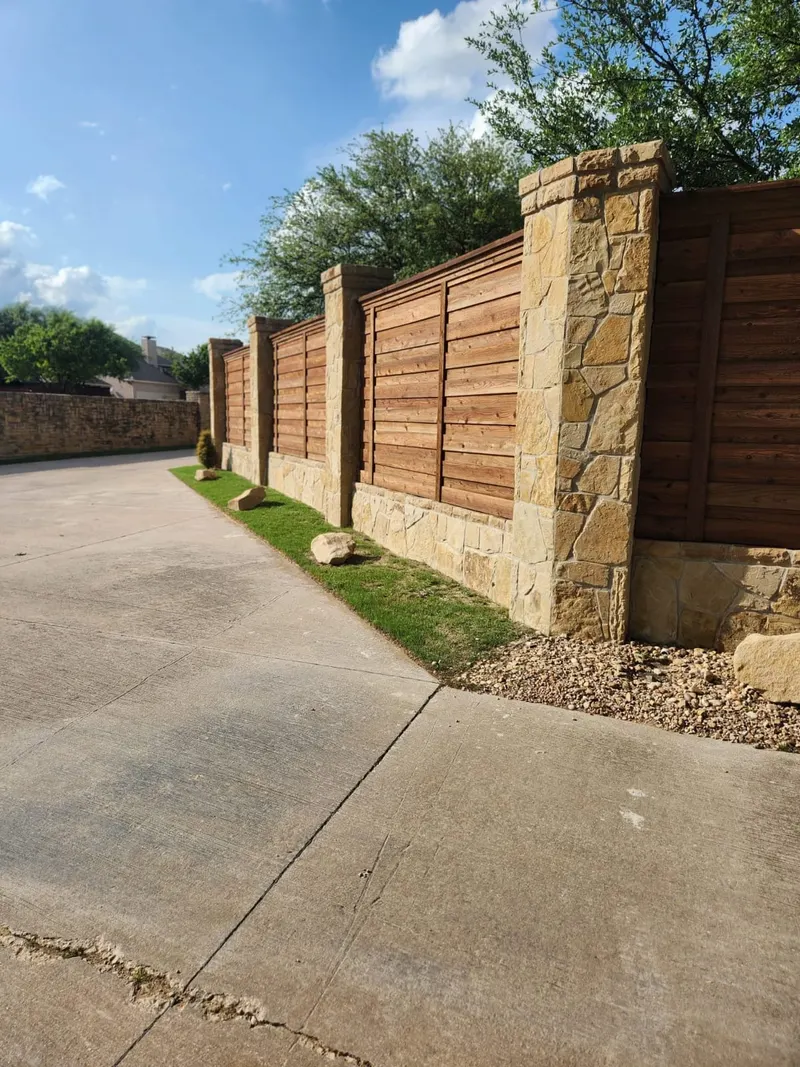
Along greenbelts, golf courses and creeks, many communities require open iron so the shared view is kept. Along alleys and between homes, they usually allow or require solid cedar privacy fencing. Perimeter walls facing a main road are often brick or stone that the association itself maintains, and owners may not alter them. Where open iron fencing is required, the pattern and color are usually specified too.
- Height: Often lower than the city maximum, and sometimes different for side, rear and street-facing runs.
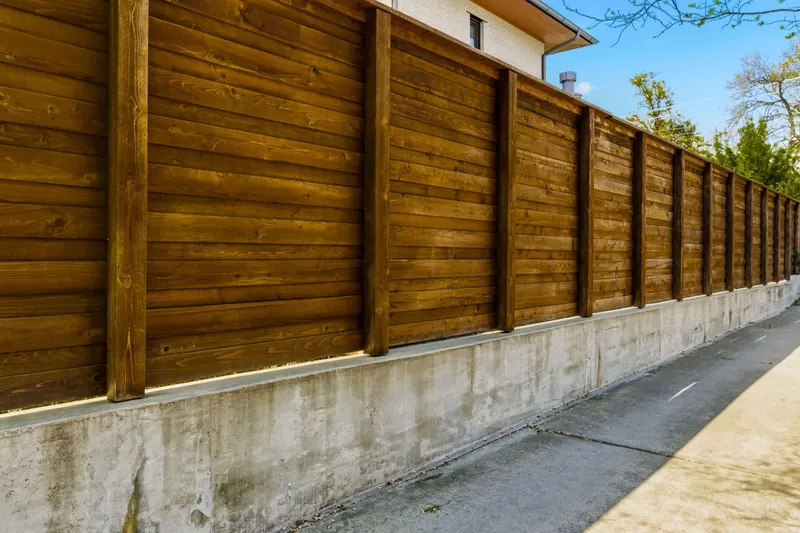
- Material and style: Board-on-board cedar, iron of a set pattern, or masonry to match the community walls.
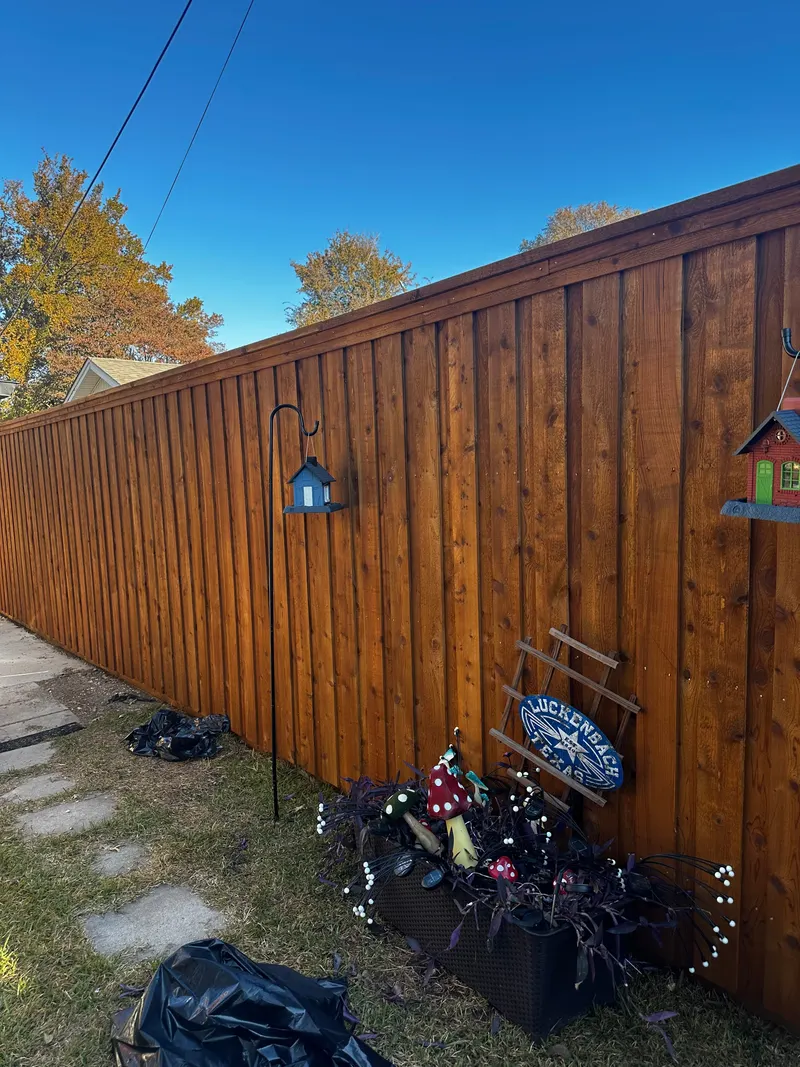
- Color: A named stain family for wood and black or bronze for metal.
- Finished side: Rails and posts facing in, smooth side facing the street or neighbor.
- Location: No fence forward of the front building line, and setbacks on corner lots.
Can an HOA stop me from building a fence at all?
Texas law limits that. Section 202.023 of the Texas Property Code says a property owners’ association may not adopt or enforce a restrictive covenant that prevents an owner from building or installing security measures, and it names security cameras, motion detectors and perimeter fences as examples.
The same section preserves the association’s design authority. It expressly allows an association to regulate the type of fencing an owner may install, and to prohibit cameras placed outside the owner’s own property. It also does not apply to certain condominium and master mixed-use communities. In practice that means your HOA can generally still tell you what the fence must look like, even where it cannot refuse a perimeter fence outright.
How this applies to a front yard, a corner lot or an unusual design is a question for your association and, if there is a disagreement, an attorney. We are fence builders. We design to the documents you give us and flag conflicts early.
How do the rules affect driveway gates?
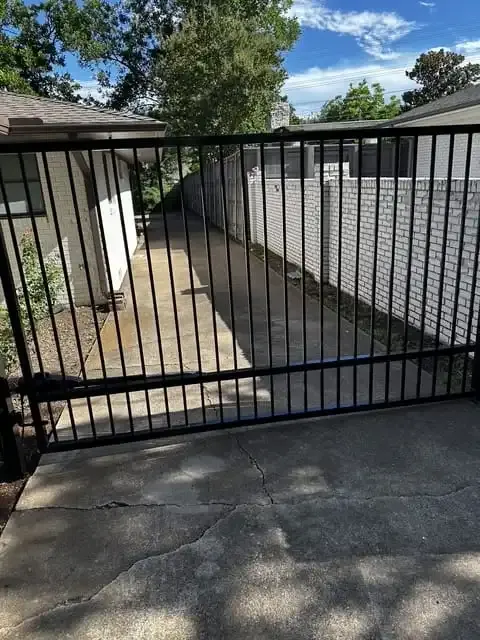
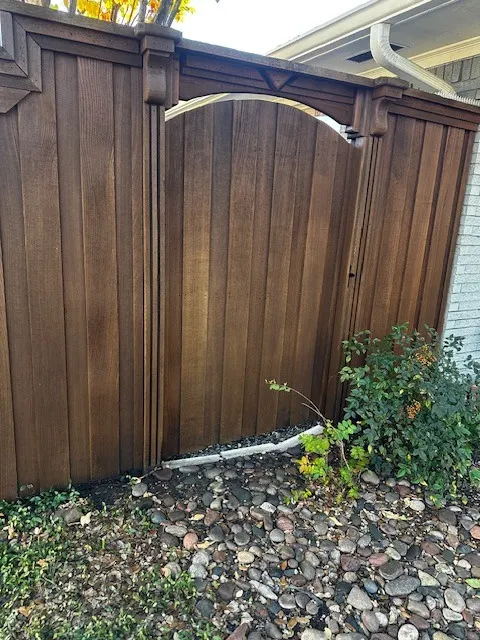
Gates draw more scrutiny than fences because they face the street. Associations commonly look at the height of the gate and columns, how far the gate sits back from the curb so a waiting car does not block the street or sidewalk, the material, and whether keypads, intercom posts and lighting are visible from the road.
The city has its own interest in the same things. The City of Dallas fence permit checklist asks for a site plan showing gates, driveways, sidewalks and visibility triangles, because a gate or column in the wrong place blocks the view of drivers pulling out. We work through both sets of requirements on every automatic gate we design, and our article on estate entrance design shows how gates, columns and lighting come together.
What about conservation districts, historic districts and the Park Cities?
Parts of Dallas sit inside conservation or historic districts with their own design standards. According to the city’s fence permit checklist, a proposed fence in one of those districts needs an approved Certificate of Appropriateness along with supporting documents. That review comes before the permit and looks at whether the fence suits the character of the district.
Highland Park and University Park are separate municipalities with their own codes. The Town of Highland Park’s fence permit packet, for example, requires a survey or scaled site plan showing fence heights and gates, says a fence may not sit in the required front yard setback or in an easement, requires engineer-stamped plans for masonry walls, and includes a final inspection to verify that height does not exceed 8 feet measured from the non-owner’s side. University Park has its own requirements, which we confirm with the city for each project.
Our guides to Highland Park and University Park fence permits and fence height rules cover these in more detail.
How does HOA approval work and what should the application include?
Most associations route fence and gate requests through an architectural review committee. You submit an application, the committee reviews it at its next meeting, and you receive written approval, a request for changes or a denial. Committees often meet monthly, so an incomplete application can cost a full cycle.
A complete package answers every question before it is asked. Written approval should be in hand before build day, and the finished fence should match what was approved. A fence that is well built but a different height or color than the application is the usual cause of a violation letter.
- Site plan: Your survey with the fence line, gates and columns drawn on it.
- Elevation drawing: What the fence looks like from the street, with height and post spacing.
- Material sheet: Wood species or metal type, cap and trim details, hardware.
- Color: The stain or powder-coat color by name, with a sample if the committee wants one.
What if there is no active HOA, only old deed restrictions?
The restrictions may still apply. Recorded covenants generally run with the land whether or not an association is collecting dues, and in many subdivisions other owners can seek to enforce them. Whether an old restriction is still enforceable is a legal question we cannot answer for you.
What we can do is help you find out what exists. Your closing documents and title commitment normally list recorded restrictions, and the county clerk keeps the originals. Bring us what you have. If a restriction limits front-yard fences or materials, it is much easier to design around it now than to learn about it from a neighbor after the posts are set. For the neighbor side of the conversation, see shared fences in Texas.
How do we design a fence that gets approved the first time?
We start by reading the rules, not the catalog. At the consultation, owner Jack Johnson asks for your HOA guidelines and any deed restrictions, checks the city or town requirement for your address, and designs to the strictest of them. Then we prepare the drawings and specification sheet the committee needs, and the permit drawings for the city.
Jack spent years as a custom home builder before he built fences, so review boards and plan submittals are familiar ground. We also build masonry walls and columns and perimeter fencing for HOAs themselves, which gives us a view from the committee’s side of the table. Call (214) 755-8100 or request a free written estimate, and send your documents with it.
How Park Cities Fence & Deck helps
Jack Johnson comes out himself, looks at your property and gives you a free written estimate with a timeline. Wood, iron and masonry are all built in-house, so the advice fits the property. Related services: wood fencing, gates & gate motors, masonry fencing. We work in Dallas and Highland Park and across Dallas.
Questions people ask next
Do I need both HOA approval and a city permit?
Often, yes. They are separate processes with separate rules. The city permit confirms the fence meets public code. HOA approval confirms it meets your community’s private standards. One does not replace the other, and the city will not check your deed restrictions for you. We prepare both submittals as part of the project.
Which rule applies if the city and the HOA disagree?
As a practical matter you must satisfy both, so the stricter rule controls the design. If the city allows a taller fence than your HOA does, you build to the HOA height. If the HOA would allow something the city prohibits, the city rule still applies. This is general information; confirm specifics with your city and association.
How do I find the deed restrictions for my lot?
Look at the title commitment and closing documents from your purchase, which normally list recorded restrictions. The county clerk’s office holds the recorded originals, and a title company can pull copies. If you are in an HOA, the management company should provide the current covenants and design guidelines on request.
Can my HOA require a specific stain color?
Many do. Associations commonly name a stain family or a short list of approved colors so fences along a street look consistent. We match the required color and note it on the application. If your fence will need restaining later, keep the same approved color so the fence stays in compliance.
What happens if I build without HOA approval?
It depends on your documents, but associations can typically send violation notices, require changes and, in some cases, levy fines or pursue removal. Even a well-built fence can be challenged if it was never approved. Getting written approval first is far less trouble than resolving a dispute afterward.
Sources and further reading
- Texas Property Code, Chapter 202, Section 202.023 (Security Measures)
- City of Dallas Planning & Development: Fence Permit Checklist
- Town of Highland Park: Fence Permit Packet
General information, not legal advice. Rules change: we confirm the current requirements with your city or HOA before we build.