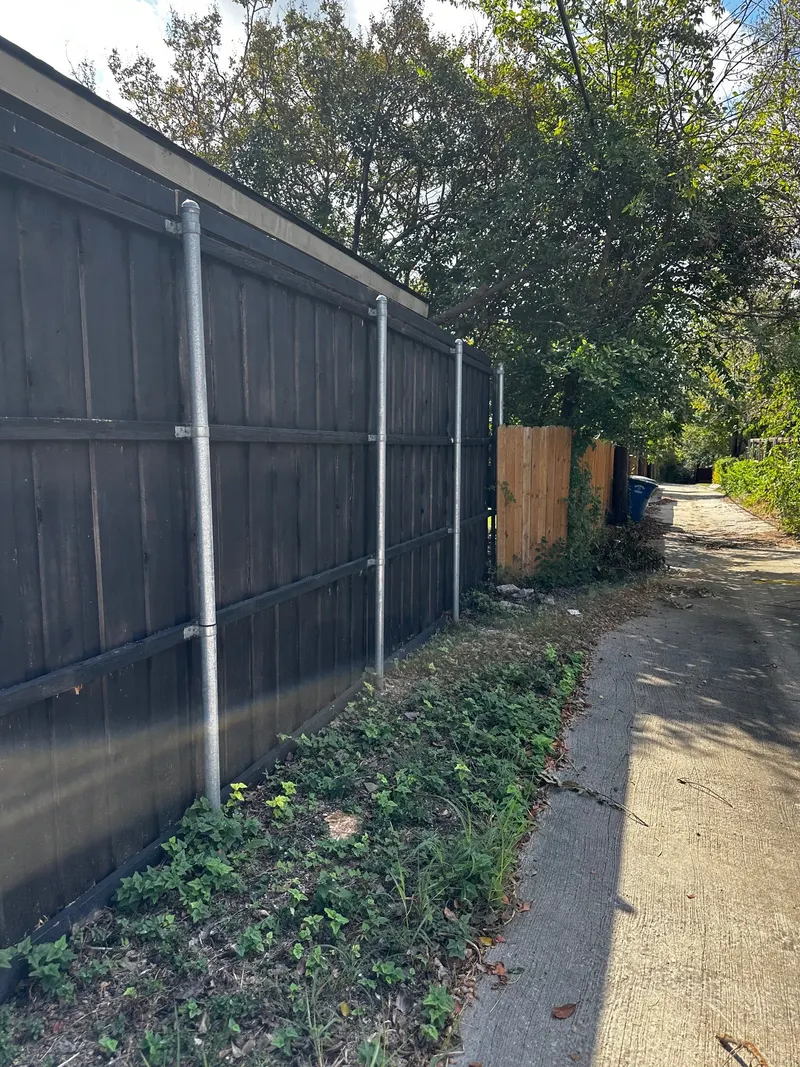
Planning · Dallas, Texas
How Do You Build a Fence on a Sloped Yard Without Blocking Drainage?
Step it or rack it, keep the water path open, and bring in an engineer when a retaining wall is involved.
 By Jack Johnson, owner of Park Cities Fence & Deck · 9 min read · 1,822 words
In short
A fence on a slope is either stepped, with level panels that drop at each post, or racked, with rails that follow the grade. Posts stay plumb in both. Drainage is protected by keeping the existing water path open under or through the fence, and any retaining wall is designed before the fence is.
In this guide
- Is a stepped fence or a racked fence better on a hill?
- Will a new fence block drainage and flood my yard?
- Can a fence be built on top of a retaining wall?
- How do you close the gaps under a fence on uneven ground?
- Do I need a retaining wall before I build a fence on a slope?
- Can a fence cross a creek, a swale or a drainage ditch?
- How is the height of a fence measured on a slope?
Need this done? See wood fencing.
Flat lots are rare in North Texas. Yards fall toward alleys, creeks and side swales that builders graded on purpose to carry rain away from the house. A fence that ignores that grade ends up with gaps a dog can walk under, pickets buried in wet soil, or a dam that floods the patio.
The good news is that slope is a layout problem, and it is solved before the first hole is dug. This guide explains the choices. Where a question belongs to a civil or structural engineer, we say so, because a fence company should not guess at soil loads.
Is a stepped fence or a racked fence better on a hill?
Neither is better everywhere. Racking suits gentle, even slopes and open iron. Stepping suits steeper grades, solid privacy fences and any fence with a cap and trim.
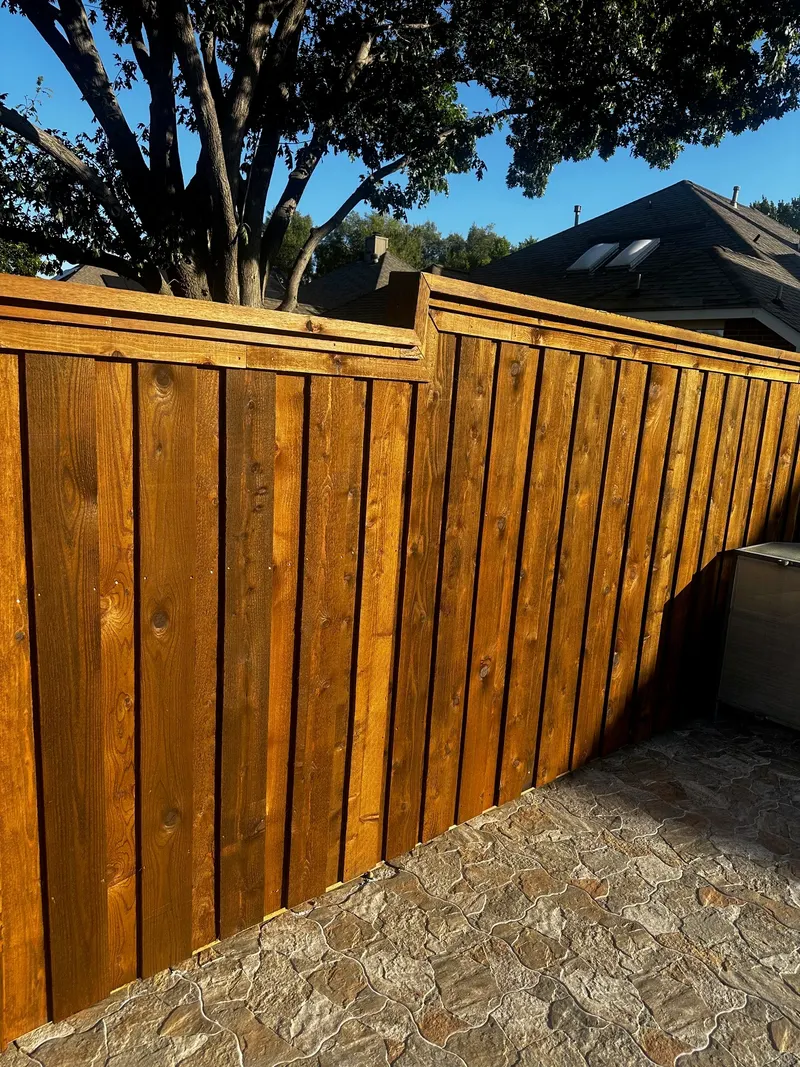
A racked fence keeps its rails parallel to the ground, so the top line follows the slope and the gap at the bottom stays even. Most ornamental steel and aluminum panels are made to rack within a set range. A stepped fence keeps each panel level and drops at the post, which gives the clean stair-step line seen on capped cedar privacy fences.
Site-built wood gives a third option. Because every picket is cut and fastened on site, the top can run level while the bottom of each picket is scribed to the ground. That closes the triangles a stepped fence leaves under each bay.
Gates need their own thought on a slope. A swing gate must clear the ground through its whole arc, so it opens toward the downhill side or is hung higher on the uphill post. Our guide to swing and slide driveway gates explains why slope often decides the gate type.
Three ways to carry a fence down a slope
| Method | How it looks | Works best for | Watch for |
|---|---|---|---|
| Racked | Top line follows the ground | Gentle slopes, iron and steel | Panels have a rack limit |
| Stepped | Level panels that drop at posts | Steeper grades, capped cedar | Triangular gaps under each bay |
| Level top, scribed bottom | Straight top, pickets cut to grade | Site-built wood privacy | More labor and longer pickets |
| Stepped on a low wall | Fence on a masonry or concrete base | Sharp grade changes | Wall design and drainage |
What this means for you: Posts are set plumb in every method. Only the rails and pickets change.
Will a new fence block drainage and flood my yard?
It should not, if the fence is laid out around the way water already moves. Trouble starts when a solid bottom edge, a kickboard or a concrete strip is run straight across a swale.
Cities treat this as a rule, not a courtesy. Frisco's fence ordinance says a fence shall not adversely affect drainage or create debris build-up. On the first visit we look for the signs of a water path: a shallow dip between lots, washed mulch, a drain inlet, or a downspout aimed at the fence line.
Where water crosses, the fence is built to let it. That can mean raising the bottom of the pickets at that bay, leaving a gap in the kickboard, or switching one section to open iron. Leaves and mulch pile up against a tight fence, so we also plan for debris. If your yard already holds water, fix the grading or add a drain first, then build the fence.
Be careful with well-meant extras. A continuous concrete mow strip looks tidy and keeps grass off the pickets, but poured without breaks it works like a curb. Any strip or base should be interrupted or sleeved where water has to cross. The same care protects planting beds, as our guide to protecting landscaping during installation explains.
Can a fence be built on top of a retaining wall?
Yes, but only when the wall was designed to carry it. A fence adds wind load at the top of a wall that may have been built only to hold soil, and that is an engineering question.
Frisco's ordinance says fence posts attached to or supported by other structures, including retaining walls, must have foundation and anchorage that prevent movement of the structure or wall. Dallas requires retaining wall plans sealed by a Texas-licensed professional engineer. Cities also measure fence height in their own way when a wall is involved, which can reduce the fence height you are allowed on top.
The common answers are to set the fence posts in their own footings behind the wall, or to build a new wall with post sleeves cast in. Our masonry crew builds walls and columns in-house, and our guide to brick and stone fence walls explains footings in more detail.
How do you close the gaps under a fence on uneven ground?
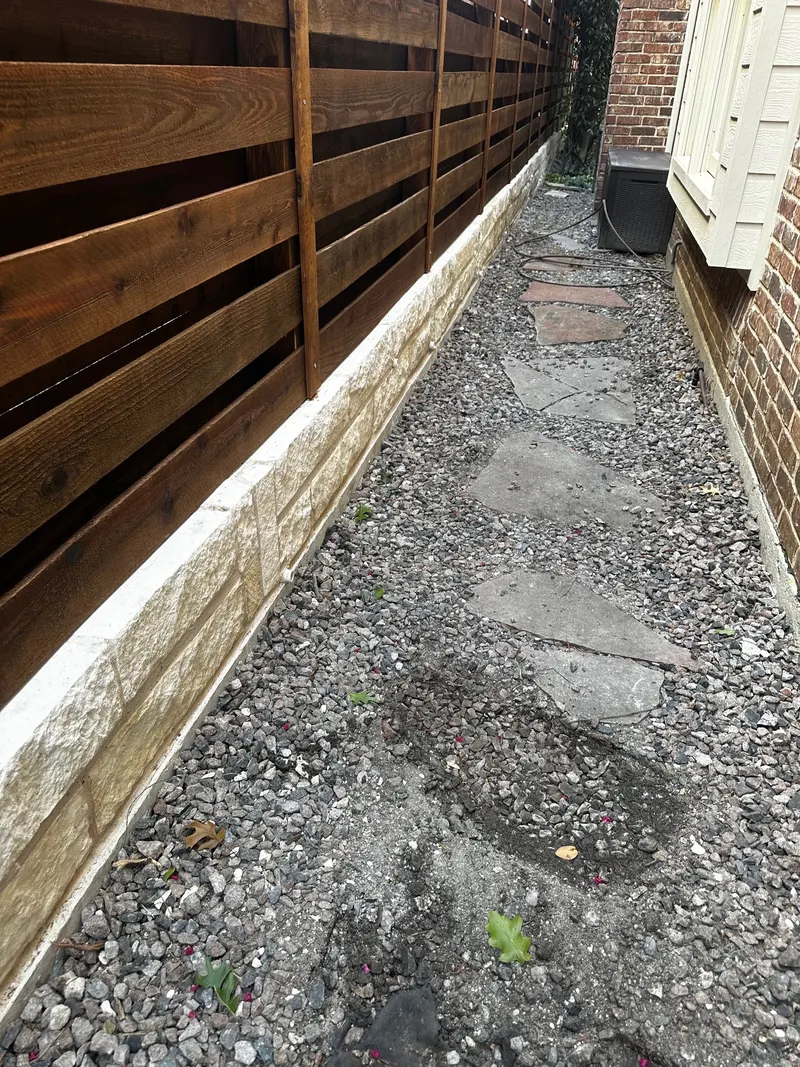
By shaping the bottom of the fence to the ground, not by pushing soil against the wood. Dirt piled on pickets rots them and reroutes water.
The usual tools are listed below. Frisco's ordinance is a useful guide to good practice here: it requires the bottom of a wood fence to be designed to prevent ground-to-wood contact and allows a treated kickboard, approved for ground contact, to cover the gap.
- Kickboard: A pressure-treated board along the base, stepped or angled with the grade. Our rot board guide explains why it protects the pickets.
- Scribed pickets: Each picket is cut to follow the ground while the top line stays straight.
- Shorter bays: Closer posts on the steep part of a run make each step smaller and each gap shorter.
- A low masonry or concrete base: A curb under the fence takes up sharp changes in grade and keeps wood dry.
Do I need a retaining wall before I build a fence on a slope?
Usually not. A fence can follow most residential slopes without changing the grade. A wall is needed when you want level ground on one side, when soil is already washing out, or when the drop at the line is too sharp for a fence to step.
If a wall is part of the plan, it comes first and it may need an engineer. Dallas asks for engineered plans for retaining walls. Plano requires an engineer's seal for retaining walls over four feet, measured from grade to the top. Frisco requires an engineered design above thirty-six inches and says no part of a retaining wall may interfere with or alter a drainage swale between lots.
A wall also moves water, so it needs its own drainage behind it. Plan the wall, the drain and the fence as one project. Our guide to working with an architect or landscape architect covers how those drawings fit together.
Can a fence cross a creek, a swale or a drainage ditch?
A shallow swale, usually yes, with an open bottom. A creek or mapped floodway, often no. The city decides, and the answer depends on what the plat calls that strip.
Frisco does not permit fences in floodway areas designated on the FEMA flood map. The Dallas fence checklist says designated floodplain areas may require additional approvals. If the low strip is a recorded drainage easement, the rules in our guide to fences on easements and alleys apply as well.
Where a crossing is allowed, open iron lets water and debris through where a solid fence would catch both. Posts are kept out of the flow line and set on the banks. Many owners stop the fence short of the creek and turn it along the top of the bank, which keeps the view and avoids the question.
A locate still comes first. Drain lines and utilities often share the low strip at the back of a lot, and our permits and 811 guide explains how the free locate is requested before any post hole is dug.
How is the height of a fence measured on a slope?
Each city has its own method, and on a slope the method can change the answer by a foot or more. Ask before the panels are ordered.
The Town of Highland Park's permit packet says the final inspection verifies that the fence does not exceed eight feet as measured above the non-owner's side. If your yard sits higher than the neighbor's, the fence looks shorter from your patio than the number the inspector records. Frisco allows a small average gap above natural grade for drainage and counts it in the measured height.
On a stepped fence the tallest point is at the low end of each panel, so that is where we check the limit. Our guide to fence height rules in Dallas and the Park Cities lists the limits by city, and privacy when height is limited covers what to do when the downhill neighbor still sees in.
How Park Cities Fence & Deck helps
Jack Johnson comes out himself, looks at your property and gives you a free written estimate with a timeline. Wood, iron and masonry are all built in-house, so the advice fits the property. Related services: wood fencing, iron / metal fencing.
Questions people ask next
Does a sloped yard make a fence more expensive?
Usually somewhat. A slope adds labor for stepping or scribing, longer pickets and posts on the low side, more kickboard, and sometimes closer post spacing. A retaining wall or drainage work is a separate cost that can outweigh the fence itself. The written estimate lists these items so you can see what the grade adds to your yard.
Can I fence across a drainage easement?
Not without checking with the city, and often not with a solid fence. A drainage easement exists to carry water, and Frisco's ordinance says a fence may not adversely affect drainage or create debris build-up. Where a fence is allowed, an open iron section or a raised bottom keeps the path clear. We confirm the rule before layout.
How much gap should be left under a fence?
Enough to keep wood off the soil and let water pass, and no more than your pets and your city allow. Frisco's ordinance, for example, counts a maximum of six inches, on average between posts, above natural grade for drainage as part of the fence height. On most yards a treated kickboard closes that space while the cedar pickets stay dry.
How do I keep rabbits, armadillos and snakes from getting under a fence?
Close the bottom and remove the reasons to dig. A treated kickboard set tight to grade stops most animals, and a buried barrier along the base stops diggers such as armadillos. Keep one opening where water must pass and screen it with mesh on the inside. No fence is fully snake-proof, so keep the base clear of brush and woodpiles.
How deep should fence posts be set in North Texas?
Deeper for taller fences, and deeper again on the low side of a slope. Frisco's ordinance sets a minimum concrete footing of twenty-four inches for wood fences under seven feet and thirty-six inches for fences seven feet or taller. Other cities leave depth to the builder. Our post depth guide explains how clay soil changes the answer.
Sources and further reading
- City of Frisco Code of Ordinances, Chapter 18, Article IX: Fences
- City of Dallas: Fence, Pool Barrier and Retaining Wall Permit Checklist (PDF)
- City of Plano: Residential Fence Permit Requirements (PDF)
- Town of Highland Park: Fence Permit Packet (PDF)
General information, not legal advice. Rules change: we confirm the current requirements with your city or HOA before we build.