
Iron & Masonry · Dallas, Texas
What Drives the Cost of a Custom Wrought Iron or Steel Fence in Dallas?
Metal, height, detail, finish, footings, columns, gates and access. What each one does to an iron fence estimate.
 By Jack Johnson, owner of Park Cities Fence & Deck · 9 min read · 1,692 words
In short
The cost of a custom iron or steel fence in Dallas is driven by the metal and its thickness, the height and length, how much custom fabrication the design needs, the finish system, the footings, any masonry columns, the gates and their automation, and how hard the site is to work on. Design detail and gates move the number most.
In this guide
- Which metal are you actually buying?
- How do height and length change the price?
- How much does design detail add?
- What does the finish system cost, and is it worth it?
- What is under the ground, and why does it matter here?
- What do masonry columns and gates do to the estimate?
- Which site conditions raise or lower the price?
- How do you compare two iron fence bids fairly?
Need this done? See iron / metal fencing.
Two iron fences of the same length can differ widely in price, and both prices can be fair. One is a standard flat-top panel bolted between steel posts. The other is solid stock, hand-welded on site to follow a slope, with scrollwork, cast finials and limestone columns. They share a material and almost nothing else.
We do not publish prices, because an honest number depends on your lot and your design. What we can do is show you exactly what an estimator looks at, so you can read any bid and see where the money goes. Our iron and metal fencing estimates are free and written, with each of these items spelled out.
Which metal are you actually buying?
Most “wrought iron” fences sold today are steel. True wrought iron is a historic material that is rarely produced now, and the name has stayed with the look. What you choose between in practice is custom-fabricated steel, manufactured ornamental steel panels, and aluminum. We explain the terms in wrought iron vs. ornamental steel.
Within steel, the question is how much metal. Solid square pickets are heavier and more rigid than hollow tube. Thicker rails resist sagging over long spans. Heavier posts hold a gate without racking. More steel means more material, more welding and more labor to set, and it is also what makes a fence feel substantial when you put a hand on it. Aluminum is lighter and does not rust, which suits some pool enclosures. The table below compares the three, and wrought iron, steel and aluminum compared goes deeper.
Three metal fence options and how each affects cost
| Option | What it is | Effect on cost |
|---|---|---|
| Manufactured ornamental steel | Factory-made panels in standard heights and styles | Lowest of the three for straight, level runs |
| Manufactured aluminum | Factory-made panels, lighter and rust-free | Similar to ornamental steel, varies by grade |
| Custom-fabricated steel | Cut and welded to your design and your grade | Higher, driven by shop and field labor |
| Custom steel with ornament | Scrolls, rings, cast finials, curved or arched tops | Highest, each detail adds fabrication hours |
| Solid stock instead of tube | Solid pickets and heavier rails and posts | Adds material weight and welding time |
What this means for you: Choose the metal for the look and stiffness you want first, because that single decision sets the range everything else is priced within.
How do height and length change the price?
Length is the obvious multiplier, but it is not a straight line. A long, simple run is efficient: materials are bought in quantity, the crew finds a rhythm, and setup is spread across more fence. A short run with three corners and two gates costs more per foot because the fixed work is the same and there is less fence to carry it.
Height matters more than people expect. A taller fence needs longer pickets, often an additional rail, heavier posts and deeper footings to resist wind and leverage. It can also move the project into a different permit category. The City of Dallas fence permit checklist requires a permit for fences over four feet in a front yard or over six feet elsewhere, and fences over nine feet need Board of Adjustment approval and engineer-sealed plans. See front-yard fence height in Preston Hollow and the Park Cities before you set a height.
How much does design detail add?
This is the largest swing in most custom estimates. A plain picket fence with a flat top rail is fast to fabricate. Every element beyond that is labor: spear or cast finials, rings between rails, scrolls, twisted pickets, a dog-proof bottom section with closer spacing, an arched or swept top line, or a pattern drawn to echo the home’s balcony railing.
Slopes add fabrication too. A manufactured panel can rack a limited amount to follow grade. Beyond that, panels have to step, which leaves triangular gaps, or be custom built so the pickets stay plumb while the rails follow the ground. On the rolling lots of Preston Hollow, custom fabrication is often the only way to get a clean line. Matching the fence to the architecture is covered in fence styles for Tudor, Georgian, Mediterranean and modern homes.
What does the finish system cost, and is it worth it?
Steel rusts, and North Texas gives it humidity, sprinkler overspray and hard sun. The finish is what stands between the steel and the weather, and there are levels of it. Primer and field-applied paint is the basic approach. Powder coating, where a dry powder is baked onto the metal, gives a harder and more uniform coat. Galvanizing puts a zinc layer on the steel before any color goes on.
The American Galvanizers Association describes galvanizing plus a paint or powder topcoat as a duplex system, and says the combination protects far better than either coating used alone. Each added layer adds cost up front and reduces repainting later. We compare the two color coats in powder coating vs. paint for an iron fence and cover upkeep in keeping an iron fence rust-free.
What is under the ground, and why does it matter here?
Dallas sits on expansive clay that swells when wet and shrinks when dry. A fence post set in a shallow footing moves with it, and an iron fence shows movement plainly because the top rail is a straight line. Proper footings go deep enough to reach below the most active soil, and they are sized for the height of the fence and the weight of any gate.
Footing cost also depends on what the auger hits. Rock, large tree roots, old concrete from a previous fence and buried irrigation all slow the work. Utility locates are requested before any digging, and private lines such as landscape lighting have to be found by hand. If your line runs under mature trees, read building a fence near mature trees, because root protection changes how posts are placed.
What do masonry columns and gates do to the estimate?
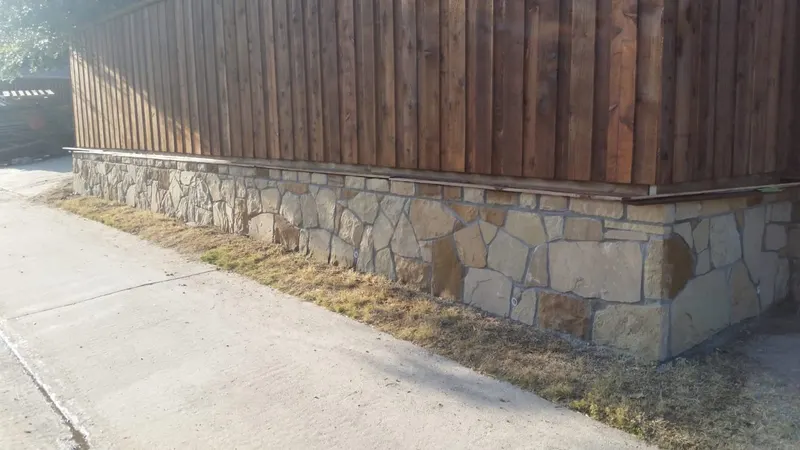
Columns change the character of an iron fence and its cost. Each brick or stone column needs its own reinforced footing, a masonry crew, material matched to the house and a cap. Spacing matters: columns at every panel cost far more than columns at corners, gates and long intervals. Our masonry fencing team builds the columns under the same contract so the ironwork fits between them without field modification.
Gates are the other major item. A walk gate needs a frame, hinges, a latch and often a closer. A driveway gate is a structure of its own, and automating it adds a motor, access controls such as keypads and remotes, safety sensors, and electrical supply to the gate location. A long slide gate needs a track or cantilever hardware and room to travel. We break this down in what drives automatic driveway gate cost.
Which site conditions raise or lower the price?
Estimators walk the lot before pricing because the site decides how long the crew will be there.
- Access: A narrow side yard or alley means materials are carried by hand and equipment may not fit.
- Removal: Taking out and hauling away an old fence, old footings or a failed wall is priced separately from the new work.
- Grade: Slopes and retaining conditions add fabrication and sometimes engineering.
- Landscaping: Working around established beds, irrigation and trees takes care and time.
- Permits and review: Surveys, engineered drawings for masonry and city or HOA review add steps before the build.
How do you compare two iron fence bids fairly?
Ask each company to write down the same things: picket size and whether it is solid or tube, rail and post sizes, post spacing, footing depth, the finish system by name, the gate hardware and operator model, and who handles the permit. If one bid is far lower, the difference is almost always in one of those lines. Thinner pickets, wider post spacing, shallower footings and a single coat of paint are invisible on installation day and obvious a few summers later.
Jack Johnson attends every consultation himself and reviews the workmanship and manufacturer warranty terms with you on the estimate. If you want to see how our numbers are built for your property in Dallas or the Park Cities, request a free written estimate or call (214) 755-8100.
How Park Cities Fence & Deck helps
Jack Johnson comes out himself, looks at your property and gives you a free written estimate with a timeline. Wood, iron and masonry are all built in-house, so the advice fits the property. Related services: iron / metal fencing, masonry fencing, gates & gate motors. We work in Dallas and Preston Hollow and across Dallas.
Questions people ask next
Is wrought iron more expensive than wood fencing?
Generally yes. A custom steel fence costs more than a cedar fence of the same length because of the material, fabrication and finishing involved. It also typically lasts longer with less upkeep when the finish is maintained. The right comparison is cost over the life of the fence, which we can walk through on your estimate.
Is aluminum cheaper than steel?
Manufactured aluminum and manufactured ornamental steel panels are often in a similar range, depending on grade and style. Aluminum does not rust, which lowers upkeep. Steel is stiffer and stronger, which matters for tall fences, long spans and gates. For a custom design, steel is usually the material fabricators work in.
Does powder coating add much to the cost?
It adds a modest amount compared with basic paint, and it is one of the better places to spend. A baked powder coat is harder and more even than brushed or sprayed paint, and it extends the time before the fence needs refinishing. We specify the finish system in writing on every iron estimate.
Can I lower the cost without losing the look?
Often, yes. Use custom ironwork on the street-facing elevation and a simpler matching panel on the sides. Space masonry columns at corners and gates instead of every panel. Keep the top line flat. Each choice reduces fabrication hours while the part of the fence people see stays fully detailed.
Why will you not give a price per foot online?
Because it would mislead you. A per-foot figure ignores gates, columns, slope, footings, finish and access, which together can outweigh the fence panels themselves. A site visit takes less than an hour and produces a written estimate you can rely on, at no charge.
Sources and further reading
- American Galvanizers Association: Duplex Systems
- City of Dallas Planning & Development: Fence Permit Checklist
General information, not legal advice. Rules change: we confirm the current requirements with your city or HOA before we build.