
Iron & Masonry · Dallas, Texas
Wrought Iron, Steel or Aluminum: Which Is Best for a Luxury Home in Dallas?
Three metals that look alike from the street and behave very differently over twenty Texas summers.
 By Jack Johnson, owner of Park Cities Fence & Deck · 9 min read · 1,810 words
In short
For most luxury homes in Dallas, powder-coated ornamental steel is the best all-around choice: it has the weight and presence of traditional wrought iron, carries wide driveway gates, and can be fabricated to any design. Aluminum wins near pools and irrigation because it does not rust. True hand-forged wrought iron is reserved for restoration and showpiece gates.
In this guide
- What do people actually mean by “wrought iron” today?
- How do the three metals compare side by side?
- Which metal holds up best in Dallas weather and clay soil?
- Which one looks right on a Park Cities or Preston Hollow estate?
- What about driveway gates and automation?
- Does the finish matter more than the metal?
- Are there pool or city rules that affect the choice?
- How do we recommend choosing?
Need this done? See iron / metal fencing.
From the sidewalk, a black metal fence is a black metal fence. Up close, and ten years later, the three metals part ways. One is heavy and can be welded into anything. One never rusts but flexes under load. One is mostly a name that people use for the other two.
This guide compares the three the way we do at a consultation in Highland Park or Preston Hollow: by how the fence will look against the house, what it has to carry, and how much upkeep the owner is willing to accept. If you want the short tour of our metal work first, see our iron and metal fencing page.
What do people actually mean by “wrought iron” today?
True wrought iron is a low-carbon iron that a blacksmith heats and hammers into shape. It is what the old fences around historic Dallas homes were made of, and it is rarely produced in volume now. Most of what is sold as wrought iron today is mild steel, cut, welded and finished to look the same.
That is not a trick. Modern ornamental steel is stronger and more consistent than the old material, and a skilled fabricator can add forged scrolls, collars, finials and hammered texture so it reads as hand work. We cover the terminology in more depth in wrought iron vs ornamental steel.
So the real decision for a new estate fence is usually between two metals, steel and aluminum, plus a question of how much hand-forged detail you want on the pieces people see up close, such as the walk gate and the driveway entrance.
How do the three metals compare side by side?
The table below is the summary we sketch on the estimate when a homeowner asks which metal to choose. None of the three is wrong. They are suited to different jobs, and many estates end up with two of them on the same property.
Wrought iron, ornamental steel and aluminum at a glance
| What matters | Hand-forged wrought iron | Ornamental steel | Aluminum |
|---|---|---|---|
| Look and presence | Heaviest, most traditional, visible hand work | Heavy and solid, any custom design | Lighter profile, clean and simple |
| Strength | Very strong | Strongest for the size | Adequate for fencing, flexes more |
| Rust | Rusts if the finish fails | Rusts if the finish fails | Does not rust |
| Custom design | Unlimited, slow to produce | Unlimited, practical to produce | Mostly standard panels and profiles |
| Wide driveway gates | Yes, very heavy | Yes, the usual choice | Only in smaller, lighter gates |
| Upkeep | Regular inspection and touch-up | Occasional touch-up of chips | Rinse and leave alone |
What this means for you: If the fence has to make a statement or carry a large gate, steel is the working answer; if it sits beside water and you never want to think about it, aluminum earns its place.
Which metal holds up best in Dallas weather and clay soil?
North Texas is hard on metal fences in two ways. Sprinklers and summer humidity attack the finish at the bottom rail, and the clay under the fence swells when wet and shrinks when dry. A fence that survives here has a sound coating and posts set deep enough to ride out that movement.
Aluminum has the easy answer to the first problem because it cannot rust. Steel answers it with coatings. The American Galvanizers Association describes the combination of galvanizing with a paint or powder coat as a duplex system, and reports that the two layers together last longer than the sum of what each would last alone. In plain terms, zinc under the color keeps a chip from turning into a rust bloom.
On the second problem, steel has the advantage. Heavier posts and welded panels resist racking when the ground shifts, and a steel fence that leans can usually be reset and re-welded on site. Aluminum panels are assembled with brackets and fasteners, which makes them quick to install and less forgiving on long runs across moving ground. Our guide to keeping an iron fence rust-free covers the upkeep side.
Which one looks right on a Park Cities or Preston Hollow estate?
Scale decides this more than the metal itself. A large house on a deep lot needs a fence with visual weight: thicker pickets, taller posts, a real top rail. Steel delivers that without looking forced. Aluminum profiles are slimmer, and on a big frontage they can read as a builder-grade fence in front of a custom home.
Detail is the second factor. Tudor and Georgian homes carry forged details well, while modern homes want plain square bar with no ornament at all. Both are steel jobs. We match the pattern to the architecture in fence styles for Tudor, Georgian, Mediterranean and modern homes.
Where the fence meets brick or stone columns, steel is also easier to work with. Panels are measured and welded to fit between columns that are never perfectly even, so the spacing looks deliberate. Owner Jack Johnson built custom homes in Preston Hollow before he built fences, and this is the detail he checks first on a walkthrough.
What about driveway gates and automation?
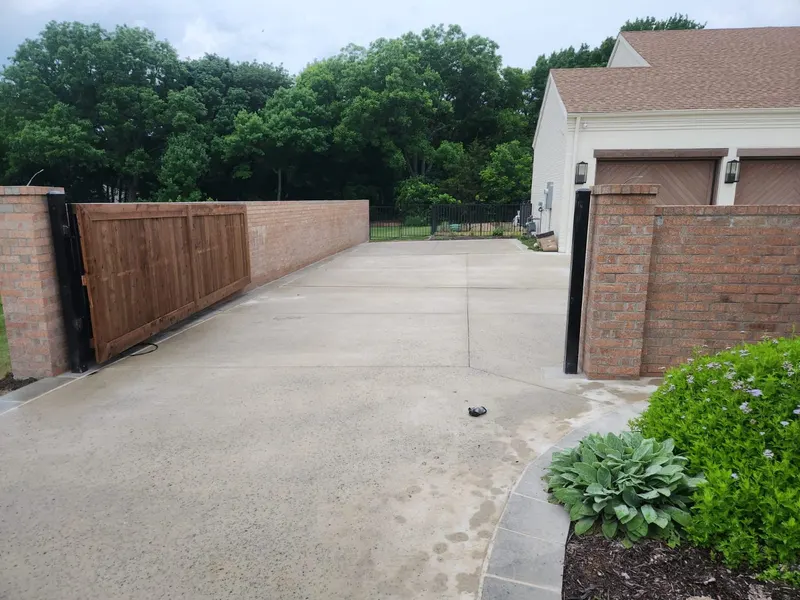
A driveway gate is a moving structure, and it is where the difference between the metals is easiest to see. A wide swing gate hangs its whole weight from the hinge side. A slide gate rides on rollers and has to stay straight over its full length. Steel frames hold their shape under those loads year after year.
Aluminum gates have a real use: a lighter gate is easier on a motor and on hinges, and for a modest single-car opening it can be the sensible choice. For the wide, tall, ornamented entrances common in Preston Hollow, we build in steel and size the operator to suit.
Either way, the gate, the motor, the keypad and the safety sensors should be designed together. Our automatic gate page explains the equipment, and driveway gate security features walks through the access options.
Does the finish matter more than the metal?
Often, yes. A well-coated steel fence will outlast a poorly coated one by a wide margin, and a rusty fence has nearly always failed at the finish first, not the metal. The questions to ask are how the steel is prepared, whether it is galvanized or primed with zinc, and whether the color coat is baked-on powder or brushed paint.
Powder coating is applied as a dry powder and cured in an oven, which gives a harder, more even film than paint applied in the yard. Our fences use powder-coated ornamental steel and aluminum for that reason. The trade-offs are covered in powder coating vs paint.
Color is less of a decision than people expect. Black and dark bronze suit nearly every house, hide dust, and let the landscaping show through. Gloss level matters more: a satin or matte black looks richer and older than a high gloss.
Are there pool or city rules that affect the choice?
Rules rarely dictate the metal, but they do dictate the design. As one local example, the Town of Highland Park’s fence permit packet lists a pool fence at a minimum of 48 inches high, with self-closing and self-latching gates and openings of no more than four inches. Picket spacing and gate hardware have to be designed around numbers like those from the start.
The City of Dallas requires a permit for pool barriers and for fences above certain heights, and other cities have their own versions. This is general information, not legal advice. We confirm the current rule with your city and your HOA before fabrication, and our Dallas pool fence code guide explains the typical requirements.
Around a pool, aluminum or galvanized and powder-coated steel are both sound. The deciding factor is usually whether the pool fence should match the perimeter fence exactly. If it should, we build both in the same material and pattern.
How do we recommend choosing?
Start with the hardest job the fence has to do. If that is carrying an automated gate, spanning between masonry columns or matching a period home, choose steel and spend the effort on the coating. If it is enclosing a pool or a side yard that gets wet every morning, aluminum is a fair answer. If it is restoring an original fence on a historic property, forged iron repairs are worth it.
Jack attends every consultation and can show you finished examples of each in our gallery. Estimates are free and written, with the metal, the coating and the footing detail spelled out line by line. Request yours or call (214) 755-8100.
- Choose ornamental steel when: the fence fronts the house, carries a driveway gate, sits between columns or needs a custom pattern.
- Choose aluminum when: the fence surrounds a pool, runs through heavy irrigation, or you want the least upkeep possible.
- Choose forged iron when: you are restoring original ironwork or want a single showpiece gate made by hand.
How Park Cities Fence & Deck helps
Jack Johnson comes out himself, looks at your property and gives you a free written estimate with a timeline. Wood, iron and masonry are all built in-house, so the advice fits the property. Related services: iron / metal fencing, gates & gate motors, masonry fencing. We work in Highland Park and Preston Hollow and across Dallas.
Questions people ask next
Is aluminum fencing strong enough for a large dog?
For most dogs, yes, provided the picket spacing suits the animal and the panels are a heavier residential or commercial grade. A powerful dog that jumps against the fence repeatedly is harder on bracketed aluminum panels than on welded steel. If containment is the main purpose, we usually recommend steel with closer picket spacing and discuss the dog at the consultation.
Will a powder-coated steel fence rust in Dallas?
It can if the coating is breached and left alone. A string trimmer nick or a scrape from a delivery truck exposes bare metal, and sprinklers do the rest. Steel that is galvanized or zinc-primed under the powder coat resists this far better. Check the fence once a year and touch up chips promptly, and rust stays a minor issue.
Can you match a new steel fence to my existing wrought iron?
In most cases, yes. We measure the picket size, spacing, rail profile and finial pattern of the existing fence and fabricate new sections to match. Older ironwork often has details that are no longer stock items, so those pieces are made to order. A fresh coat on the old sections helps old and new read as one fence.
Which metal fence needs the least maintenance?
Aluminum. It does not rust, so upkeep is limited to rinsing off dust and checking gate hardware. Powder-coated steel is close behind when the finish is sound and chips are touched up. Hand-forged iron with a painted finish needs the most attention, with regular inspection of joints and scrollwork where water sits.
Do you build combination fences with metal and masonry?
Yes. Steel panels between brick or stone columns are a classic estate fence, and the columns can be matched to the house. The metal is fabricated to the measured openings so each bay fits. We also build combination walls with a low masonry base and iron above it.
Sources and further reading
- American Galvanizers Association: Duplex Systems, Paint or Powder Coating Over Hot-Dip Galvanizing
- Town of Highland Park: Fence Permit Packet
- City of Dallas: Fence Permit, Pool Barrier and Retaining Wall Checklist
General information, not legal advice. Rules change: we confirm the current requirements with your city or HOA before we build.