Iron & Masonry · Dallas, Texas
What Is the Best Fence to Keep Large Dogs In Without Blocking the View?
A see-through fence can hold a big dog if the height, picket spacing, bottom edge and gates are designed for it.
 By Jack Johnson, owner of Park Cities Fence & Deck · 8 min read · 1,947 words
In short
For most Dallas homes the best see-through fence for a large dog is powder-coated ornamental steel or wrought iron: welded pickets spaced tightly, a height matched to the dog, a bottom rail close to the ground and posts set in concrete. It keeps the view open and gives a strong dog nothing to chew, climb or push through.
In this guide
- What makes a fence hold a large dog?
- Which fence types keep the view open?
- How tall should the fence be for a big dog?
- How do you stop a dog from digging under or squeezing through?
- Will my dog bark more with a fence it can see through?
- What should the gates have?
- How long will an iron dog fence last in North Texas?
- How do we design one for your yard?
Need this done? See iron / metal fencing.
A solid cedar fence will hold almost any dog, but it also hides the creek, the golf course, the garden or the street you bought the house to look at. The good news is that you do not have to choose. A fence can be open to the eye and closed to a ninety-pound dog, as long as four details are right: height, the gap between pickets, the bottom edge and the gates.
This guide covers each of those details, compares the open fence types we build, and is honest about the one thing an open fence cannot fix, which is a dog that barks at everything it can see. If you want to start with the material itself, our iron and metal fencing page shows the styles.
What makes a fence hold a large dog?
Large dogs get out in four ways: over the top, under the bottom, through a gap or through a gate that did not latch. A fence that looks strong can still fail on any one of them.
Strength matters too. A big dog that hits a fence at a run, or leans on it every time the mail carrier walks by, puts real load on the posts. Posts set in concrete and welded panels handle that for years. Light panels held together with small screws loosen, rattle and eventually open up.
- Over: Height matched to the dog, with no horizontal rails placed where they work as a ladder.
- Under: A bottom rail that follows the grade closely, plus a dig guard where the dog likes to dig.
- Through: Picket spacing tighter than the dog’s head and chest, including at the posts and gates.
- Gates: Self-closing hinges and a latch a dog cannot nose open.
Which fence types keep the view open?
Ornamental steel and wrought iron are the standard answer because the pickets are thin and dark. From a few steps back the eye reads straight through them, and a black or dark bronze powder coat disappears against planting faster than any lighter color. Aluminum looks similar and never rusts, but it is a lighter material. Our comparison of wrought iron, steel and aluminum explains where each one belongs.
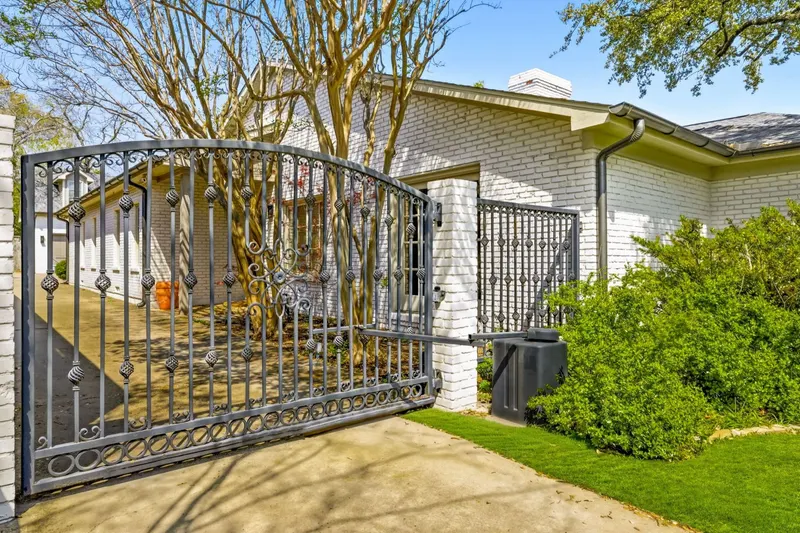
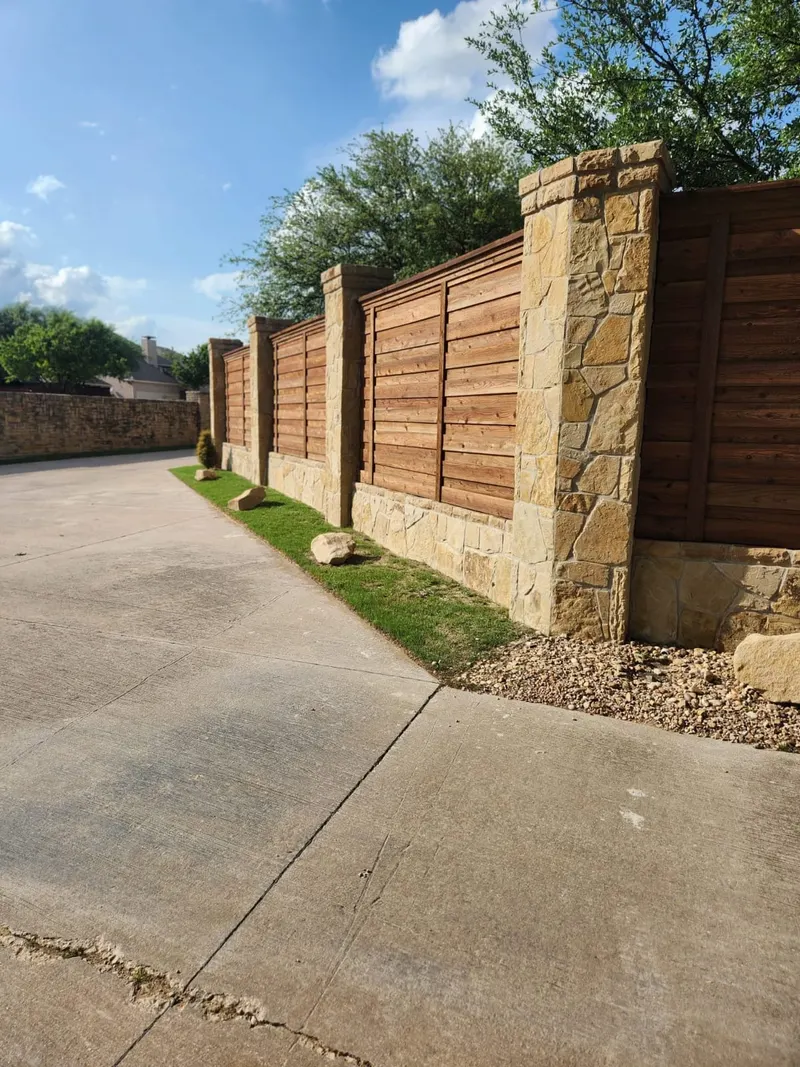
For estates, iron panels set between brick or stone columns, sometimes on a low masonry curb, give the same open view with more presence and a built-in barrier against digging. Wood can be partly open as well. A cedar fence with a lattice topper or a spaced-picket design lets light and air through, though it screens far more of the view than iron does.
Open and semi-open fence types for homes with large dogs
| Fence type | View through the fence | How it holds a large dog |
|---|---|---|
| Ornamental steel or wrought iron | Almost fully open | Very strong; welded pickets, nothing to chew or climb |
| Aluminum | Almost fully open | Fine for calm dogs; lighter panels can flex under a hard charger |
| Iron between masonry columns on a low curb | Open above the curb | Strongest option; the curb also stops digging |
| Cedar with a lattice topper | Filtered at the top only | Solid and secure; the dog sees less, so many bark less |
| Spaced cedar picket | Partly open | Good for medium dogs; a determined chewer can damage boards |
What this means for you: If the view is the priority and the dog is strong, steel or iron is the safe choice, and masonry is the upgrade when digging is the problem.
How tall should the fence be for a big dog?
It depends on the dog more than the breed chart. Many large dogs never test a fence that reaches an adult’s chest. Athletic jumpers and climbers are different, and for them height is the first line of defense. Tell us honestly how your dog behaves, because a fence sized for a calm Great Dane will not hold a young Malinois.
Height is also where city rules come in. The City of Dallas requires a fence permit for fences over 4 feet in a front yard or over 6 feet anywhere else, and lists 9 feet as the maximum allowable height. The Town of Highland Park does not allow a fence in the required front yard setback and verifies at final inspection that the fence does not exceed 8 feet measured from the non-owner’s side. Other cities and HOAs set their own limits, so we confirm the rule for your lot before we draw anything. Our guide to fence height rules in Dallas and the Park Cities goes deeper.
Design can add security without adding height. Flat-top panels with no mid-rail give paws nothing to grip. Keeping planters, benches, air conditioning units and firewood away from the fence removes the launch pads that turn a five-foot fence into a three-foot one.
How do you stop a dog from digging under or squeezing through?
Start with picket spacing. Standard ornamental panels are spaced for people, not for a slim dog with a narrow head, and a young dog fits through gaps that surprise its owners. Where that is a concern we tighten the spacing across the whole panel or add shorter intermediate pickets along the lower section, often called puppy pickets, so the bottom third of the fence is twice as dense while the top stays open.
Then the bottom edge. On a sloped yard, panels that step down in stair fashion leave triangular gaps at the low end of every step. We rack the panels to follow the grade where the slope allows, and close the remaining gaps with a concrete mow strip or a low masonry curb. A curb built as part of a brick or stone fence is the most permanent dig guard there is.
Do not forget the hinge side of the gate and the space between the last picket and the house wall. Those two spots are where we most often find the gap the dog already found.
Will my dog bark more with a fence it can see through?
Possibly, and it is better to know before you build. Some dogs relax when they can see what is making a noise. Others treat every jogger, squirrel and delivery truck as a job. If your dog is already reactive at the front window, a fully open fence along a busy sidewalk will give it more to react to.
The usual fix is a mixed design. Keep the open iron where the view is, facing the creek, the greenbelt or the back of the lot, and use a solid material along the side that faces foot traffic or a neighbor’s dog. Planting helps too. A hedge or a row of hollies in front of the iron softens what the dog sees without closing the view from the house. We cover the options in how to add privacy to an iron fence.
What should the gates have?
Most dog escapes we hear about involve a gate, not the fence. Walk gates should close and latch on their own, with the latch on the inside or high enough that a standing dog cannot work it. If landscapers use the gate every week, a self-closing hinge is worth far more than a reminder note.
Driveways are the harder case. A dog loose in the yard while cars come and go needs either a second, inner fence line or an automatic driveway gate that closes behind every vehicle. Be aware that the photo-eyes and edge sensors on a gate motor are there to protect people and cars. They are not designed to keep a dog from slipping through while the gate is moving, so the timing of the close cycle and the picket spacing on the gate itself both need thought.
If the same fence encloses a pool, the gate hardware has a second job. Pool barrier rules cover gate latches and openings, and they are stricter than anything a dog requires. See our Dallas pool fence code guide.
How long will an iron dog fence last in North Texas?
A powder-coated steel fence handles Texas sun far better than a painted one, and dogs do not shorten its life the way they do with wood. There is nothing to chew and nothing for claws to splinter. The weak points are the places where the coating gets chipped: the bottom rail where a string trimmer hits it, and the gate latch area. Touching up chips when they appear keeps rust from starting. Our iron fence rust maintenance guide lists the short routine.
The posts matter as much as the panels. North Texas clay swells and shrinks with the seasons, and a fence that a big dog leans on every day needs footings deep enough to stay plumb through that movement. We set posts in concrete and size the footing for the fence height and the soil on your lot.
How do we design one for your yard?
Owner Jack Johnson attends every consultation himself. He walks the line with you, asks how the dog behaves, looks at the slope, the gates and the view you want to keep, and then prices the fence in a free written estimate. Homes in Preston Hollow and Highland Park often end up with iron and masonry on the visible sides and cedar where privacy matters more.
If you already have an iron fence and a new dog is getting through it, a full replacement is rarely needed. Added pickets, a curb along the dig spots and better gate hardware usually solve it. Call (214) 755-8100 or request a free estimate and tell us about the dog. It changes the design more than people expect.
How Park Cities Fence & Deck helps
Jack Johnson comes out himself, looks at your property and gives you a free written estimate with a timeline. Wood, iron and masonry are all built in-house, so the advice fits the property. Related services: iron / metal fencing, masonry fencing, gates & gate motors. We work in Preston Hollow and Highland Park and across Dallas.
Questions people ask next
Is aluminum fence strong enough for a large dog?
For a calm dog that respects a boundary, yes. Aluminum will not rust and looks very close to steel. It is a lighter material, though, so a heavy dog that charges or leans on the fence every day can flex the panels and loosen connections over time. For strong, athletic or reactive dogs we recommend welded ornamental steel with posts set in concrete.
What are puppy pickets?
Puppy pickets are shorter extra pickets welded between the full-height pickets along the lower part of an iron or steel panel. They cut the gap in half near the ground, where a dog would push through, while the upper part of the fence stays open. They can be built into a new fence or added to many existing fences.
Can my dog still dig under an iron fence?
It can if the bottom rail sits high or the ground is soft. The reliable fixes are a bottom rail that follows the grade closely, a concrete mow strip under the fence line, or a low brick or stone curb with the iron set on top. We look at where your dog digs now and reinforce those runs first.
Do I need a permit for a taller dog fence in Dallas?
The City of Dallas requires a fence permit for fences over 4 feet in a front yard or over 6 feet elsewhere. Highland Park, University Park and the suburbs have their own rules, and HOAs often add limits on height and material. This is general information. We confirm the rule for your address with the city and handle the permit as part of the job.
Can you add dog-proofing to the fence I already have?
Often, yes. We can weld in additional pickets, close gaps at posts and gates, pour a mow strip or build a curb along problem areas, and replace gate hinges and latches with self-closing hardware. If the posts are sound and the panels are straight, upgrading is usually far less work than replacing the fence.
Sources and further reading
- City of Dallas Planning & Development: Fence Permit Checklist
- Town of Highland Park: Fence Permit Packet
- DASMA: Gate System Safety guide (UL 325 and ASTM F2200)
General information, not legal advice. Rules change: we confirm the current requirements with your city or HOA before we build.