Planning · Dallas, Texas
Can a Fence Be Built Near Large Old Trees Without Damaging Their Roots?
Yes, if the posts are placed around the roots instead of through them and the crew keeps weight off the root zone.
 By Jack Johnson, owner of Park Cities Fence & Deck · 8 min read · 1,923 words
In short
Yes. A fence can be built close to large old trees when the builder plans around the roots: individual post holes instead of a continuous trench, holes dug by hand near the trunk, posts shifted to miss large roots, and equipment and materials kept off the root zone. The roots to protect are shallow and spread well past the branches.
In this guide
- Why are fence posts a risk to tree roots?
- How close to a tree is too close?
- Which fence construction does the least damage?
- What happens when a big root is exactly where a post should go?
- Do oaks need special care because of oak wilt?
- What if the trunk itself is on the fence line?
- How do we protect trees during the build?
- Do city rules protect trees on a fence project?
Need this done? See wood fencing.
The live oaks, pecans and red oaks on older Dallas lots are worth more to a property than any fence, and they take decades to replace. They are also right where fences need to go: along the back line, at the corner, beside the driveway. A careless crew can do damage in an afternoon that does not show for years.
A fence is one of the gentler things you can build near a tree, because it touches the ground only at the posts. This guide explains where the roots are, which building methods protect them and what we do when a root or a trunk sits exactly on the line. For the rest of the yard, see protecting landscaping during fence installation.
Why are fence posts a risk to tree roots?
Most people picture tree roots going straight down like a mirror of the branches. They do not. Colorado State University Extension describes a shallow, wide-spreading root plate that reaches beyond the dripline, the edge of the branches, and stays close to the surface. That is the same layer of soil a fence post goes through.
Clemson University’s extension service names three main causes of construction damage to trees: soil compaction, grade changes and root severing. A fence project can cause the first and third. Post holes cut roots, and trucks, pallets of lumber and wheelbarrows of concrete compact the soil over them. Compaction cuts off the air and water roots need.
The trouble is the delay. Clemson notes that compaction damage develops slowly and may take several years to become visible. A tree can look fine at the final walkthrough and begin thinning at the top three summers later, long after anyone connects it to the fence.
How close to a tree is too close?
Arborists work with a protected root zone. Colorado State’s guidance defines it as the area beneath the dripline, while noting that roots extend past it, and offers a trunk-based rule of thumb: the radius of the zone in feet is about one and a half times the trunk diameter in inches. For a mature live oak, that circle covers a large part of a typical back yard.
A fence cannot always stay out of that zone, and it does not have to. The goal is to disturb as little of it as possible. The same guidance points out that impacts add up, and that a tree may tolerate root cuts on one side but not on all sides. A row of post holes along one edge of the root zone is a very different thing from a trench, a new patio and a pool on the other three.
So the question is less about a fixed distance and more about what else has happened to the tree. If it has already lost roots to a driveway, an addition or utility work, tell us. We will be more conservative, and on a valuable tree we recommend having a certified arborist look at the plan before we dig.
Which fence construction does the least damage?
Anything built on separate posts is far kinder to roots than anything built on a continuous footing. A standard brick or stone wall needs a trench, and a trench across a root zone cuts every root in its path. Clemson’s guidance suggests posts and pillars in place of footers and walls for exactly that reason.
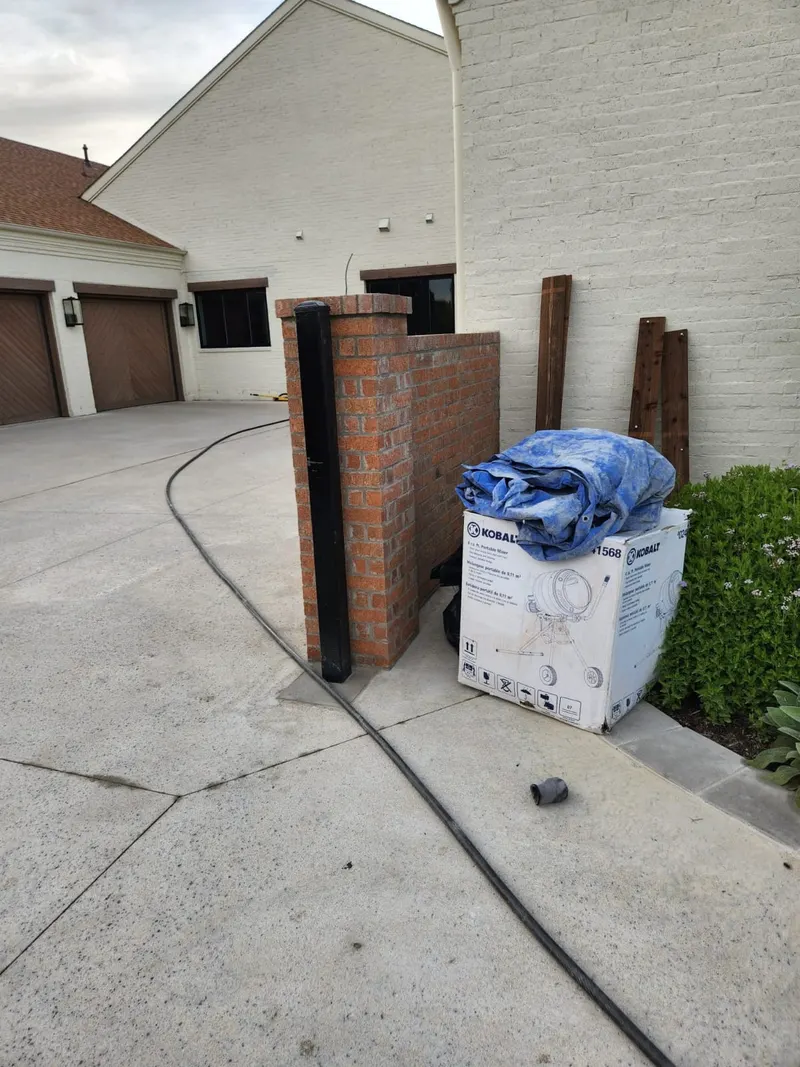
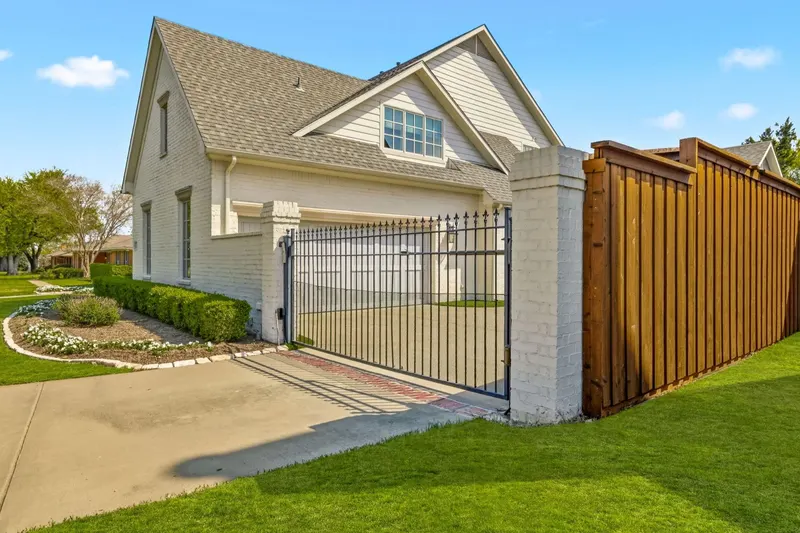
When a client wants masonry near a tree, we change the structure instead of giving up the look: columns on individual piers with iron panels or cedar spanning between them, or a wall carried on a beam that bridges from pier to pier above the roots. Our guide to planning a brick or stone fence wall explains footings in more depth.
Fence construction methods near mature trees
| Method | Effect on roots | When we use it |
|---|---|---|
| Hand-dug post holes | Lowest; roots can be seen and avoided before they are cut | Any post inside the canopy of a tree worth keeping |
| Adjusted post spacing | Avoids large roots entirely by moving the post | Whenever a hole lands on a major root |
| Longer span over a root | No digging at the root; a framed panel bridges the gap | At the root flare or where roots run along the surface |
| Masonry columns on piers with iron or cedar between | Limited to the pier locations | Estate fence lines that pass under large trees |
| Continuous trenched footing | Highest; severs every root crossing the trench | Only outside root zones |
What this means for you: The closer the fence comes to the trunk, the more it should be built from individual posts or piers that can be placed between roots.
What happens when a big root is exactly where a post should go?
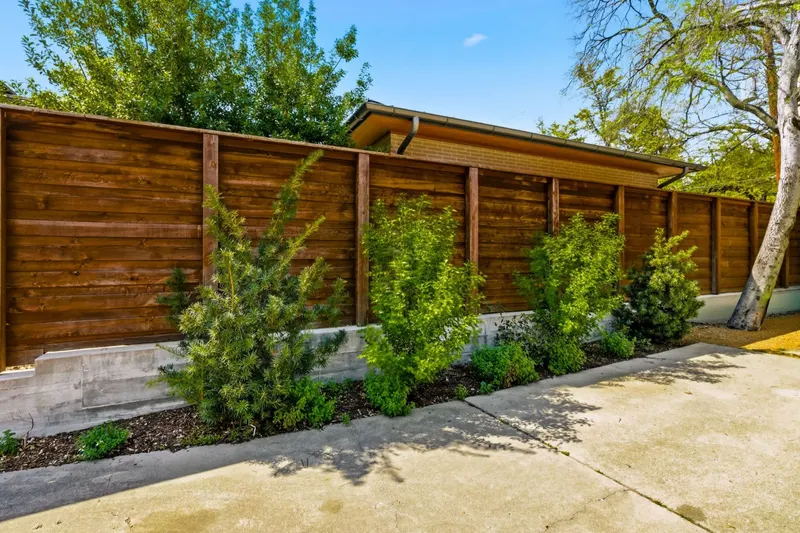
We move the post. Fence panels do not have to be identical in width, and shifting a post a foot in either direction is invisible in a finished cedar fence. With iron, we can fabricate a custom-width panel. The fence adapts; the root stays.
Near the trunk we dig by hand so roots are found with a shovel, not a power auger. An auger does not stop at a root. A person does. Colorado State’s guidance also mentions hand digging or an air spade as ways to locate roots before work begins.
If a small root has to be cut, a clean cut with a sharp saw is better than a torn one. We do not cut large structural roots close to the trunk to make a fence line straight. If the only path for the fence requires that, we stop and talk to you about a jog in the line or an arborist’s opinion.
Do oaks need special care because of oak wilt?
Yes, and it matters in Dallas, where live oaks and red oaks define many streets. Texas A&M Forest Service lists construction among the sources of wounds that can let the oak wilt fungus in, because fresh wounds attract the insects that carry it. The agency advises against pruning or wounding oaks from February through June and recommends painting fresh wounds right away at any time of year.
For a fence project, that affects two things. Low limbs that hang over the fence line sometimes need to be lifted for the crew to work, and that pruning should be timed and sealed properly, ideally by a tree service. And any accidental scrape to a trunk or exposed root flare during the build should be painted immediately, not left for later.
The same source notes that live oaks can pass the disease from tree to tree through connected roots. That is one more reason to treat a group of oaks along a fence line as a single system and keep cutting to a minimum.
What if the trunk itself is on the fence line?
It happens on almost every older lot. There are three sound options. The fence can jog around the tree, leaving it fully on one side. It can stop short on both sides with a framed gap sized for the trunk plus room to grow. Or a short removable panel can close the gap for pets while keeping wood and fasteners off the bark.
What we will not do is nail, screw or wire a fence to a living tree, or pour concrete against the trunk. The tree grows around the hardware, the wound never closes properly, and the fence is pulled out of line as the trunk expands.
If the tree sits on or near the property line, ownership and responsibility can be shared, and it is worth a conversation with the neighbor before work starts. Our article on shared fences in Texas covers the etiquette. This is general information, not legal advice.
How do we protect trees during the build?
Most protection is logistics. Before the first delivery we decide where materials will be stacked, where concrete will be mixed and which way the crew will walk, and we keep all three away from the canopies of the trees that matter. Clemson suggests spreading several inches of wood chips over the root zone where traffic cannot be avoided, and we use mulch or plywood paths on tight sites.
Concrete wash water and leftover mix never go at the base of a tree. Excavated clay from the post holes is hauled off or spread elsewhere, not piled against the trunk, because changing the soil level over roots is one of the three causes of damage named above.
Colorado State recommends watering trees before and after root disturbance. In a North Texas summer we ask owners to give affected trees a slow, deep soak in the weeks around the build. It is a small step that helps a stressed tree recover.
Do city rules protect trees on a fence project?
Some cities and towns regulate the removal of protected trees or work around street and parkway trees, and the rules differ between Dallas, Highland Park, University Park and the suburbs. Homeowners associations sometimes add their own tree rules. A fence built around a tree rarely triggers them, but removing a tree to make way for a fence might. We confirm the requirement with your city before the build, alongside the permit and utility locates.
Owner Jack Johnson attends every consultation and walks the fence line with you, tree by tree. If you are working with a landscape architect, we coordinate with their plan; see fence design with an architect or landscape architect. Call (214) 755-8100 or request a free written estimate.
How Park Cities Fence & Deck helps
Jack Johnson comes out himself, looks at your property and gives you a free written estimate with a timeline. Wood, iron and masonry are all built in-house, so the advice fits the property. Related services: wood fencing, masonry fencing, iron / metal fencing. We work in Highland Park and University Park and across Dallas.
Questions people ask next
Will digging fence post holes kill my tree?
A handful of carefully placed post holes rarely harms a healthy mature tree. The risk rises when many roots are cut close to the trunk, when a trench is dug instead of individual holes, or when heavy traffic compacts the soil. Hand digging near the trunk and moving posts off large roots keeps the impact small.
Can you build a brick or stone wall next to a large tree?
Not on a standard trenched footing without cutting roots. The better approach near a tree is masonry columns on individual piers with iron or cedar panels between them, or a wall carried on a beam that spans from pier to pier. You keep the masonry look and the tree keeps its roots.
Should I hire an arborist before building a fence near old trees?
For an especially valuable tree, a tree that is already stressed, or a fence that must pass very close to the trunk, yes. A certified arborist can mark the roots that matter and advise on pruning and aftercare. We are fence builders, not arborists, and we are glad to work from an arborist’s recommendations.
How soon would I see damage if roots were harmed?
Often not for a long time. University extension guidance notes that damage from soil compaction develops slowly and can take several years to show. Signs include thinning at the top of the canopy, smaller or off-color leaves and dead branch tips. That delay is why prevention during the build matters so much.
Can the fence be attached to the tree to close the gap?
No. Fasteners in a living trunk create permanent wounds, and the growing tree will push the fence out of line. We frame the fence to stop short of the trunk with room for growth, or route the fence around the tree. A removable panel can close the gap for pets without touching the bark.
Sources and further reading
- Colorado State University Extension: Tree Preservation During Construction
- Clemson Cooperative Extension: Protecting Trees During Construction
- Texas A&M Forest Service: Prevent the spread of oak wilt in Texas this spring
General information, not legal advice. Rules change: we confirm the current requirements with your city or HOA before we build.