Planning · Dallas, Texas
What Is the Best Fence for Home Security?
A security fence works when it is hard to climb, hard to hide behind and closed by a gate that locks every time.
 By Jack Johnson, owner of Park Cities Fence & Deck · 9 min read · 1,889 words
In short
The best fence for home security is one that is hard to climb, gives an intruder nowhere to hide and is closed by a gate that latches and locks every time. For most Dallas homes that means powder-coated ornamental steel on the sides people can see, tall cedar where privacy matters, and self-closing, lockable gates.
In this guide
- Is a privacy fence or a see-through fence better at deterring burglars?
- How tall should a security fence be?
- Are spikes, barbed wire or electric fences legal on a home in Dallas?
- What makes a fence hard to climb?
- What locks work best on backyard gates?
- Do cameras and lighting along a fence line improve security?
- How should you plan a security fence for your own lot?
Need this done? See iron / metal fencing.
A fence does not stop a determined person. What it does is add time, noise and exposure, and those three things are what make a house a poor target. The right design depends on which of them your lot is missing: a corner lot with an open side yard has a different weak point than a house that backs onto an alley.
This guide explains how each fence type performs, what height does and does not buy you, what the City of Dallas allows on a residential lot, and why the gate matters more than the fence. It is general information, not legal advice, and we confirm the current city rule for your address before we build. If you are still choosing a contractor, start with our guide to choosing a fence company in Dallas.
Is a privacy fence or a see-through fence better at deterring burglars?
Neither wins everywhere. A see-through fence keeps an intruder in view of the street and the neighbors, and a solid fence hides what you own but also hides anyone who gets over it. The usual answer on a Dallas lot is both: open metal where the public can see, solid wood where they cannot.
Along a front or side street, ornamental steel or aluminum fencing leaves sight lines open, so anyone working on a window or a gate is doing it in plain view. Along a back line that faces another yard, a board-on-board cedar fence stops people from seeing whether you are home, what is on the patio and where the dog is. We do not quote crime statistics for either choice, because no fence style comes with a guarantee.
If you already own an iron fence and want more screening without losing the open look, there are ways to add privacy to an iron fence with plantings or partial panels. The point is to decide, side by side, whether that stretch needs to be watched or needs to be hidden.
How tall should a security fence be?
Tall enough that getting over it takes effort and attention, and no taller than the city and your HOA allow. On most Dallas lots that means building to the permitted height in the side and rear yards and keeping the front yard low and open.
The City of Dallas fence standards we read set the outer limits. A fence in a required yard may not stand more than nine feet above grade, and in single-family districts a fence in the required front yard may not exceed four feet. A fence panel that is less than 50 percent open may not sit closer than five feet to the front lot line. The Board of Adjustment may grant a special exception when it finds that neighboring property will not be harmed.
Height is only one part of the picture. A six foot fence with a handy trash cart, a low wall or a utility box beside it is easier to cross than a lower fence with nothing to step on. Our guide to fence height rules in Dallas and the Park Cities covers the limits by city, and we check deed restrictions as well, because many are lower than the city number.
Are spikes, barbed wire or electric fences legal on a home in Dallas?
Barbed wire and razor ribbon are not allowed on a home in Dallas. The city's fence standards prohibit both in residential districts other than the agricultural district. The same ordinance prohibits sheet metal, corrugated metal, fiberglass panels and plywood as fence materials.
The Dallas ordinance we read does not address electrically charged fences or decorative spear points by name, so we do not state a rule for them here. We confirm both with the city before we draw anything. Rules differ from city to city. Frisco, for example, prohibits electrically charged fences in residential districts, with an exception for a low-voltage pet wire inside the yard, and it bans fences with barbs, projections or broken glass that could reasonably injure a person or an animal.
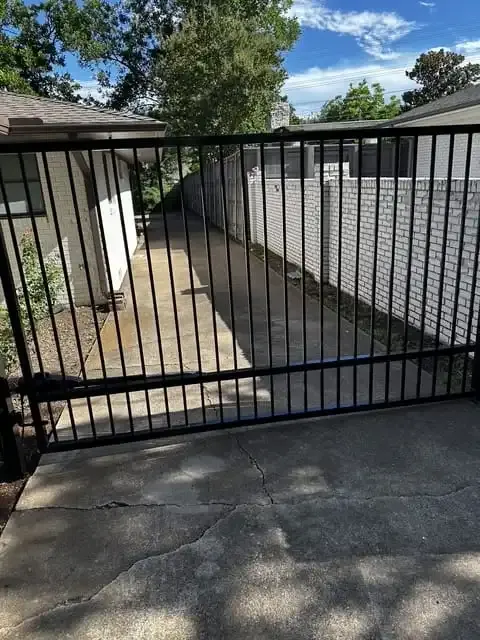
There is a practical side as well. Anything designed to injure creates liability for the owner and tends to hurt children, pets and service workers before it hurts a burglar. A pressed-point or finial top on a steel fence gives most of the deterrent effect with none of that exposure. See our guide to iron fence styles, heights and picket spacing for the options.
What makes a fence hard to climb?
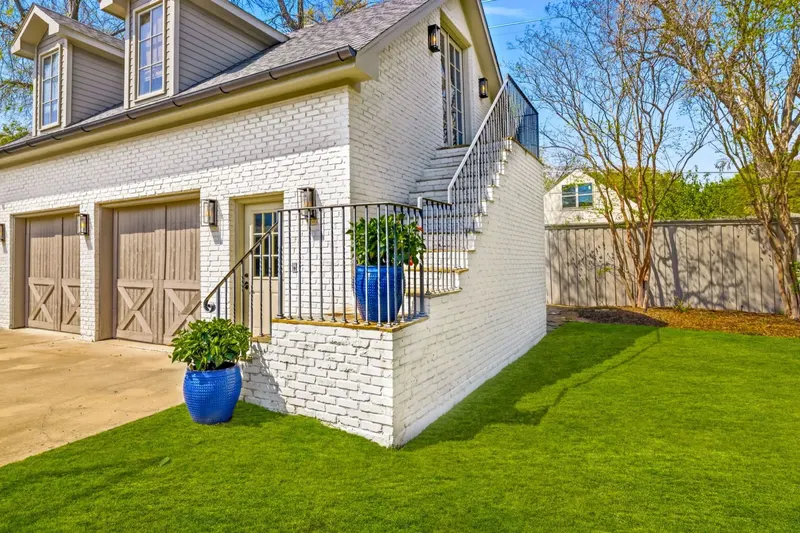
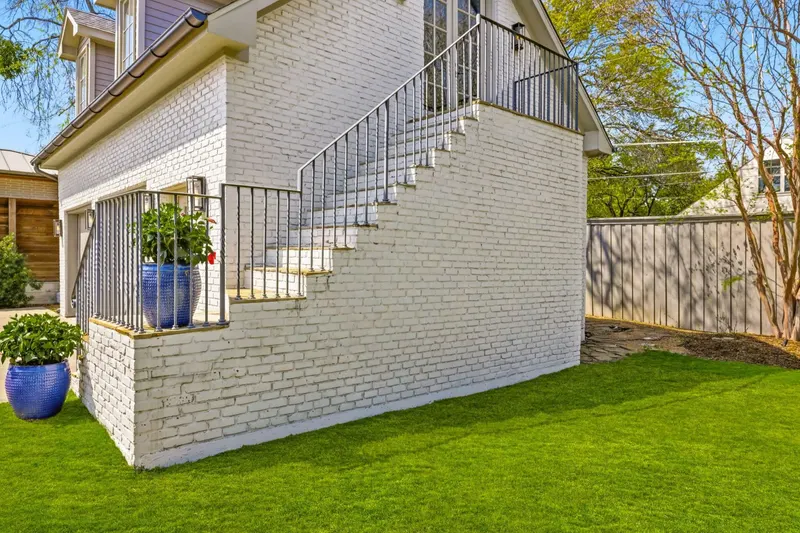
A fence is hard to climb when it offers no foothold, no handhold at the top and nothing nearby to step on. Design matters more than height.
On metal fences, vertical pickets with close spacing and rails set far apart leave nothing to stand on. On wood fences, the rails are the ladder, so we turn the framed side toward your yard and the smooth picket face toward the outside. Horizontal fences look sharp, but every board is a rung unless the gaps are tight. The table compares the styles we build.
How common residential fence types compare for security
| Fence type | Climb resistance | View from the street | Best use |
|---|---|---|---|
| Ornamental steel, pressed-point top | High with close pickets and wide rail spacing | Open | Front and side yards, corner lots |
| Board-on-board cedar with cap | High when the smooth face is outside | Blocked | Rear and alley lines |
| Horizontal cedar | Moderate, boards can act as rungs | Blocked or filtered | Interior courtyards and screens |
| Brick or stone wall | High, no footholds on a flush face | Blocked | Street frontage and noise control |
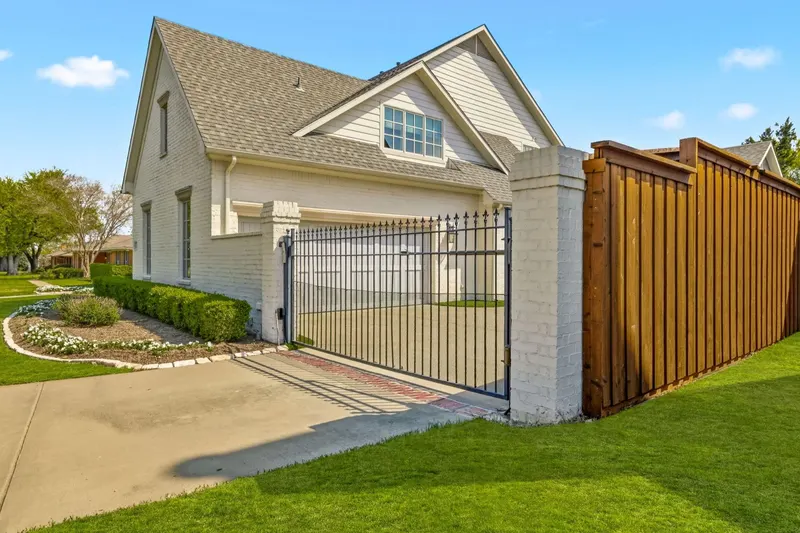
| Iron between masonry columns | High, columns must not form steps | Open | Estate frontage with a driveway gate |
What this means for you: Any fence loses its rating when a planter, a low wall or stored items sit against the outside face.
What locks work best on backyard gates?
The best gate lock is one that engages by itself. A self-closing hinge and a self-latching, key-lockable latch beat a padlock that someone has to remember, because the weak point of most fences is a gate left open.
On a walk gate we fit a latch that can be keyed from both sides, mounted high enough that a hand cannot easily reach over or through to release it. A steel frame keeps a wooden gate square so the latch keeps lining up. A gate that sags stops latching, and our guide to why wood gates sag explains how to prevent it.
For a driveway, an automatic gate closes behind every car. Keypads, remotes and phone-app access let you give a code to a guest or a contractor and remove it later, and battery backup keeps the gate working when the power is out. We cover the options in driveway gate security features.
- Self-closing hinges: The gate shuts behind children, guests and the lawn crew without anyone thinking about it.
- Keyed or coded latch: Lockable from both sides, with the release shielded from a hand reaching over the top.
- Steel gate frame: Holds the gate square through clay soil movement so the latch still meets the strike.
- No gap at the bottom: The gate should sit close to grade so nothing crawls under and nothing props it open.
Do cameras and lighting along a fence line improve security?
Yes, when they cover the gates and remove dark corners. Light and cameras do the watching that a solid fence prevents the neighbors from doing.
Low-voltage lighting on columns and at gates makes it clear the property is cared for and makes anyone at the gate visible from the house. Motion lighting on the alley side does the same for the back line. We plan conduit and power before posts and footings go in, which is far cleaner than adding it later. Our guide to fence, gate and column lighting walks through the choices.
Texas law also protects your right to install these measures. Under Property Code Section 202.023, a property owners' association may not adopt or enforce a covenant that prevents an owner from installing security measures such as a security camera, a motion detector or a perimeter fence, although it may limit cameras to your own property.
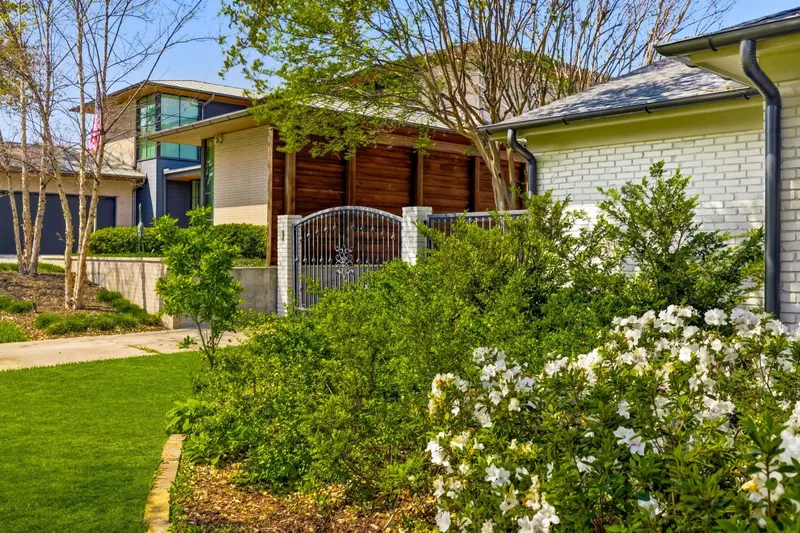
How should you plan a security fence for your own lot?
Walk the lot the way a stranger would. Start at the street, find every place a person could cross out of sight, and note what they could stand on to do it.
Then set priorities. Gates come first, the alley or greenbelt side second, and the side yards third. Check the city height limit, the front-yard rule and your deed restrictions before choosing a style. Our overview of fence permits, HOAs and 811 locates explains the order of approvals, and our Dallas fence page lists what the city asks for.
Jack Johnson, the owner, attends every consultation and walks the finished job, and wood, iron and masonry are all built in-house, so one company answers for the fence, the columns and the gate. Estimates are free and in writing. Call (214) 755-8100 or use the contact page to book a visit.
How Park Cities Fence & Deck helps
Jack Johnson comes out himself, looks at your property and gives you a free written estimate with a timeline. Wood, iron and masonry are all built in-house, so the advice fits the property. Related services: iron / metal fencing, wood fencing, gates & gate motors. We work in Dallas and across Dallas.
Questions people ask next
Does a fence lower home insurance in Texas?
We cannot promise that it will. Whether a fence, a locking gate or a monitored system earns a discount depends on your insurer and your policy, and we have not found an official rule that applies across Texas. Ask your agent before you build and get the answer in writing. A fence is usually covered as another structure on a homeowners policy, which matters more after a storm.
How do I secure a back gate that opens to an alley?
Treat it as the front door of the back yard. Use a steel-framed gate with a self-closing hinge and a latch that locks with a key or a code from both sides, shield the latch so a hand cannot reach it from outside, and light the gate. Keep trash carts and stored items away from the fence so they cannot be used as a step.
Can a Texas HOA ban a security fence around my own lot?
Generally no. Texas Property Code Section 202.023 says a property owners' association may not enforce a covenant that prevents an owner from installing a perimeter fence as a security measure. The association may still regulate the type of fencing, keep fences out of drainage easements and, if a covenant says so, prohibit fencing in front of the front-most building line. Condominiums are excluded.
Should an iron fence have a flat top, spear points or finials?
For security, a pressed-point or finial top is harder to grip and cross than a flat top rail. A flat top is the safer choice beside a play area, and some pool barrier designs call for it. City and HOA rules on pointed tops vary, so we confirm what is allowed at your address before the panels are fabricated.
Can a lock or keypad be added to a wooden side gate?
Yes. A wooden gate can take a keyed latch, a mechanical push-button lock or an electronic keypad, as long as the gate is rigid enough to keep the latch aligned. We often rebuild the gate on a steel frame first, because a lock on a sagging gate fails within a season. A self-closing hinge finishes the job.
Sources and further reading
- City of Dallas: Ordinance amending Section 51A-4.602, fence standards (PDF)
- Texas Property Code, Chapter 202, Section 202.023: Security Measures
- City of Frisco Code of Ordinances, Chapter 18, Article IX: Fences
General information, not legal advice. Rules change: we confirm the current requirements with your city or HOA before we build.