Planning · Dallas, Texas
How Should an HOA or Property Manager Plan a Perimeter Fence or Wall Replacement?
Settle who owns the fence, write one scope every bidder prices, and phase the work by condition.
 By Jack Johnson, owner of Park Cities Fence & Deck · 9 min read · 1,874 words
In short
An HOA or property manager should plan a perimeter replacement in four steps: confirm from the plat and the declaration who owns each stretch, survey the condition and rank it, write one scope that every bidder prices, and phase the work so the worst and most visible sections go first. Pool enclosures and access gates need their own review.
In this guide
- What is the best fence for an apartment complex or a commercial property?
- Who is responsible for the fence between my yard and the HOA common area or a main road?
- What should an HOA board or property manager ask for in a commercial fence bid?
- How should a board phase and budget a perimeter replacement?
- What does Texas law require for pool fences at apartments and HOA pools?
- What access control works best for a gated community or an apartment gate?
- How are dumpster enclosures and equipment screens usually built?
Need this done? See wood fencing.
A community perimeter is the largest thing most associations own and the first thing a buyer sees. It also fails slowly, which is why boards tend to patch it for years and then face the whole length at once. A plan turns that into a schedule the reserve budget can follow.
This guide is written for board members and property managers in Dallas and the northern suburbs. It covers materials, ownership, bids, the Texas pool enclosure law and gate access. It is general information, not legal advice, and your association's attorney and governing documents have the last word. Park Cities Fence & Deck builds commercial and HOA perimeter fencing in wood, iron and masonry with its own crews.
What is the best fence for an apartment complex or a commercial property?
The best perimeter for a multifamily or commercial site is usually a mix: ornamental steel where visibility and a clean look matter, masonry along busy roads, and cedar on steel posts where the goal is screening. One material rarely suits every side.
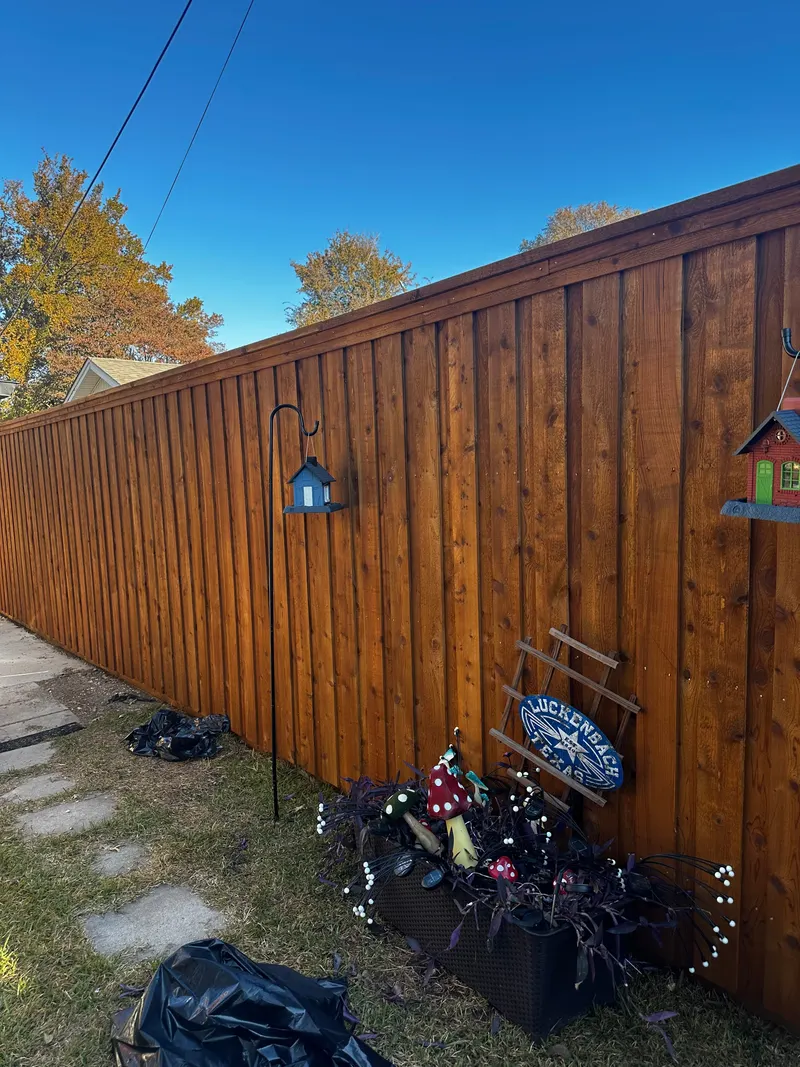
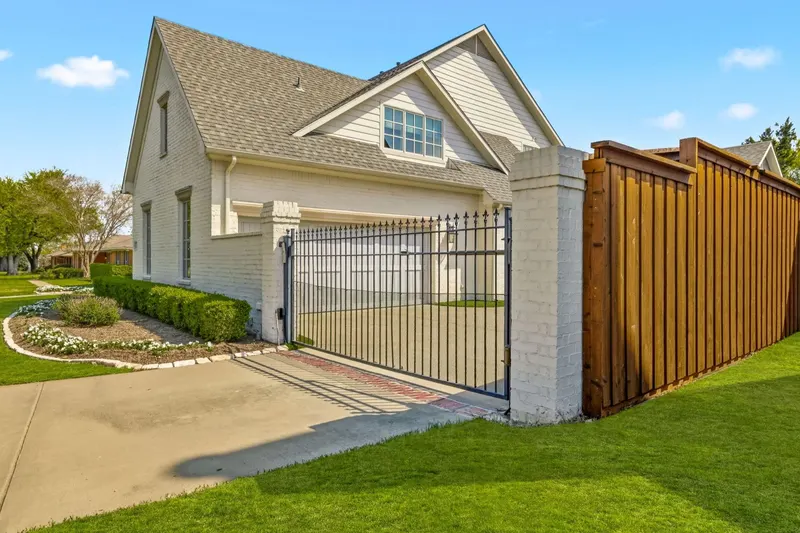
Powder-coated ornamental steel lets staff and residents see the parking areas and holds up to daily use. Brick or stone carries road noise better and needs the least routine care, though it has to be built on engineered footings for North Texas clay. Cedar gives privacy for the lowest initial outlay and needs a stain cycle to last. We do not install chain link or vinyl, so if a back-of-house line calls for chain link, we will say so and price only what we build.
Perimeter materials compared for communities and commercial sites
| Perimeter type | Best fit | Upkeep to plan for | Watch for |
|---|---|---|---|
| Ornamental steel | Entries, pools, parking and greenbelt lines | Wash, touch up chips, check gate hardware | Picket spacing where a pool is enclosed |
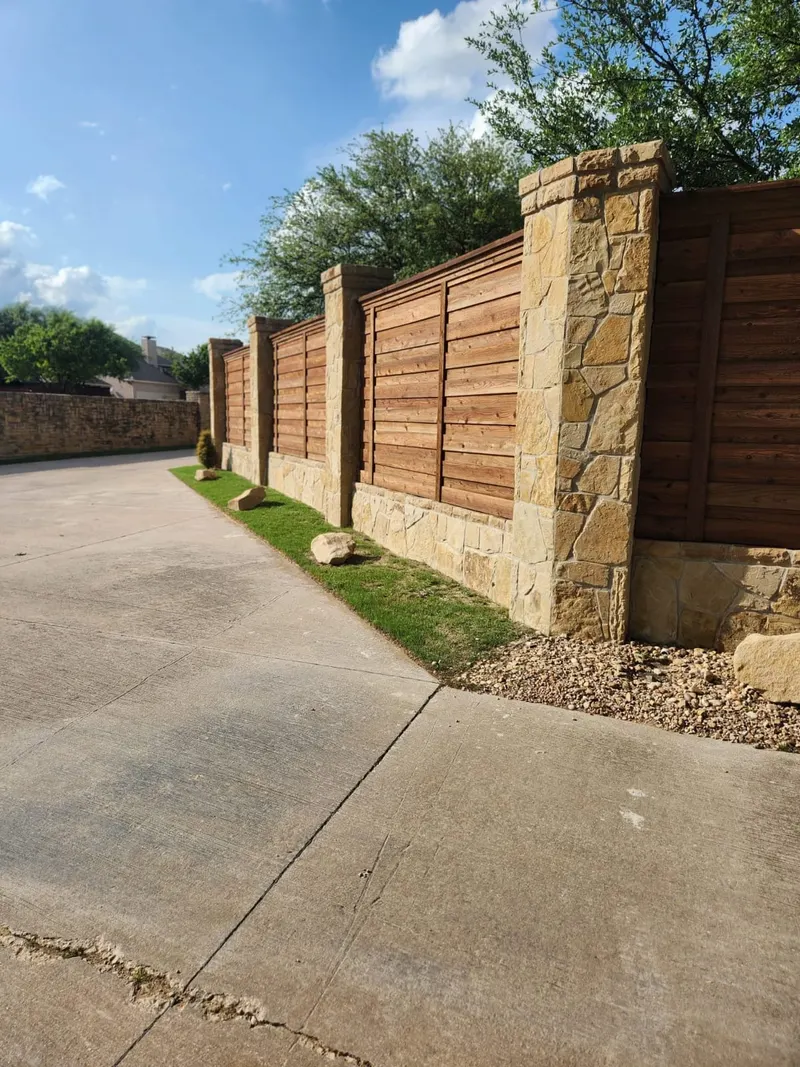
| Brick or stone wall | Road frontage and monument entries | Joint repair and cap inspection | Footings, drainage and leaning panels |
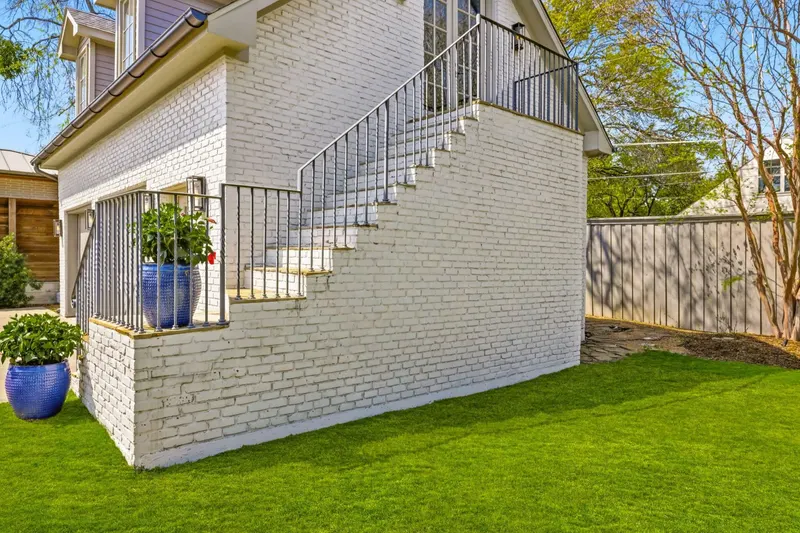
| Iron between masonry columns | Entries that need presence and visibility | Both of the above, in smaller amounts | Column footings and panel attachment |
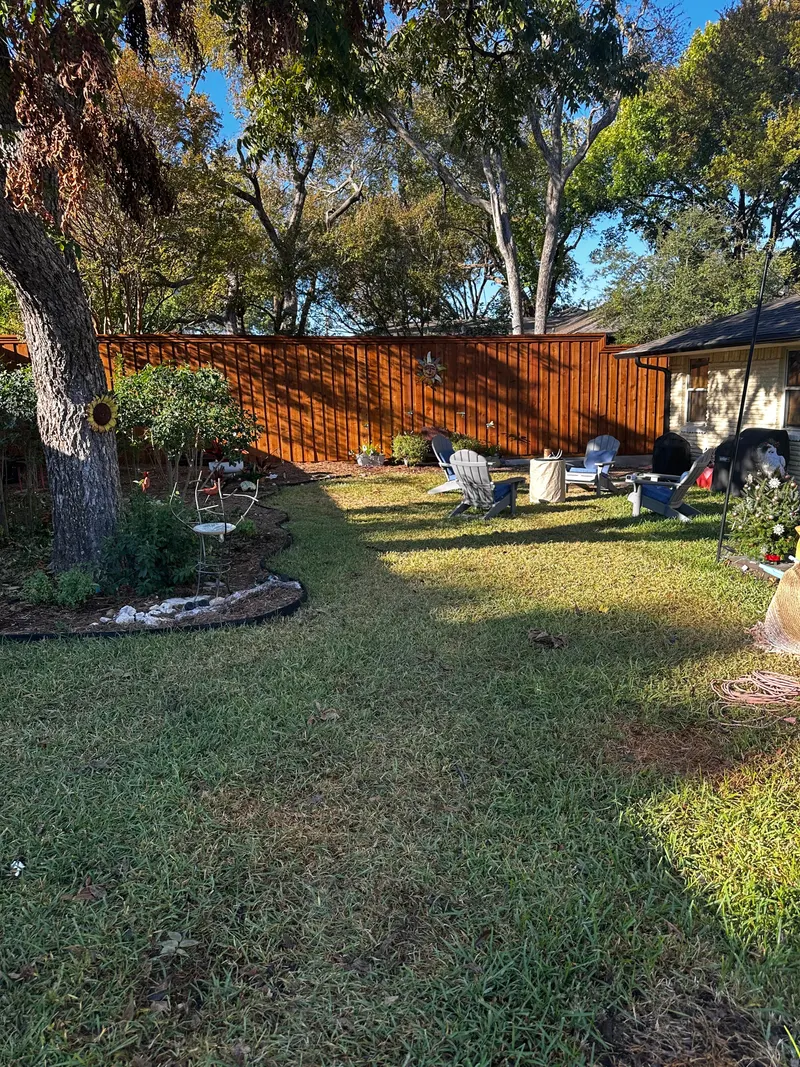
| Cedar on steel posts | Interior lot lines and screening | Restain every few years, board repairs | Ground contact and sprinkler overspray |
| Cedar enclosure with steel-framed gates | Dumpster and equipment screens | Gate hinges, latches and impact damage | Truck clearance and gate swing |
What this means for you: City screening and material rules differ by zoning district, so we confirm them with the city before the scope is final.
Who is responsible for the fence between my yard and the HOA common area or a main road?
It depends on where the fence or wall sits and what the recorded documents say. The plat shows whether the wall stands on an owner's lot, in a wall easement or on a common-area lot, and the declaration says who maintains it. There is no single Texas rule that answers it for every community.
Before a board budgets a single panel, it should pull the plat and the declaration and map the perimeter into three groups: association-owned, owner-owned and unclear. The unclear group goes to the association's attorney. Skipping this step is how a board ends up replacing fences it does not own or billing owners for a wall the association must maintain.
A survey settles location questions on the ground. Our guides to fences and property lines in Texas and shared fences between neighbors explain how ownership is usually worked out when the paperwork is thin.
What should an HOA board or property manager ask for in a commercial fence bid?
Ask every bidder to price the same written scope. A bid that does not name the materials, the post and footing details and the length of each phase cannot be compared with another one.
Texas Property Code Section 209.0052 adds two duties. An association that proposes to contract for services above a dollar threshold set in the statute must solicit bids or proposals using a bid process it has established. A contract with a board member, a relative or a company they control is enforceable only if at least two other bids from unrelated bidders were received, where reasonably available, and the interested member did not see the other bids, take part in the discussion or vote. Our fence quote and contract checklist lists the line items to expect.
- Scope by section: A marked site plan with lengths, heights and materials for each stretch and each phase.
- Structure: Post type and size, footing depth and diameter, rail count, fasteners and wall footing design.
- Removal and site care: Tear-out, haul-off, irrigation and landscape protection, and working hours.
- Permits and locates: Who prepares the city permit, who requests the 811 locate and who attends inspections.
- Insurance and warranty: A current certificate of insurance and the workmanship and manufacturer terms in writing.
- Unit pricing: A rate for added or deleted length so later phases are priced on the same basis.
How should a board phase and budget a perimeter replacement?
Phase by condition and visibility, not by geography. The stretches that lean, have failed posts or face the main entry go first, and sound sections wait.
Start with a condition walk that grades each run: sound, repairable or failed. On wood, the posts decide the grade. On masonry, look for leaning panels, cracked columns and open joints. Our guide to repairing or replacing an aging fence uses the same test at a smaller scale. A perimeter rarely fails all at once: some runs need replacement now, some can be repaired and stained, and the rest can wait. The walk decides the split.
We do not publish prices or budgets. The free written estimate gives a figure for each phase, and unit pricing lets the reserve study carry later phases forward. If the perimeter is cedar, a power wash and restain program on the sound sections is the least costly way to delay their replacement.
What does Texas law require for pool fences at apartments and HOA pools?
Texas Health and Safety Code Chapter 757 requires the owner of a multiunit rental complex with a pool, and a property owners association that owns, controls or maintains a pool, to completely enclose the pool yard. The enclosure must be at least 48 inches tall, measured from the ground on the side away from the pool.
Openings under the enclosure may not pass a four inch sphere. Where the tops of the horizontal members are at least 45 inches apart, openings may not pass a four inch sphere. Where they are closer than 45 inches, the limit drops to one and three quarter inches. Chain link is prohibited for a pool yard enclosure built after January 1, 1994, and equipment may not be placed where it can be used to climb over.
Gates must have a self-closing and self-latching device, hardware that allows them to be locked, and must open outward, away from the pool yard. The latch must be at least 60 inches above the ground, with stated exceptions for a latch on the pool side or a gate opened by key, card or combination on both sides. Cities add their own pool codes, which we compare in pool fence rules by city.
What access control works best for a gated community or an apartment gate?
The system that works best is the one residents can use without thinking and managers can update without a service call. For most communities that is a credential for residents, a call box or phone entry for visitors, and codes that can be issued and removed remotely.
The gate itself matters as much as the electronics. Slide gates suit busy entries with little room to swing, and every motor we install includes safety photo-eyes and battery backup. Emergency access for fire and police is set by each city, so we confirm it with the fire marshal before ordering. See gate motors, keypads and safety sensors and our gate maintenance schedule, because a community gate cycles far more often than a residential one.
Our automatic gate service covers swing and slide gates with keypads, remotes and phone-app access.
How are dumpster enclosures and equipment screens usually built?
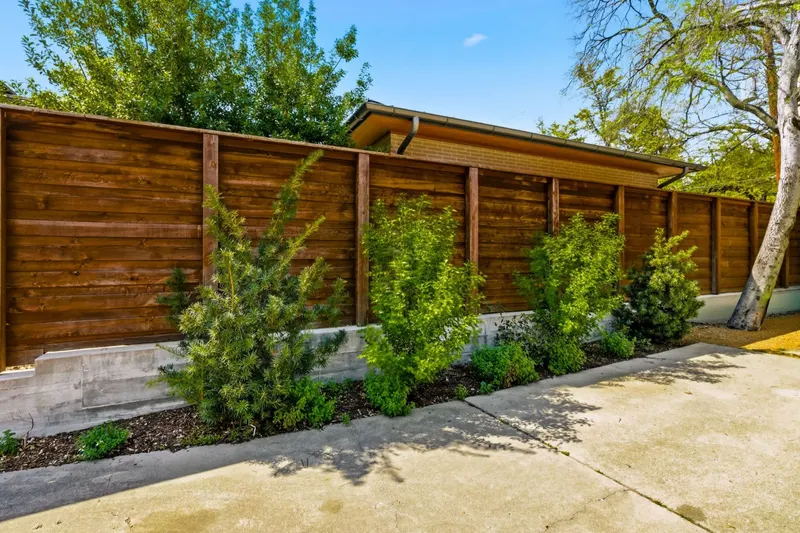
A dumpster enclosure is usually three solid walls on a concrete pad with a pair of heavy gates on steel frames. It takes more abuse than any other fence on the property, so it is built heavier than the perimeter.
Walls are masonry to match the buildings, or cedar on steel posts set in concrete. Gates hang on steel posts sized for the load, with latches and drop rods that hold them open while the truck works. Many cities require refuse containers and mechanical equipment to be screened from the street and from neighboring homes, and the details vary by zoning district, so we confirm them before the build. In Plano and Frisco we check the city requirement and the association's design standards together.
How Park Cities Fence & Deck helps
Jack Johnson comes out himself, looks at your property and gives you a free written estimate with a timeline. Wood, iron and masonry are all built in-house, so the advice fits the property. Related services: wood fencing, masonry fencing, gates & gate motors. We work in Plano and Frisco and across Dallas.
Questions people ask next
Can my HOA make me replace my fence or pay for the community wall?
It depends on your declaration. If the recorded documents make owners responsible for the fences on their lots, the association can usually enforce a maintenance standard. Whether it can assess owners for a common wall depends on who owns the wall and what the assessment provisions say. Read the declaration and the plat, and ask the board for the section it relies on before you pay or refuse.
Can a Texas HOA ban a security fence around my own lot?
Generally no. Texas Property Code Section 202.023 says a property owners' association may not enforce a covenant that prevents an owner from installing security measures, including a perimeter fence. The association may still regulate the type of fencing, protect sidewalks and drainage easements, and, if a covenant provides for it, prohibit fencing in front of the front-most building line. Condominiums are not covered.
How do I appeal when my HOA denies my fence request?
In an association of more than 40 lots, Texas Property Code Section 209.00505 lets you appeal an architectural denial to the board. The denial notice must explain the basis and tell you that you may request a hearing on or before the 30th day after it was mailed. The board must hold the hearing within 30 days of your request and give you at least 10 days' notice.
Who maintains the screening wall behind my Plano home?
We could not confirm a single rule on the City of Plano pages we read, so check three things: the recorded plat, which shows whether the wall sits on your lot, in an easement or on a common lot; your HOA declaration; and the city. Responsibility differs from one subdivision to the next. We confirm it with the city before quoting any wall repair.
Do gate and access control installers need a special license in Texas?
Sometimes. Texas Occupations Code Section 1702.1025 requires a license to act as an electronic access control device company. The definition excludes an operator that opens or closes a gate and accessories such as a transmitter, card reader or keypad, when they only activate the gate and are not connected to an alarm system. Ask any bidder which license covers the system proposed.
Sources and further reading
- Texas Property Code, Chapter 202: Construction and Enforcement of Restrictive Covenants
- Texas Property Code, Chapter 209: Texas Residential Property Owners Protection Act
- Texas Health and Safety Code, Chapter 757: Pool Yard Enclosures
- Texas Occupations Code, Chapter 1702: Private Security
General information, not legal advice. Rules change: we confirm the current requirements with your city or HOA before we build.