Planning · Dallas, Texas
How Long Does It Take to Design and Install a Custom Estate Fence and Gate?
The build is the short part. Design, approvals and fabrication decide when your fence and gate are finished.
 By Jack Johnson, owner of Park Cities Fence & Deck · 9 min read · 1,756 words
In short
Most residential wood and iron fences take one to three days to build once materials arrive. Masonry, large estate fences and automated gates take longer. For a custom estate project, the calendar is set less by the build than by what comes before it: design decisions, HOA and city approvals, and fabrication of custom iron and gates.
In this guide
- What are the phases of a custom fence and gate project?
- How long does the design phase take, and why does it matter?
- What approvals are needed before work can start?
- Why does custom iron and gate fabrication add time?
- How long is the crew actually on site?
- What does an automated gate add to the schedule?
- What delays a project, and how do we avoid it?
Need this done? See gates & gate motors.
Homeowners usually ask how long the crew will be in the yard. That is the easiest part of the schedule to answer and the least important. On a custom fence with columns and a driveway gate, the work on site is the last stretch of a longer process.
This guide walks through each phase in order, says what controls its pace, and shows where an owner can save time. We do not quote week counts for approvals here, because they belong to your HOA and your city, not to us. We give you a written schedule with your free estimate once we know the property.
What are the phases of a custom fence and gate project?
Every estate project we build moves through the same six phases. They overlap where they can. The table shows what happens in each and what decides how fast it goes.
Phases of a custom estate fence and gate project
| Phase | What happens | What controls the pace |
|---|---|---|
| Consultation and estimate | Site walk, measurements, written estimate | How soon we can meet and how clear the scope is |
| Design and selections | Style, materials, column and gate drawings | How quickly decisions are made and revised |
| Approvals | HOA review, city permit, engineered plans where required | The HOA and city review calendars |
| Fabrication and materials | Iron and gates made, stone, brick and cedar ordered | Complexity of the design and supplier lead times |
| Construction | Footings, columns, fence panels, gates hung | Size of the job, masonry cure time and weather |
| Automation and walkthrough | Motor, keypad, sensors, testing, final walk with Jack | Electrical readiness at the gate |
What this means for you: The phases you control are the first two; make decisions early and the rest of the schedule tightens up.
How long does the design phase take, and why does it matter?
Design is where a schedule is won or lost. A straightforward cedar fence needs a height, a style and a stain color. An estate frontage needs a column design, a stone or brick selection, an iron pattern, a gate design, an opening direction and an access system. Each of those is a decision someone has to make.
Jack Johnson attends every consultation himself, and his background as a custom home builder shows here. He will look at the house, the driveway grade and the trees, and narrow the options to the few that suit the property. If you are working with a designer, bring them in at this stage. Our guide to working with an architect or landscape architect explains how the drawings are shared.
The fastest projects are the ones where the owner sees finished examples early. Look through our gallery and the notes in designing an estate entrance before the first meeting, and the design phase gets shorter.
What approvals are needed before work can start?
Three sets of rules can apply: deed restrictions or an HOA, the city or town, and the utility locate law. They differ by address, which is why we confirm them for your property before promising a start date. This is general information, not legal advice.
In the City of Dallas, the published fence checklist says a permit is required for a fence over four feet in a front yard or over six feet elsewhere, and that fences in conservation and historic districts need a Certificate of Appropriateness. The application asks for a scaled site plan showing the fence, gates, easements and driveways, plus an elevation drawing of a typical panel.
The Town of Highland Park’s fence permit packet asks for a survey or scaled site plan with fence heights and gates marked, and requires engineer-stamped plans for masonry walls. It also lists two inspections: a location inspection with a string line at the property pins, and a final inspection. Each of these adds a step, and none of them can be skipped. More detail is in our guides to Highland Park and University Park fence permits and HOA and deed restrictions.
Why does custom iron and gate fabrication add time?
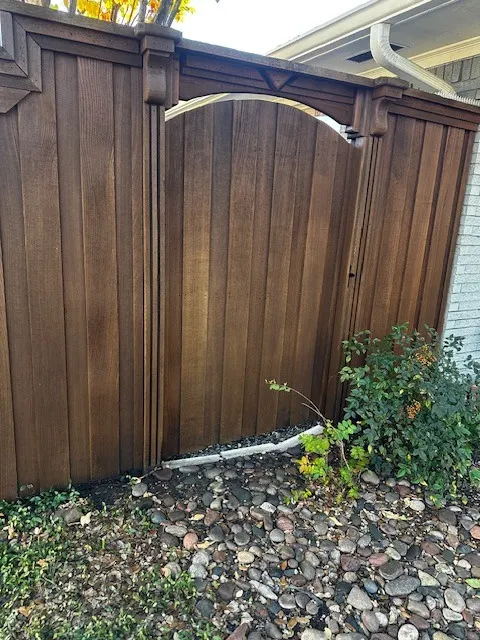
A stock fence panel comes off a shelf. A custom iron fence is cut, welded, ground and powder coated to your drawings, and a driveway gate is built as a single rigid frame sized to your opening. That work happens in a shop while approvals are in review, so the two phases overlap when the design is locked early.
Changes are what slow fabrication down. Altering a gate width or a picket pattern after the steel is cut means starting that piece again. We ask for a signed drawing before fabrication begins for this reason.
Materials for the rest of the job are ordered in the same window: cedar, stone or brick for the columns, caps, hardware, and the gate operator with its keypad, remotes and safety sensors. Matched masonry can take the longest to source, which we explain in matching brick and limestone for new columns.
How long is the crew actually on site?
Most residential wood and iron fences take one to three days once materials arrive. That covers removing the old fence, setting posts in concrete and installing the panels or pickets. A typical backyard cedar fence falls in this range.
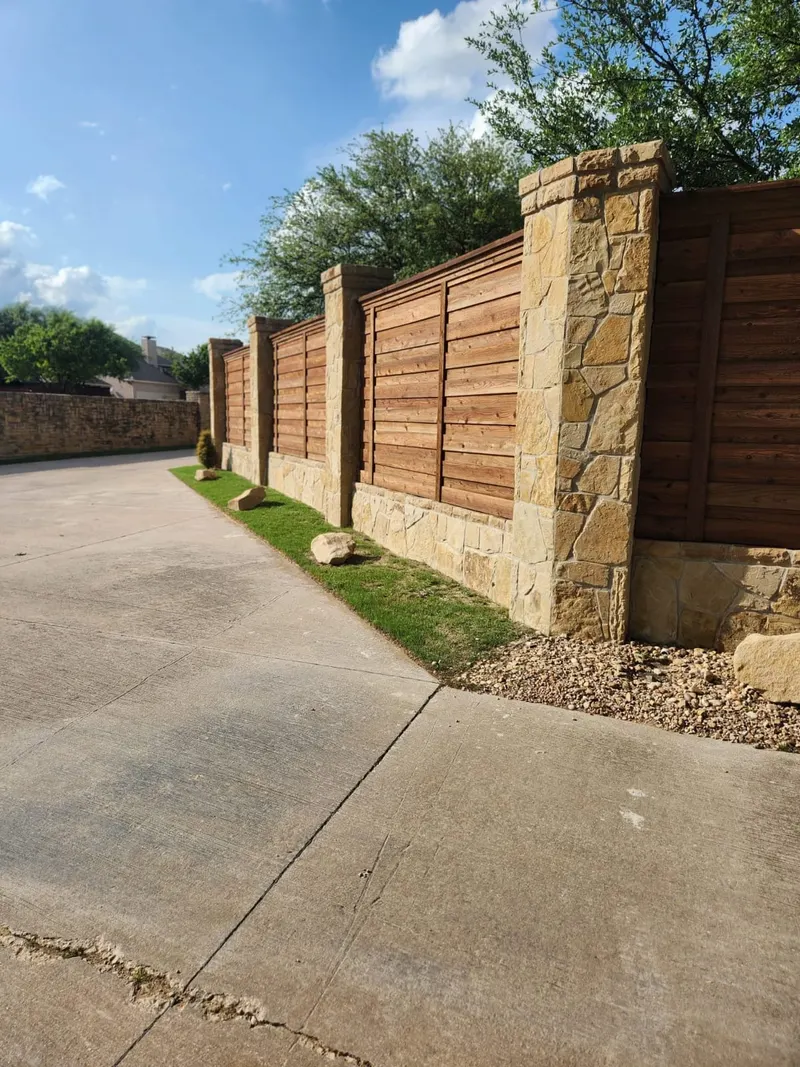
Masonry, large estate fences and automated gates take longer. Footings are dug and poured, columns are laid in courses, and the masonry needs time to cure before heavy gates are hung from it. A long frontage with many columns is simply more work than a rear property line. We give the build duration for your job in writing on the estimate.
Before any digging, buried utilities are located through 811. The Railroad Commission of Texas states that homeowners, excavators and contractors are required by law to call 811 at least two days before digging, and that the call is free. We file the locate ticket as part of scheduling, so it does not add a delay.
What does an automated gate add to the schedule?
A gate that opens by itself needs three things beyond the gate: a solid mounting point, power, and a tested control system. The motor, keypad, remotes and safety sensors are installed after the gate is hung and swinging or rolling freely by hand. A gate that binds by hand will wear out a motor.
Power is the step owners forget. If there is no electrical supply near the gate, it has to be brought there, and that should be planned during design so trenching happens before landscaping is restored. Our automatic gate page lists the equipment, and gate motors 101 explains how the parts work together.
The last task is testing. Travel limits and safety sensors are set, and each remote and keypad code is checked. Then Jack does the final walkthrough with you himself.
What delays a project, and how do we avoid it?
Nearly every delay we see traces back to one of four causes: an unresolved design decision, an incomplete HOA or permit submission, a surprise underground, or weather during masonry work. Three of the four can be handled on paper before the crew arrives.
Underground surprises deserve a word. The 811 locate marks lines owned by utilities. It does not mark what a previous owner buried, such as an old sprinkler main, lighting cable or an abandoned footing from an earlier wall. On older lots in University Park and Highland Park we expect to find something, and we allow for hand digging near anything you can tell us about.
Access is the other quiet factor. A long frontage beside a busy street, a narrow side yard or a rear line reached only through a finished garden all slow the handling of stone, steel and concrete. We look at access during the site walk so the build duration on your estimate reflects your property and not an average one.
If you have a date in mind, such as a party, a move-in or a pool completion, tell us at the first meeting. We will work backward from it and tell you plainly whether it is realistic. The contract should state the scope and the sequence, a point covered in our fence quote and contract checklist.
- Decide early: Lock the style, materials, gate type and access system before drawings go to the HOA or city.
- Submit complete: A full package with site plan, elevations and specifications is reviewed once instead of being returned.
- Find your survey: A current survey with property pins speeds up both the permit and the layout on site.
- Flag private lines: Tell us about sprinkler mains, lighting wire and pool lines so we can dig around them by hand.
How Park Cities Fence & Deck helps
Jack Johnson comes out himself, looks at your property and gives you a free written estimate with a timeline. Wood, iron and masonry are all built in-house, so the advice fits the property. Related services: gates & gate motors, iron / metal fencing, masonry fencing. We work in Preston Hollow and Highland Park and across Dallas.
Questions people ask next
How long does it take to install a standard fence?
Most residential wood and iron fences take one to three days once materials arrive. That includes removal of the old fence, posts set in concrete and installation of the new panels or pickets. Longer runs, difficult access and gates add time. The written estimate states the expected build duration for your property.
Can you start before the HOA or city approves the design?
We can measure, design, prepare drawings and line up materials, but we do not build before required approvals are in hand. A fence built ahead of approval can be ordered changed or removed, and that costs far more time than waiting. We prepare the submission so it is complete the first time.
Does the weather affect the schedule in Dallas?
Yes, mainly for masonry and concrete. Heavy rain fills footing excavations and stops brick and stone work, and saturated clay is difficult to dig cleanly. Iron and cedar installation is less sensitive. We schedule around forecasts and tell you when a weather day moves the finish date.
Can the fence be built first and the gate automated later?
Yes, and it is a sensible way to phase a project. If you plan to automate later, tell us now so the gate posts or columns, the hinges and the conduit for power are sized and placed for a motor. Adding an operator to a gate that was never designed for one is harder and less tidy.
Who handles the permits and the 811 utility locate?
We do. Permit drawings, HOA submissions and the 811 locate ticket are part of our installation process. You may need to sign an application or provide your survey. Jack attends the consultation and the build, so the person who planned the paperwork is the same person checking the finished fence.
Sources and further reading
- City of Dallas: Fence Permit, Pool Barrier and Retaining Wall Checklist
- Town of Highland Park: Fence Permit Packet
- Railroad Commission of Texas: Before Digging Under Your Property, Call 811
General information, not legal advice. Rules change: we confirm the current requirements with your city or HOA before we build.