Decks & Pergolas · Dallas, Texas
What Drives the Cost of a Deck or Pergola in Dallas?
Height and structure move a deck or pergola price more than the boards you see. Here is what to compare.
 By Jack Johnson, owner of Park Cities Fence & Deck · 8 min read · 1,717 words
In short
The cost of a deck or pergola in Dallas is driven by size, height above grade, the decking or timber chosen, the frame and footings underneath, and extras such as stairs, railings, benches, lighting and shade slats. Height and structure move the price more than the surface boards. A free written estimate gives the number for your yard.
In this guide
- What drives the cost of a deck in Dallas?
- How much does a pergola cost in Dallas?
- What makes one deck quote twice as high as another?
- Do stairs, railings and built-in benches add much to the cost of a deck?
- Is a raised deck more expensive than a ground-level deck?
- Is an attached pergola cheaper than a freestanding one?
- Is it cheaper to resurface an old deck than to build a new one?
Need this done? See deck installation.
A deck quote is mostly a structure quote. The boards you walk on are what you see, but the footings, posts, beams, joists and hardware below them carry the load and take a large share of the labor. A pergola is the same story overhead: post size, beam spans and anchoring decide the price long before the stain color does.
Park Cities Fence & Deck builds cedar and composite decks and custom pergolas across Dallas. We do not publish prices, so this guide explains what moves an estimate and how to compare two bids fairly.
What drives the cost of a deck in Dallas?
Six things: square footage, height, the decking material, the frame, the footings and the features attached to it. Shape matters too. A plain rectangle uses lumber efficiently, while angles, curves, picture-frame borders and multiple levels add cuts, waste and hours.
Material is the choice homeowners think about first. Cedar costs less on day one and needs sealing. Composite costs more up front and less to maintain. Our composite vs. cedar decking comparison covers that trade in detail. Under either surface the frame is usually pressure-treated lumber, because, as the Western Red Cedar Lumber Association notes, even cedar should be preservative-treated where it touches the ground.
What moves a deck or pergola estimate
| Factor | Simpler and lower | More involved and higher |
|---|---|---|
| Size and shape | Compact rectangle | Large, angled, curved or multi-level |
| Height | Close to the ground | Raised, with guards, bracing and stairs |
| Surface | Cedar decking | Composite decking, borders and hidden fasteners |
| Footings | Few piers and easy digging | More piers, deeper holes, roots or tight access |
| Features | Open edge and one step | Railings, wide stairs, benches and lighting |
| Pergola | Standard rafters and an open top | Heavy timbers, long spans, shade slats or fans |
What this means for you: Two bids are comparable only if they describe the same choices in every row. Ask each builder to write the joist spacing, post size and footing depth on the estimate.
How much does a pergola cost in Dallas?
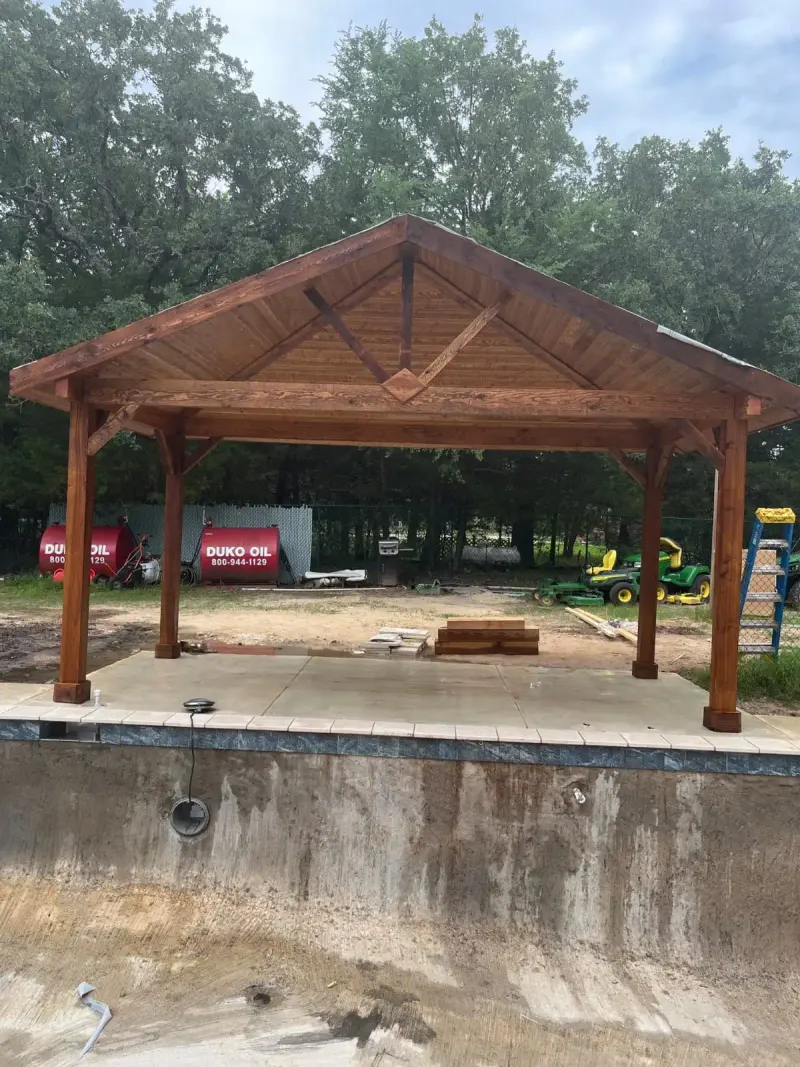
A pergola’s price depends on its footprint, its height, the size and species of the timbers, and how much shade structure sits on top. We do not quote a figure without seeing the site, because the same footprint can be a light garden frame or a heavy timber room.
The main drivers are post and beam size, the span between posts, and the top layer. Larger timbers and longer clear spans need heavier beams and stronger connections. Closely spaced rafters and shade slats, which are what make a pergola useful at 5 p.m. in July, add lumber and labor. Our guide to pergola designs that beat Texas heat explains which of those are worth paying for.
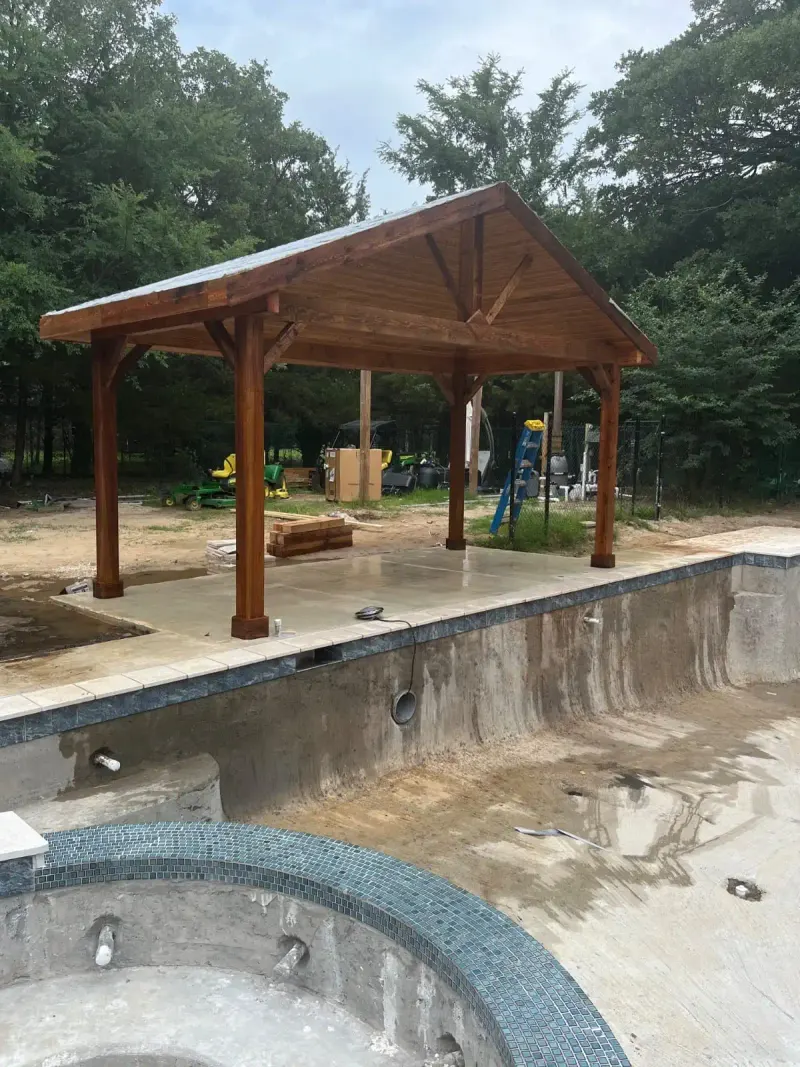
Footings count as well. Posts can be anchored to new concrete piers or, where the slab is suitable, to an existing patio. Electrical work for fans and lights, stain, and any permit or HOA drawings are separate lines that a complete estimate lists.
What makes one deck quote twice as high as another?
Usually the two quotes describe two different decks. The surface area matches, but the structure, the materials and the items included do not.
Check the five items below on each bid. The quote and contract checklist we wrote for fences applies to decks almost line for line: named materials, structure in writing, and a clear list of what is and is not included.
- Frame: Joist size and spacing, beam size and the number of posts. A lighter frame is cheaper and bouncier.
- Footings: How many piers, how deep, and whether they reach stable soil. This is the first place a low bid saves money.
- Hardware: Galvanized or stainless connectors and structural screws compared with plain nails and deck screws.
- Decking grade: The cedar grade or the composite product line. Entry and premium composite lines are far apart.
- Inclusions: Demolition of the old deck, haul-off, stairs, railings, permit drawings and sealing may be in one bid and missing from the other.
Do stairs, railings and built-in benches add much to the cost of a deck?
Yes. Stairs and railings are the most labor-intensive parts of a deck per foot, and on a raised deck they can rival the cost of the platform itself.
Stairs need stringers cut to the exact rise, their own footing at the bottom, and usually a handrail. The American Wood Council’s deck guide, which is based on the International Residential Code, calls for a minimum stair width of 36 inches and a handrail on stairs with four or more risers. Wide, wrapping steps look generous and use a great deal of lumber.
Railings are priced by the running foot and vary widely with the style: cedar pickets, metal balusters and cable systems sit at very different levels. Built-in benches and planters are carpentry, and they cost less when they are framed with the deck than when they are added later. If the budget is tight, a lower deck that needs no railing frees money for the surface you will use every day.
Is a raised deck more expensive than a ground-level deck?
Yes. A raised deck needs taller posts, bracing, a guard around the edge and a full stair, none of which a low deck requires.
The American Wood Council guide states that all decks greater than 30 inches above grade are required to have a guard, and it calls for diagonal bracing at corner posts more than two feet tall. It also requires footings to bear on undisturbed soil at least 12 inches below the surface or below the frost line, whichever is deeper. Those are model-code minimums. Dallas and each suburb adopt and amend their own codes, so we confirm the current requirement with the city before the build.
In North Texas clay, soil movement is the bigger design concern, and piers are sized for it. Ground-level decks have their own costs: there is little air under the frame, so drainage and ventilation have to be planned. See planning a deck in Dallas for structure and permits, and deck or patio for a Dallas backyard if you are weighing a low deck against concrete.
Is an attached pergola cheaper than a freestanding one?
Often slightly, because an attached pergola uses the house for one side and needs fewer posts and footings. The saving is smaller than people expect, and sometimes it disappears.
Attaching to a house means a ledger fastened into sound framing, flashing so water does not get behind it, and care around brick veneer, which is a facing and not a structure to hang weight from. If the wall cannot take a ledger properly, the right answer is a freestanding frame set close to the house. A freestanding pergola can also go where the shade is needed, not only where the wall is.
A pergola built over a deck should be planned with the deck so its posts land on their own footings. We compare the layouts in pergola, patio cover or gazebo, and you can see finished work in our project gallery.
Is it cheaper to resurface an old deck than to build a new one?
Yes, when the frame is sound. Resurfacing replaces the decking, and often the railings and stairs, on the existing structure, so you skip demolition of the frame, new footings and new framing lumber.
The condition is the catch. Posts, beams, joists and the connection to the house have to be inspected once the old decking is off. Rot at the joist tops, undersized framing or failing footings turn a resurfacing into a rebuild, and an honest estimate says so before work starts. Composite boards may also need closer joist spacing than the old frame provides.
For the checks that tell you whether a frame has life left, read deck maintenance and safety in Texas. If the surface is only gray and rough, a power wash and reseal may be all it needs. For a number on either route in Dallas, ask for a free written estimate or call (214) 755-8100. Jack Johnson, the owner, attends every consultation.
How Park Cities Fence & Deck helps
Jack Johnson comes out himself, looks at your property and gives you a free written estimate with a timeline. Wood, iron and masonry are all built in-house, so the advice fits the property. Related services: deck installation, pergola installation. We work in Dallas and across Dallas.
Questions people ask next
How much does a covered patio cost compared with a pergola?
A covered patio with a solid roof generally costs more than an open pergola of the same footprint, because it adds roof framing, sheathing, roofing, flashing and drainage, and it is more likely to need a permit. A pergola gives filtered shade, not rain cover. We build pergolas, and the right figure for your site comes from a written estimate.
Does a deck add value to a home in Texas?
A well-built deck makes a backyard more usable, and buyers notice outdoor living space. How much of the cost returns at sale depends on the neighborhood, the condition of the deck and the rest of the yard, and we will not quote a percentage we cannot stand behind. A sound, maintained deck helps a sale. A gray, soft or wobbly one becomes an inspection item.
Does a pergola add value to a home?
A pergola adds usable shade and gives a patio a finished, room-like feel, which helps how a home shows. It is not a guaranteed return, and no honest builder can promise a figure. The pergolas that hold their value are sized to the house, built from durable lumber on proper footings and kept stained. A flimsy kit can count against a listing.
Is pressure-treated pine decking a good budget choice?
Pressure-treated pine is the usual choice for the frame under a deck, because lumber in contact with the ground needs preservative treatment. As a walking surface it costs less than cedar or composite but tends to check, cup and splinter in Texas sun unless it is sealed regularly. We build deck surfaces in cedar or composite, and we explain the difference on the estimate.
Is a louvered or adjustable-roof pergola worth it?
It can be, if you want rain protection and adjustable shade from one structure and accept motors, drainage channels and electrical work. Louvered systems are manufactured aluminum products priced well above a cedar pergola. A fixed cedar pergola with closely spaced shade slats handles most Dallas patios for less. We build custom pergolas and will tell you plainly whether an adjustable roof suits your space.
Sources and further reading
- American Wood Council: DCA 6, Prescriptive Residential Wood Deck Construction Guide (based on the 2015 IRC)
- Western Red Cedar Lumber Association: Characteristics and Properties of Western Red Cedar
General information, not legal advice. Rules change: we confirm the current requirements with your city or HOA before we build.