Decks & Pergolas · Dallas, Texas
Is a Deck or a Patio Better for a Dallas Backyard?
Decks handle slope, trees and raised doors. Patios suit flat ground. Clay soil affects both.
 By Jack Johnson, owner of Park Cities Fence & Deck · 9 min read · 1,881 words
In short
A deck is better for a Dallas backyard that slopes, has mature trees, or has a back door well above the ground, because it sits on footings and leaves the soil alone. A patio is better on flat, well-drained ground where you want a hard surface at grade. Many yards use both.
In this guide
- What is the real difference between a deck and a patio on a Dallas lot?
- Is a ground-level or floating deck a good idea on clay soil?
- Can a deck be built around a pool or a hot tub?
- Can a deck be built around a tree?
- Is pressure-treated pine decking a good budget choice?
- How big should a deck be for a table, a grill and seating?
- Can a deck hold a hot tub or an outdoor kitchen?
Need this done? See deck installation.
The choice comes down to the ground you have. A patio is a slab or a field of pavers that rests on the soil. A deck is a framed platform held above the soil on posts. In North Texas the soil is expansive clay that swells when wet and shrinks when dry, and that one fact shapes how each option performs over time.
One thing to know up front: Park Cities Fence & Deck builds cedar and composite decks and pergolas. We do not pour concrete patios or lay pavers. The comparison below is honest about where a patio is the better answer, because a deck sold for the wrong yard is a deck that disappoints. For the build process itself, see planning a deck in Dallas.
What is the real difference between a deck and a patio on a Dallas lot?
A patio moves with the ground and a deck is held above it. On stable, flat soil that makes a patio simple and durable. On clay that heaves, on a slope, or over tree roots, it makes a deck the better fit.
Patios also store heat and stay hard underfoot, and they need no railings. Decks can be set level with the back door so there is no step down, they drain through the gaps, and they can be rebuilt or resurfaced in pieces. Neither is maintenance-free. A wood deck needs cleaning and a new coat of stain every few years, and a slab on clay can crack or settle and is difficult to repair invisibly.
Deck or patio: which suits common Dallas backyard conditions
| Your yard | Deck | Patio |
|---|---|---|
| Sloped lot | Strong choice, posts absorb the grade | Needs retaining walls and fill |
| Back door well above grade | Sets level with the door | Needs steps down |
| Mature trees nearby | Framed around trunks, light on roots | Excavation and base can damage roots |
| Flat, well-drained ground | Works, though not required | Strong choice |
| Around a pool at grade | Possible with careful detailing | The usual choice |
| Fire pit or heavy masonry | Needs special design | Strong choice |
What this means for you: Many good backyards combine the two: a deck off the house and a patio or gravel area out in the yard.
Is a ground-level or floating deck a good idea on clay soil?
A low deck works well on clay when its footings go deep enough to get below the soil that moves and when air can circulate under the frame. A deck that simply floats on surface blocks is the version that causes trouble here.
Shallow blocks ride up and down with the clay through the seasons. Because they do not all move the same amount, the deck racks, boards lift and doors that open onto it start to bind. The second problem is moisture. A frame set inches above damp ground with no airflow stays wet, and wet framing does not last. Lumber that touches the ground has to be pressure-treated and rated for ground contact.
Done properly, a ground-level deck is a fine answer for a flat Dallas yard: proper footings, treated framing, clearance beneath, a gap between boards and a slope in the soil below so water runs away from the house. The same soil principles decide how we set fence posts, explained in our guide to post depth and concrete in clay soil.
Can a deck be built around a pool or a hot tub?
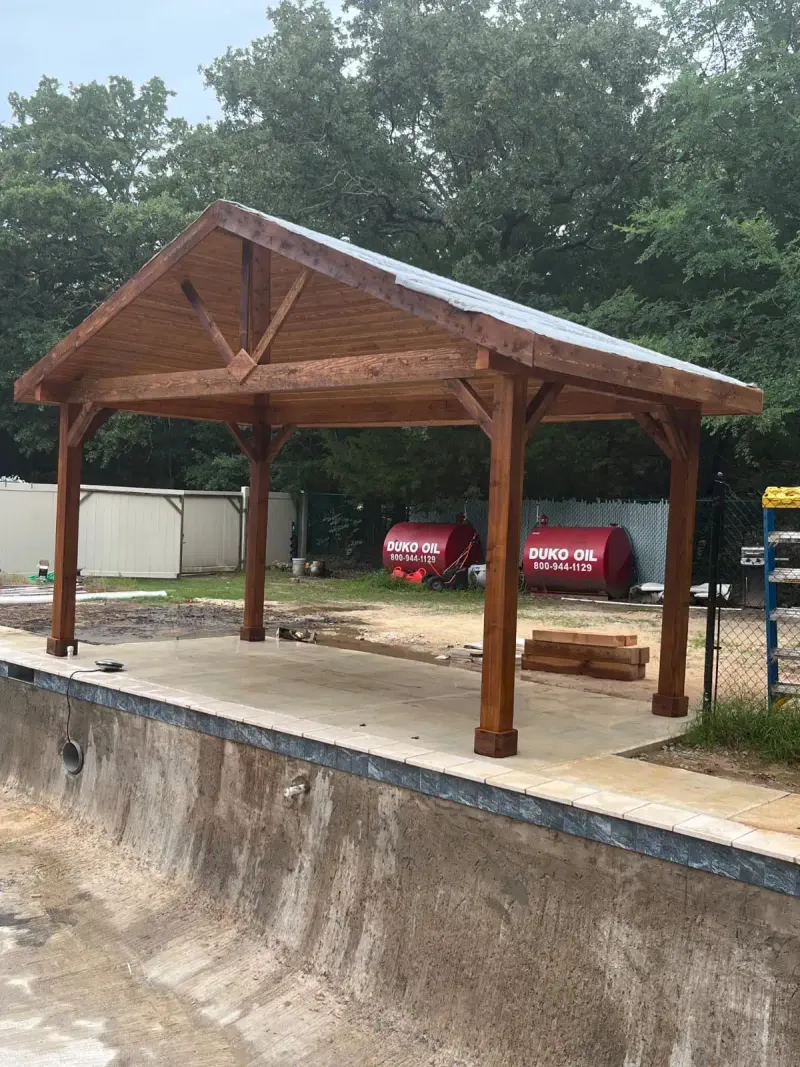
Yes. A deck can surround an above-ground pool, step down to an in-ground pool or wrap a hot tub. It takes more planning than an ordinary deck because of water, weight and safety rules.
Use decking that stays comfortable and safe when wet. Composite and cedar both work. Composite needs less upkeep, and color choice matters because dark boards get hot in full Texas sun. Hardware near a pool should be stainless or hot-dip galvanized, and access panels are needed wherever equipment, skimmers or a hot tub’s service side must be reached.
The rules matter most. A deck beside a pool can become part of the required pool barrier, and its gates, steps and railings then have to meet the barrier requirements of your city. See pool fence rules by city in DFW and the best pool fences for families. We build pool-code iron and aluminum fencing alongside decks, so the two can be designed together.
Can a deck be built around a tree?
Yes, and it is one of the best reasons to choose a deck over a patio. A deck is framed around the trunk with an opening left for growth, and it reaches the ground only at its footings, so most of the root zone stays undisturbed.
A patio does the opposite. It needs excavation, a compacted base and an impervious surface across the roots, and compaction and grade changes over the root zone are among the common ways construction harms mature trees. In the Park Cities and Preston Hollow, where a large live oak can be the most valuable thing in the yard, that difference often settles the question.
The details count. Leave a generous gap around the trunk and trim it back as the tree grows. Place footings between major roots, dig them by hand where needed, and never fasten framing to the tree. Some cities protect certain trees, so ask before work starts. Our guide to building near mature trees covers the same care for fence lines.
Is pressure-treated pine decking a good budget choice?
Pressure-treated pine is the right material for the frame of almost every deck and an acceptable budget choice for the surface, provided you accept more upkeep and more movement than cedar or composite.
Treated pine resists rot and insects, which is why joists, beams and posts are made of it. As a walking surface it tends to shrink, check and cup as it dries in the Texas sun. It often arrives wet from treatment and needs time to dry before it will take a stain, and it wants regular sealing to stay presentable.
Cedar costs more, stays flatter, is naturally decay-resistant and is more pleasant under bare feet. Composite costs more again and trades the staining cycle for occasional washing. We build decks with cedar or composite surfaces on treated frames. Our comparison of composite and cedar decking and the wood guide cedar versus pine versus redwood explain the trade-offs in detail.
How big should a deck be for a table, a grill and seating?
Size the deck from the furniture outward. Lay out the table, the chairs pulled back from it, the grill and the seating group, then add walking room around each. A useful rule is about three feet of clear space behind every chair and along every path.
A dining table for six with that clearance takes a zone roughly the size of a small room. A grill needs its own station away from the house wall, the railing and the path to the door, following the grill maker’s clearance instructions. A separate lounge area for a sofa and chairs is a third zone. Add them up and most families land on a deck larger than their first guess, or on two connected levels.
Mark it out before you decide. Garden hose or painter’s tape on the lawn, with the real furniture set inside it, shows more in ten minutes than any drawing. Shade belongs in the plan too. A west-facing deck in Dallas is hard to use in summer without cover, which is why many of our decks are designed with a pergola. See pergola designs that beat Texas heat.
- Dining zone: The table, every chair pulled out, and a clear path all the way around.
- Cooking zone: The grill, a landing spot for platters, and distance from the wall, the railing and the door.
- Lounge zone: Sofa and chairs facing each other, close enough to talk, with room to walk behind.
- Paths: A direct route from the back door to the steps that does not cut through the table or the grill.
Can a deck hold a hot tub or an outdoor kitchen?
Yes, when it is designed for that load from the start. A standard deck frame is not built for it, and an existing deck should never be assumed strong enough.
A filled hot tub with people in it is one of the heaviest things a homeowner will ever put on a structure, and the weight sits in one spot. The American Wood Council’s prescriptive deck guide states plainly that decks supporting large concentrated loads such as hot tubs are outside its scope. In plain terms, the standard span tables do not apply and the framing and footings need their own design. Stone counters, a built-in grill surround and a pizza oven raise the same issue.
The usual solutions are more footings and closer, heavier framing under the load, or setting the tub on its own slab with the deck built around it at rim height. An outdoor kitchen also brings gas, electrical and sometimes plumbing work, which licensed trades and city permits cover. Tell us about heavy features at the first visit, so the deck is designed around them.
How Park Cities Fence & Deck helps
Jack Johnson comes out himself, looks at your property and gives you a free written estimate with a timeline. Wood, iron and masonry are all built in-house, so the advice fits the property. Related services: deck installation. We work in Dallas and across Dallas.
Questions people ask next
Is cedar, redwood or ipe the best wood for a deck?
Cedar is the best fit for most North Texas decks: stable, naturally decay-resistant, light and comfortable underfoot. Redwood behaves much the same and is harder to source here. Ipe is an extremely dense hardwood with a long life, but it is heavy, difficult to work and expensive. We build in cedar and in composite and can show you both.
How do I clean a composite deck?
Sweep it regularly and wash it with warm water, mild soap and a soft brush, then rinse. Wipe up grease and food spills soon after they happen and keep the board gaps clear. Check the manufacturer’s care guide before using a pressure washer or a specialty cleaner, since the wrong product or too much pressure can damage the cap layer.
Does my HOA have to approve a deck or a pergola?
In most HOA neighborhoods, yes. Deed restrictions commonly require architectural committee approval for decks, pergolas and other structures, often with a drawing, materials and colors. That approval is separate from any city permit, and you may need both. We prepare the drawings and details the committee asks for and coordinate the city permit before the build.
Is a raised deck more expensive than a ground-level deck?
Yes. Height adds taller posts, larger footings, bracing, stairs and a guard railing, and railings and stairs are the most labor-intensive parts of any deck. A raised deck may also need more detailed plans for the permit. A ground-level deck avoids most of that, though it still needs proper footings and treated framing to last on clay soil.
What makes one deck quote twice as high as another?
Usually the scope is different, not the profit. Compare the decking material and grade, the framing size and spacing, footing depth and count, hardware type, railings, stairs, permit handling and haul-off. A low bid often leaves several of these out or leaves them unstated. Ask each company to price the same written specification so the numbers can be compared fairly.
Sources and further reading
- American Wood Council: DCA 6, Prescriptive Residential Wood Deck Construction Guide (based on the 2015 IRC)
- International Code Council, Building Safety Journal: Is Your Deck Safely Connected to Your House?
General information, not legal advice. Rules change: we confirm the current requirements with your city or HOA before we build.