Decks & Pergolas · Dallas, Texas
How Do I Maintain a Wood Deck in Texas, and How Do I Know an Old Deck Is Safe?
Clean it yearly, keep a penetrating finish on it, and check the ledger, posts and railings before every season.
 By Jack Johnson, owner of Park Cities Fence & Deck · 9 min read · 1,852 words
In short
Maintain a wood deck in Texas by cleaning it once a year, keeping a penetrating stain or sealer on it every few years, and replacing loose fasteners and damaged boards promptly. Judge an old deck’s safety by its structure: how it attaches to the house, the posts and footings, and the railings and stairs.
In this guide
- What does a yearly deck care routine look like in Texas?
- Should I stain, seal or paint my deck?
- How do I know if my old deck is safe?
- When does a deck need a railing, and how high must it be?
- Can a deck be repaired, or does it need to be rebuilt?
- Why are my deck boards cupping, splitting or popping up?
- How long does a wood deck last in North Texas?
Need this done? See deck installation.
A deck in North Texas lives a hard life. Months of direct sun dry the boards, spring storms soak them, and the clay under the footings swells and shrinks with every wet and dry spell. Surface care keeps the deck looking good. Structural checks keep it standing.
The two are different jobs, and the second matters more. Gray boards are cosmetic. A ledger held to the house with nails is not. This guide covers both, with the safety points drawn from the American Wood Council’s deck guide and the International Code Council. It is general information, and a deck you have doubts about should be looked at in person. For new builds, see planning a deck in Dallas.
What does a yearly deck care routine look like in Texas?
Once a year, clear the deck, clean it, inspect it and fix what you find. Spring is the natural time, before the season of heavy use. A second quick look in fall catches storm and summer damage.
The routine takes an afternoon on most decks, and it is the cheapest thing you can do to extend the deck’s life.
- Clear and sweep: Move furniture and planters, and clean the gaps between boards so water drains and debris does not hold moisture against the joists.
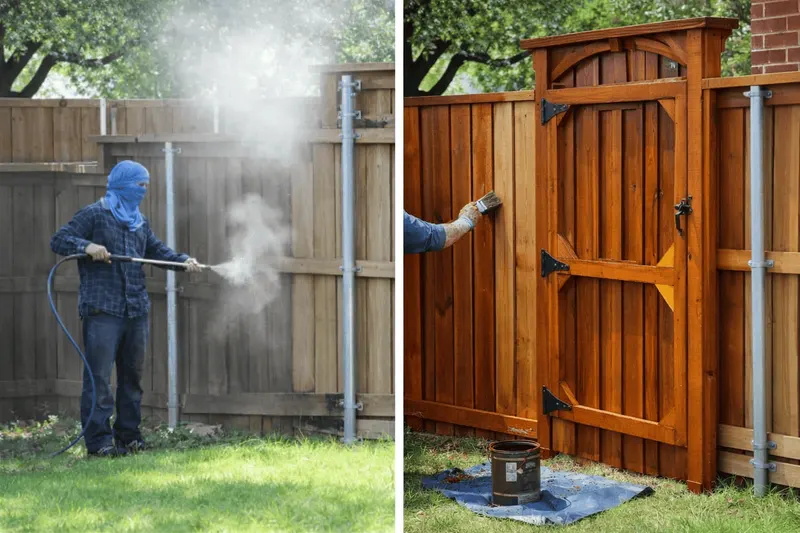
- Wash: Use a deck cleaner and a soft brush, or a pressure washer on a low setting with a wide tip.
- Inspect from below: Look at the ledger, joists, hangers, beams and posts with a flashlight, not only the walking surface.
- Tighten and replace: Reset raised fasteners, replace cracked or soft boards and firm up any loose rail post.
- Test the finish: Sprinkle water on the boards. If it soaks in instead of beading, the deck is ready for a new coat.
Should I stain, seal or paint my deck?
Stain or seal it. A penetrating finish, either a clear water-repellent sealer or a semi-transparent stain, is the right choice for a deck floor. Paint and other thick film finishes tend to peel on a horizontal surface that people walk on and water sits on.
The difference is in how they fail. A penetrating finish wears away gradually, and you renew it by cleaning and recoating. A film traps moisture when it cracks, lifts in sheets and has to be stripped before anything new will hold. Pigment matters as well. A tinted stain blocks more sunlight than a clear sealer, so it usually lasts longer between coats under Texas sun.
Plan to recoat every few years, typically two to four, sooner on a deck in full sun and later on one under a roof or a pergola. Let new wood dry before the first coat. Our power wash and restain service covers decks as well as fences, and the cedar stain guide explains color choices that apply to both.
How do I know if my old deck is safe?
Look at the connections, not the boards. The attachment to the house, the posts and the railings are where older decks fail, and all three can be checked with a flashlight and a screwdriver.
Start at the ledger, the board that fastens the deck to the house. The International Code Council reports that nail-only ledger connections are one of the primary causes of deck collapse, that the residential code has barred nails as the only attachment since 2000, and that it has called for half-inch bolts or lag screws since 2009. If you see only nail heads along the ledger, treat the deck as unsafe until a professional has looked at it. Many Dallas houses raise a second concern. The American Wood Council’s guide prohibits attaching a deck ledger to brick or stone veneer or to a cantilevered overhang, and calls for a freestanding deck with its own posts in those cases.
Then probe the wood. Push a screwdriver into post bases, joist ends and the ledger. Sound wood resists. Wood that takes the tip easily is rotting.
Where to check an older deck and what the warning signs mean
| Where to look | Warning sign | What to do |
|---|---|---|
| Ledger at the house | Nails only, no bolts or lag screws, no flashing | Stay off and have it evaluated |
| Post bases and footings | Soft wood, leaning posts, soil washed away | Have posts or footings replaced |
| Joists and hangers | Rusted hangers, split joist ends, sagging | Repair framing before resurfacing |
| Railings | Posts that move when pushed | Refasten or rebuild the guard |
| Stairs | Loose treads, cracked stringers, no handrail | Repair before anyone uses them |
What this means for you: A deck that bounces, sways side to side or has pulled away from the house should not be used until it has been inspected.
When does a deck need a railing, and how high must it be?
Under the model residential code, a deck more than 30 inches above the ground needs a guard. That is the trigger stated in the American Wood Council’s deck guide, which is based on the 2015 International Residential Code. The same guide calls for a handrail on stairs with four or more risers.
The required guard height, the allowed gap between balusters and the loads a railing must resist depend on the code edition your city has adopted and any local amendments. We do not quote one number for all of DFW. We confirm the current requirement with the city before the build. A deck beside a pool may also be part of the pool barrier, which carries its own rules, covered in our guide to pool fence rules by city.
Low decks often do not require a guard. Many owners add one anyway, or a bench or a wide step, where children, older family members or a hard landing surface make a fall more serious than its height suggests.
Can a deck be repaired, or does it need to be rebuilt?
A deck can be repaired when the frame is sound and the problems are in the surface: worn boards, loose railings, a tired finish. It needs rebuilding when the structure is compromised: a rotted or nailed-only ledger, decayed posts, undersized or sagging framing.
Resurfacing is the middle path. If the joists, beams and posts pass inspection, new decking and railings on the existing frame give you what looks and feels like a new deck. This is also the moment many owners move from wood boards to composite. The catch is that the frame has to be worth keeping, because new boards will outlast a weak frame and hide its condition. The same logic we apply to fences in repair or replace applies here: fix a sound structure, replace a failing one.
We build cedar and composite decks and handle the carpentry repairs that go with them. Ask us to look at the frame before you decide. Our deck installation page explains how we build.
Why are my deck boards cupping, splitting or popping up?
Boards cup, split and lift because the top and bottom of each board gain and lose moisture at different rates. The sun bakes the top face while the underside stays damp, and the board curls toward the dry side.
Several things make it worse: boards installed tight with no gap for drainage, a deck built low over wet ground with no air moving beneath it, a finish that wore off years ago, and smooth nails that back out a little with every wet and dry cycle. The American Wood Council’s guide calls for a gap of about an eighth of an inch between boards and for threaded nails or screws for exactly these reasons.
The fixes follow from the causes. Replace badly cupped or split boards, refasten the rest with deck screws, clean the gaps, improve airflow under a low deck where you can, and keep a finish on the surface. If many boards are failing at once, look underneath. Widespread movement can mean the joists are spaced too far apart or the frame is taking on water.
How long does a wood deck last in North Texas?
There is no single honest number, because a deck is two things with two lifespans. The frame, built from pressure-treated lumber and kept reasonably dry, normally outlasts the surface. The decking and railings take the sun and the foot traffic and wear out first.
What decides the outcome is water and upkeep. Decks that drain, dry out between rains, have flashing at the house and get cleaned and recoated on schedule last far longer than decks that sit damp and bare. Hardware counts too. Treated lumber is hard on plain steel, which is why the fasteners and connectors should be hot-dip galvanized or stainless.
If you are deciding what to build or resurface with, our comparison of composite and cedar decking lays out how each ages, and deck and pergola cost factors explains what moves the price. For a look at your deck, request a free written estimate or call (214) 755-8100.
How Park Cities Fence & Deck helps
Jack Johnson comes out himself, looks at your property and gives you a free written estimate with a timeline. Wood, iron and masonry are all built in-house, so the advice fits the property. Related services: deck installation, powerwash & restain.
Questions people ask next
Can I pressure wash my deck?
Yes, with care. Use a low pressure setting and a wide fan tip, keep the wand moving and work along the grain. Too much pressure or a narrow tip held close will raise the grain, leave stripes and shorten the life of softwoods such as cedar. Let the deck dry fully before staining. If the surface feels fuzzy afterward, a light sanding fixes it.
How do I clean a composite deck?
Sweep it, then wash with warm water, a mild soap and a soft-bristle brush, and rinse well. Clean grease and food spills promptly, and keep the gaps between boards clear so water drains. Follow the board manufacturer’s care guide for stubborn stains and for whether a pressure washer is allowed, because the wrong cleaner or too much pressure can mark the surface.
Is it cheaper to resurface an old deck than to build a new one?
Usually, because you keep the footings, posts, beams and joists and pay only for new decking, railings and labor. It is the better value only when the frame passes inspection. If the ledger, posts or joists need major work, the savings shrink quickly and a rebuild may be the sounder choice. A written estimate for both options makes the comparison clear.
Is cedar, redwood or ipe the best wood for a deck?
Each has a place. Cedar is light, stable, naturally decay-resistant and comfortable underfoot. Redwood performs similarly and is less available in Texas. Ipe is a very dense tropical hardwood that lasts a long time but is heavy, hard to work and costly. We build decks in cedar and in composite, and we will tell you which suits your site and budget.
Do stairs, railings and built-in benches add much to the cost of a deck?
Yes. They are the most labor-intensive parts of a deck. Stairs need stringers, footings and handrails, railings need structural posts and many pieces of infill, and benches are custom carpentry. A low, simple platform costs far less per square foot than a raised deck with wraparound rails and wide steps. Your written estimate lists each as its own line.
Sources and further reading
- American Wood Council: DCA 6, Prescriptive Residential Wood Deck Construction Guide (based on the 2015 IRC)
- International Code Council, Building Safety Journal: Is Your Deck Safely Connected to Your House?
General information, not legal advice. Rules change: we confirm the current requirements with your city or HOA before we build.