Cost & Hiring · Dallas, Texas
Do Fence Contractors Need a License or Insurance in Texas?
Texas has no state fence contractor license. Here is what to check instead: registration, insurance and proof.
 By Jack Johnson, owner of Park Cities Fence & Deck · 9 min read · 1,791 words

In short
No. Texas does not issue a state license for fence contractors. The Texas Department of Licensing and Regulation licenses trades such as electricians, but its list of regulated programs has no fence or general contractor license. Cities may require contractors to register before pulling permits, and insurance is something you must ask for and verify yourself.
In this guide
- Is there a state license for fence contractors in Texas?
- What insurance should a fence company carry in Texas?
- What does licensed, bonded and insured actually mean for a fence contractor?
- Do gate and access control installers need a special license in Texas?
- How do I verify that a fence company is a real, registered business in Texas?
- How do I check a fence company’s reviews and tell which ones are real?
- Does it matter if a fence company uses its own crews or subcontractors?
Need this done? See wood fencing.
In many states a homeowner can look up a contractor’s license number and stop there. Texas does not work that way for fences. There is no state fence license to look up, which means the checking falls to you.
That is less work than it sounds. Four things tell you most of what you need: whether the company is registered where it pulls permits, whether it carries insurance and will prove it, whether it is a real business with an address, and whether its reviews and photographs are its own. This guide covers each one, using the state’s and the City of Dallas’s published pages. For the wider list of questions, see how to choose a fence company in Dallas.
Is there a state license for fence contractors in Texas?
No. The Texas Department of Licensing and Regulation, the agency that licenses most skilled trades in the state, lists the programs it regulates, and fence contractors, general contractors and home builders are not among them. Electricians and air conditioning contractors are.
So when a fence company in Texas says it is licensed, ask what license it means. It may mean a city registration, a business filing or a license for a related trade. None of those is a state fence license, because that license does not exist. A company that explains this plainly is being more honest with you than one that prints the word on a truck and hopes you do not ask.
Cities fill part of the gap. The City of Dallas’s permitting guide states that general contractors must register with its Planning and Development department before performing any work that requires a permit. Other cities keep their own contractor registration lists. If your fence needs a permit, ask the bidder whether it is registered in your city. Our guide to fence permits, HOAs and 811 in DFW explains when a permit applies.
What insurance should a fence company carry in Texas?
At minimum, general liability insurance, which pays for damage the company causes to your property or a neighbor’s. Ask also how its workers are covered if one is hurt, because Texas handles that differently from most states.
The Texas Department of Insurance states that private employers can choose whether to carry workers’ compensation coverage and that it is not required in most cases. A fence crew digs with power augers, cuts steel and lifts heavy gates, so the answer to the question is worth hearing. Some companies carry workers’ compensation, some carry an occupational accident policy and some carry nothing.
Do not accept a verbal yes. Ask for a certificate of insurance sent to you by the company’s insurance agent, naming the insurer, the policy dates and the coverage types, and check that the dates cover your build. Park Cities Fence & Deck is insured, and you can request the certificate with your estimate. A larger project with masonry walls or a motorized gate makes this check more important, not less.
What does licensed, bonded and insured actually mean for a fence contractor?
They are three separate things, and only one of them, insured, applies to every fence company in Texas. The phrase is often used as a slogan, so ask for the document behind each word.
The table sets out what each term means and how you check it. Bonds in particular are misunderstood: a bond is a guarantee from a surety company to a city or a customer that certain obligations will be met. Some cities ask for one with registration. It is not insurance for your fence.
What licensed, registered, bonded and insured mean for a Texas fence company
| Term | What it means | How to check it |
|---|---|---|
| Licensed | No state fence license exists; may refer to another trade | Ask which license and search the agency that issues it |
| Registered | On file with a city to pull permits there | Ask the city permit office |
| Bonded | A surety backs specific obligations | Ask for the bond and who it protects |
| General liability | Covers damage to property caused by the work | Certificate sent by the insurance agent |
| Worker injury coverage | Workers’ compensation or another policy for the crew | Named on the certificate or a separate one |
What this means for you: A word on a website is a claim. A certificate or a city record is proof.
Do gate and access control installers need a special license in Texas?
For a standard driveway gate operator, no state security license is required, but two related rules apply. The Texas Department of Public Safety, which regulates private security, says a person who only installs gate operators and the accessories that activate them, such as push buttons, radio transmitters, keypads and card readers, does not need a DPS license.
The same DPS page names the exceptions. A license is required when the operator is connected to an alarm system, or when the system allows monitoring or logging of who comes and goes. So a keypad and remotes are one thing, and an access system that records entries or ties into your alarm is another. Ask the installer which category your design falls in.
Power is the second rule. Electricians are licensed by the state through TDLR, so ask who runs the electrical circuit to the gate and under what license. We cover the equipment in gate motors 101 and the choices that affect security in driveway gate security features. City permit rules for gates are in driveway gate setback, permit and safety rules.
How do I verify that a fence company is a real, registered business in Texas?
Check that the name on the estimate matches a business you can find in public records, at an address you can visit. A real company leaves a trail that takes about fifteen minutes to follow.
Corporations and limited liability companies are on file with the Texas Secretary of State and can be looked up by name through the Texas Comptroller’s franchise tax account search. A business operating under a trade name files an assumed name certificate. Then check the basics a scammer rarely has in order.
- Same name everywhere: The estimate, the insurance certificate and the payee on your check should all show one business name.
- Physical address: An office or yard in the area, not only a phone number. Ours is 7123 Azalea Ln, Dallas, TX 75230.
- City registration: Where a permit is needed, the company is on the city’s contractor list.
- Written estimate: On letterhead, with the scope and materials spelled out.
- A person who answers: An owner or manager with a name, reachable before and after the job.
How do I check a fence company’s reviews and tell which ones are real?
Read the reviews instead of counting them. Real reviews mention specifics: the street or neighborhood, the kind of fence, a person’s name, a problem and how it was handled. Invented ones are short, vague and arrive in clusters.
Look at the dates, the reviewers’ other reviews and how the company replies to criticism. Then ask for photographs of the company’s own finished work and, for a large job, an address you can drive past. We hold a 5.0 Google rating from 18 reviews. That is a small number, and we would rather you read all of them and look through our gallery of completed fences and gates than take a star count on trust.
A warranty is part of the same check. Ask what is covered and get it in writing; see what to expect from a fence and gate warranty.
Does it matter if a fence company uses its own crews or subcontractors?
It matters less who signs the paycheck than who is accountable on site and whose insurance covers the people working in your yard. Subcontracting is common and legal in Texas. The risk is when nobody from the company you hired is present and the crew’s coverage is unknown.
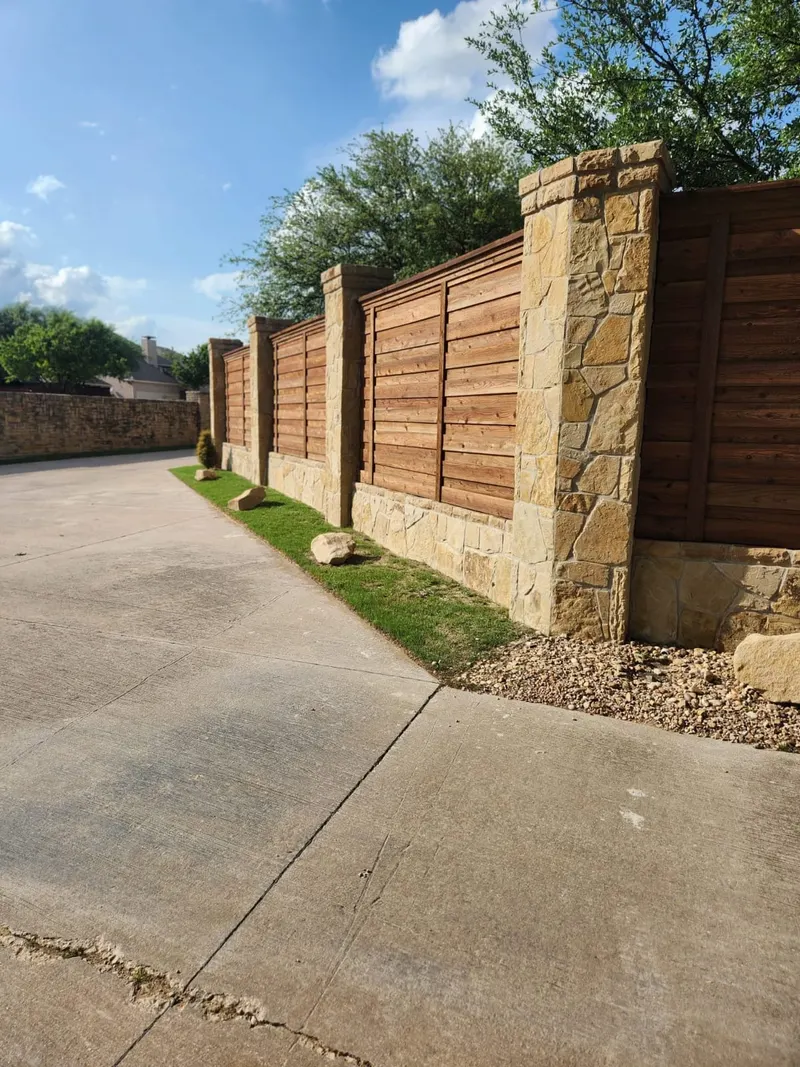
Ask three questions: who supervises the build each day, are the installers covered by the company’s insurance or their own, and who do you call if something is wrong afterward. At Park Cities Fence & Deck, wood, iron and masonry are built in-house, and the owner, Jack Johnson, attends every consultation and build and walks the finished job. That is the model we think protects a homeowner best, whether the project is a cedar privacy fence or an iron fence with stone columns.
The differences are laid out in fence installer vs. full-service company, and the paperwork to ask for is in our quote and contract checklist.
How Park Cities Fence & Deck helps
Jack Johnson comes out himself, looks at your property and gives you a free written estimate with a timeline. Wood, iron and masonry are all built in-house, so the advice fits the property. Related services: wood fencing, gates & gate motors.
Questions people ask next
What happens if a fence worker gets hurt on my property?
It depends on what coverage the company carries. Texas does not require most private employers to carry workers’ compensation, so some crews have it and some do not. Where there is no coverage, an injured worker may look to other parties. Ask for proof of worker injury coverage before work starts, and check your own homeowners policy with your agent.
Can a homeowner pull their own fence permit in Texas?
In many cities, yes. Permits are issued by the city, not the state, and many cities let an owner apply for work on their own homestead, often on the condition that the owner does the work personally. Ask your city’s permit office for its homeowner form before you start, and confirm whether your fence needs a permit at all.
Where do I report a bad contractor in Texas?
There is no state fence board to complain to, because there is no state fence license. Consumer complaints about a contractor go to the Texas Attorney General’s consumer protection division. If a licensed trade such as an electrician was involved, complain to TDLR as well. Unpermitted work is reported to the city’s building inspection office.
Is it cheaper to hire a handyman than a fence company?
Often the labor rate is lower, and for a few pickets or a latch that is a sensible choice. For a full fence, compare more than the rate: post depth and concrete, material grade, insurance, city registration where a permit is needed, and who returns if a gate sags. A lower price without those is a different product.
Should I hire the fence crew that knocks on my door after a storm?
Be cautious. Storms bring out-of-town crews working door to door, and some of them collect a deposit and leave. A knock is not proof of a scam, but it is no proof of a business either. A legitimate company will leave a written bid and an address and let you check them. Get more than one bid, verify insurance and do not pay in full up front.
Sources and further reading
- Texas Department of Licensing and Regulation: list of regulated programs and licenses
- Texas Department of Public Safety, Private Security: Gate Operators and Garage Door Openers
- City of Dallas Planning & Development: DallasNow Terminology Reference Guide (contractor registration)
- Texas Department of Insurance: Workers’ compensation information for employers
General information, not legal advice. Rules change: we confirm the current requirements with your city or HOA before we build.