Maintenance · Dallas, Texas
Should I Stain My Fence Myself or Hire a Professional?
Staining a fence is simple work that is easy to do badly. Here is how to decide who should hold the sprayer.
 By Jack Johnson, owner of Park Cities Fence & Deck · 9 min read · 1,786 words
In short
Stain it yourself if the fence is short, easy to reach and already clean, and you have two dry days to give it. Hire a professional when the fence is long, gray or mildewed, close to cars, windows or a neighbor’s property, or when you want an even color without lap marks.
In this guide
- Should I stain my fence myself or hire a professional?
- How much does it cost to stain a fence in Dallas?
- Is it better to paint or stain a wood fence?
- Do both sides of a fence need to be stained?
- Is oil-based or water-based fence stain better in Texas?
- Is a pre-stained fence better than staining after installation?
- How do you keep stain overspray off the house, the cars and the neighbor’s yard?
Need this done? See powerwash & restain.
Stain is the cheapest protection a wood fence will ever get, and most of the result comes from preparation, not from the product. That is why two fences stained with the same can look so different a year later.
This guide lays out what the job involves, where homeowners go wrong and what a professional crew does differently. Timing has its own guide: when to power wash and restain your fence.
Should I stain my fence myself or hire a professional?
Do it yourself when the job is small and the wood is in good shape. Hire it out when the fence needs cleaning first, when the run is long, or when overspray could land on something expensive.
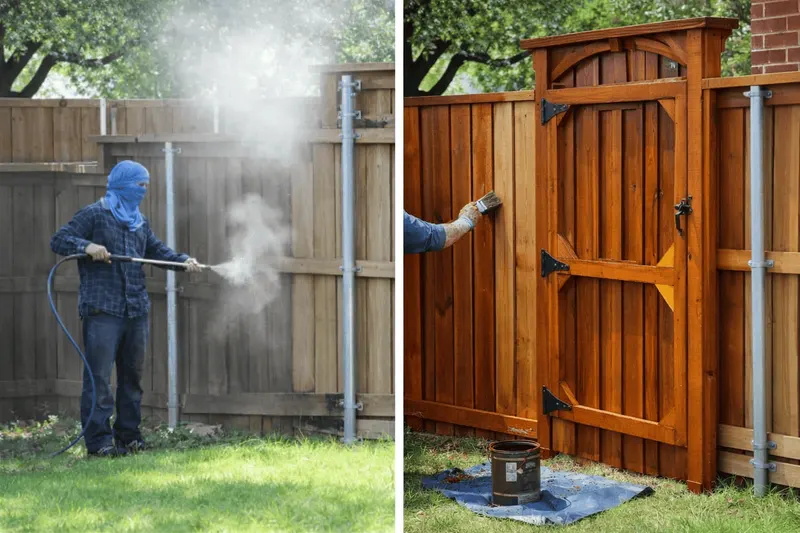
A homeowner can get a good result with a brush, a pump sprayer and patience. The U.S. Forest Service’s Forest Products Laboratory notes that brushing improves penetration and evenness, so slow hand work is not a handicap. What is hard for one person is speed. Stain has to go on wet edge to wet edge down the full length of a board, or it leaves lap marks where a second pass overlaps a dry one.
A crew brings cleaning equipment, masking, sprayers and enough hands to keep that wet edge moving. Our power wash and restain service covers cleaning, repairs to loose boards and the finish in one visit plan.
Be honest about the fence you have. A newer fence that still shows its cedar color needs a rinse and a coat. A gray fence with dark patches needs real cleaning first, and that is where most Dallas homeowners either damage the wood with too much pressure or stain over mildew that shows through within months.
Staining a wood fence yourself compared with hiring a professional crew
| What you are comparing | Doing it yourself | Professional crew |
|---|---|---|
| Cleaning and prep | Hand scrubbing or a rented washer | Controlled washing, then a proper dry time |
| Applying the stain | Brush or pump sprayer, one section at a time | Sprayer with back-brushing, full runs kept wet |
| Overspray control | Depends on your masking and the wind | Masking, shields and a wind call before starting |
| Time | One or more weekends | Usually a day or two after the fence is dry |
| Small repairs | Separate trip to the lumber yard | Loose pickets and rails fixed before the finish |
| Where the money goes | Stain, tools and your time | Labor, prep, product and accountability |
What this means for you: On an old or mildewed fence, the cleaning step is where a professional earns the fee.
How much does it cost to stain a fence in Dallas?
The price follows the amount of surface, the condition of the wood and how much has to be protected around it. We do not publish numbers. A free written estimate after seeing the fence is the only honest figure.
Four things move a staining bid. Size comes first: the length, the height and whether one side or both are stained. Condition is second, because gray or mildewed wood has to be cleaned and dried before any finish goes on. Product is third, since a quality penetrating stain costs more than a thin sealer. Access is fourth: beds, pools, cars and a neighbor’s patio all add masking time.
When you compare bids, ask each company to name the stain, state the number of coats, say whether cleaning is included and say whether both sides are covered. The same logic applies to new fences, as we explain in what drives the cost of a cedar fence in Dallas.
Is it better to paint or stain a wood fence?
Stain is better for almost every wood fence. Paint and other film-forming finishes sit on the surface, and when moisture gets behind them they crack and peel. A penetrating stain soaks in and wears away gradually.
That is not only our opinion. The Forest Products Laboratory’s report on exterior stains says penetrating finishes are not prone to crack or peel the way film-forming finishes can, and that wood finished with them does not need scraping before it is refinished. The same report says opaque, solid-color stains should not be used on structures such as decks and fences, because they behave like paint.
Paint has one fair use: a smooth picket fence on a traditional house where a crisp white is the design. Accept that it will need scraping and repainting. For cedar privacy fences, pick a pigmented stain. Our cedar fence stain guide covers color and transparency.
Do both sides of a fence need to be stained?
Both sides should be stained if you can reach both. Stain on one face protects that face only, and the bare side keeps taking sun and water.
A board that is sealed on one side and raw on the other also takes on and loses moisture unevenly, which encourages cupping. Tops and end grain matter even more than faces, because that is where water enters. A cap and trim help, and so does a brush run along the top edge of every picket.
The practical limit is ownership and access. The outside of an alley fence is easy. The far side of a fence shared with a neighbor is their yard, so it needs their permission and a conversation about color. We cover that in shared fences in Texas. The rest of the yearly routine is in our wood fence maintenance checklist.
Is oil-based or water-based fence stain better in Texas?
For rough-sawn cedar in full Texas sun, an oil-based penetrating semitransparent stain is the traditional choice, because it soaks into the wood. Water-based products have improved, but many of them form a thin film on the surface.
The Forest Products Laboratory describes oil-based semitransparent stain as the finish of choice for wood fully exposed to the weather and says it performs much better on rough-sawn wood than on smooth. It describes latex semitransparent stain as a thin film that tends to wear by flaking. That report dates from 1999 and formulations keep changing, so read the label of the product in front of you.
Pigment matters as much as the base. An older Forest Service field study found clear water repellents were the least durable natural finishes it tested, and pigmented semitransparent stains lasted longer. In North Texas, expect to restain every few years, typically two to four. Our wood fences are built with kiln-dried cedar, which takes stain evenly.
Is a pre-stained fence better than staining after installation?
Each has a real advantage. Pre-stained pickets are coated on all faces and edges before they are nailed up, which no sprayer can match afterward. Staining on site covers the cut ends, the cap, the trim and the fastener heads in one even color.
The weak points of pre-stained material are the field cuts and the mix of boards. Every picket trimmed to follow the grade exposes raw wood, and those cuts need touching up by hand. The weak point of on-site staining is that the backs of overlapping boards and the faces against the rails never see finish.
Timing matters with on-site staining. Stain goes on once the wood is dry enough to accept it, and kiln-dried cedar reaches that point sooner than green lumber. Whichever route you take, ask what stain is used and whether the cuts are sealed. For the difference stain makes to service life, see how long a cedar fence lasts in North Texas.
How do you keep stain overspray off the house, the cars and the neighbor’s yard?
By controlling wind, pressure and distance, and by covering what cannot be moved. Overspray is the most common staining complaint, and oil-based stain does not wash off brick, concrete or car paint easily.
- Pick the day: Do not spray in wind. A light breeze carries fine mist much farther than people expect.
- Move and cover: Move cars well away, cover AC units, windows, stone and pool decks, and wet down or cover plants.
- Use a shield: Hold a spray shield behind the fence top and at the ends, and keep the tip close to the wood.
- Back-brush: Follow the sprayer with a brush. It works the stain in and lets you spray lighter.
- Tell the neighbors: Give a day’s notice so cars, furniture and pets on the other side can be moved.
- Handle rags safely: The Forest Products Laboratory warns that oil-soaked rags can ignite on their own. Soak them in water and seal them in a can.
How Park Cities Fence & Deck helps
Jack Johnson comes out himself, looks at your property and gives you a free written estimate with a timeline. Wood, iron and masonry are all built in-house, so the advice fits the property. Related services: powerwash & restain, wood fencing. We work in Dallas and across Dallas.
Questions people ask next
What weather is too hot, too cold or too wet to stain a fence?
Follow the temperature range on the can first. As a guide, the Forest Products Laboratory says latex coatings generally need at least 50 degrees for several hours after application, while oil-based stains tolerate cooler days. Avoid staining boards in direct afternoon sun, which causes lap marks and uneven penetration, and never stain damp wood. After washing, let the fence dry a day or two.
Can I stain my side of a neighbor’s fence?
Ask first. If the fence belongs to your neighbor, the side facing you is still their property, and stain can bleed through gaps to their side. Most neighbors agree when you show them the color. If nobody knows whose fence it is, a survey answers that. Our guide to neighbor fence questions in Texas covers the common cases. This is general information, not legal advice.
Is it worth staining an old fence before listing a house?
Usually yes if the structure is sound. A cleaned and stained fence photographs well and removes an item from a buyer’s list. It is not worth it when posts are leaning or boards are rotted, because stain does not hide structural problems. In that case repair first. Our repair or replace guide helps you judge which fence you have.
How do I clean a fence without a pressure washer?
Use a wood cleaner or a bleach and water mix, a soft brush and a garden hose. The Forest Products Laboratory’s formula is one third of a cup of household detergent, one quart of liquid household bleach and three quarts of warm water. Never use a detergent that contains ammonia with bleach. Scrub, rinse well, protect plants and let the wood dry before staining.
Why is my wood fence turning gray or black?
Gray is weathering. Sunlight breaks down the surface of unprotected wood and rain washes the color out. Black or dark green patches are usually mildew or algae growing on a damp, shaded surface, often near sprinklers. Gray wood can be cleaned and stained if it is still solid. Mildew should be removed before any finish goes on, or it will show through.
Sources and further reading
- USDA Forest Service, Forest Products Laboratory: Selection and Application of Exterior Stains for Wood (FPL-GTR-106)
- USDA Forest Service: Durability of Exterior Natural Wood Finishes in the Pacific Northwest (FPL-RP-366)
General information, not legal advice. Rules change: we confirm the current requirements with your city or HOA before we build.