Wood · Dallas, Texas
What Are the Different Styles of Wood Privacy Fence, and Which One Fits My Yard?
A plain glossary of wood fence styles, with how private each one is and which yard it suits.
 By Jack Johnson, owner of Park Cities Fence & Deck · 8 min read · 1,778 words
In short
The main wood privacy fence styles are side-by-side (stockade), board-on-board, board-and-batten, shadowbox and horizontal. Picket and lattice-top fences are decorative or semi-private. Board-on-board gives the most complete privacy; shadowbox looks the same from both sides but can be seen through at an angle. The right style depends on privacy, wind, the house and your HOA.
In this guide
- What are the main wood fence styles at a glance?
- What is a shadowbox fence, and is it really private?
- What is the difference between a stockade fence and a board-on-board fence?
- Is a picket fence a good choice for a front yard?
- Is a lattice-top fence a good idea in Texas?
- Should fence pickets be dog-eared, flat-top or arched?
- Is a split-rail or ranch-style fence a good fit for a large lot?
Need this done? See wood fencing.
Fence style names get used loosely, and two bids for a “cedar privacy fence” can describe two different fences. The style decides how much the neighbors can see, how the fence handles wind, how much lumber goes into it and how it looks from the street side.
This is a plain glossary of the wood styles we build, who each one suits and what to ask for. Two styles already have their own guides, so we link to them instead of repeating them: board-on-board versus side-by-side and horizontal wood fences in Dallas.
What are the main wood fence styles at a glance?
There are six styles most Dallas homeowners choose from, and they differ mainly in how the pickets are arranged on the rails. The table gives the short version.
Every one of them can be built in Western Red Cedar, redwood or pressure-treated pine, with or without a cap, trim and a rot board. See our wood fencing service for the options, or the project gallery for finished examples.
Wood fence styles compared by construction, privacy and best use
| Style | How it is built | Privacy | Best for |
|---|---|---|---|
| Side-by-side (stockade) | Pickets butted edge to edge on one side | High, with thin gaps as wood dries | Simple back and side lines |
| Board-on-board | Overlapping pickets on one side | Complete | Full privacy, pools, close neighbors |
| Board-and-batten | Wide boards with narrow strips over the joints | Complete | A more architectural look |
| Shadowbox | Pickets alternate on both sides of the rail | Partial at an angle | Shared lines, breezy sites |
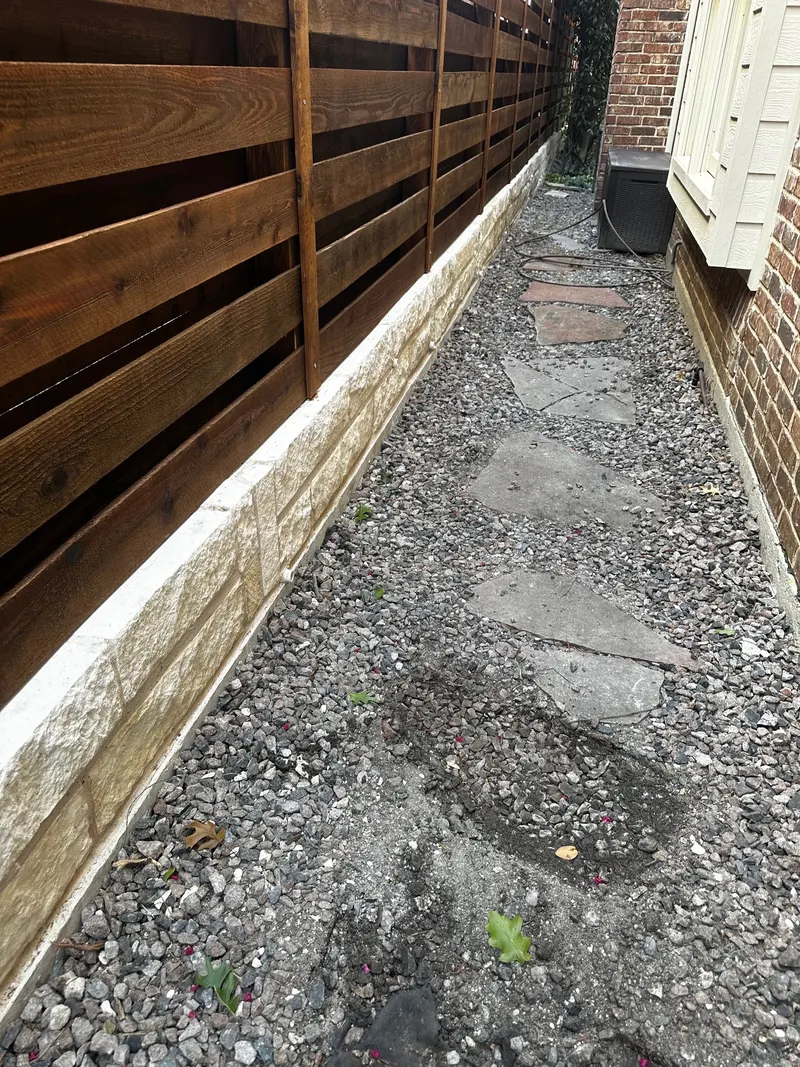
| Horizontal | Boards run level between posts | High to complete | Modern and mid-century homes |
| Picket | Spaced pickets, usually low | Low by design | Front yards and gardens |
What this means for you: Any of these can be capped, trimmed and stained; the style describes the picket layout, not the finish.
What is a shadowbox fence, and is it really private?
A shadowbox fence has pickets on both sides of the rails, staggered so each board covers the gap on the opposite side. It is private when you look straight at it and partly see-through from an angle.
Its strength is that both neighbors get the same view. There is no “good side,” which settles a common argument on a shared line. Air moves through it, and it casts an attractive pattern of light.
Its weakness is the angle. Someone walking along the fence can catch glimpses through it, and the gaps widen slightly as the boards dry. If the goal is to hide a pool or a patio from a second-story window next door, shadowbox is the wrong choice. It also uses more lumber than a side-by-side fence and is harder to stain, because the inside faces of the boards are tough to reach. Where a dog needs to be contained but you want to keep a view, an open metal fence does that job better, as we explain in the best fence for large dogs with a view.
What is the difference between a stockade fence and a board-on-board fence?
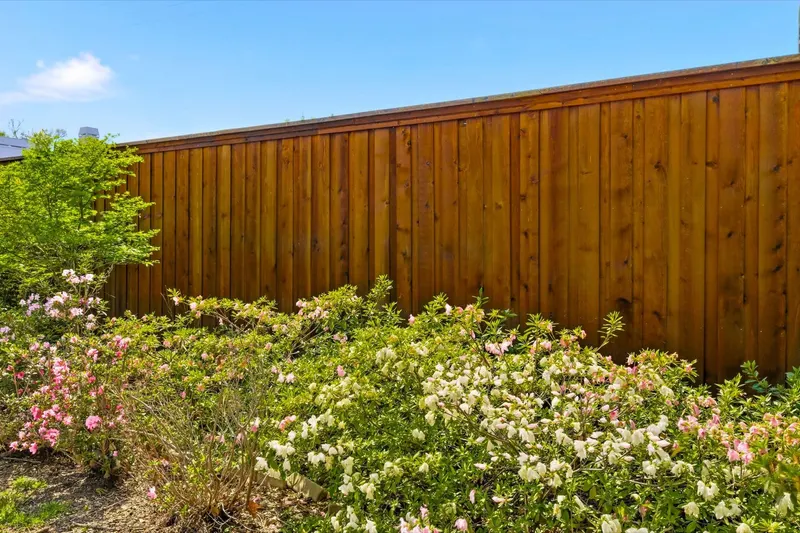
A stockade fence, also called side-by-side, sets the pickets edge to edge in a single layer. A board-on-board fence overlaps them in two layers, so there is never a line of sight through it.
Stockade is the standard, lower-cost privacy fence. It is fully private on install day, then thin gaps appear as the pickets shrink. That is normal wood movement, which we explain in why a new wood fence shows gaps. Board-on-board uses more pickets and costs more, but the overlap hides shrinkage for the life of the fence.
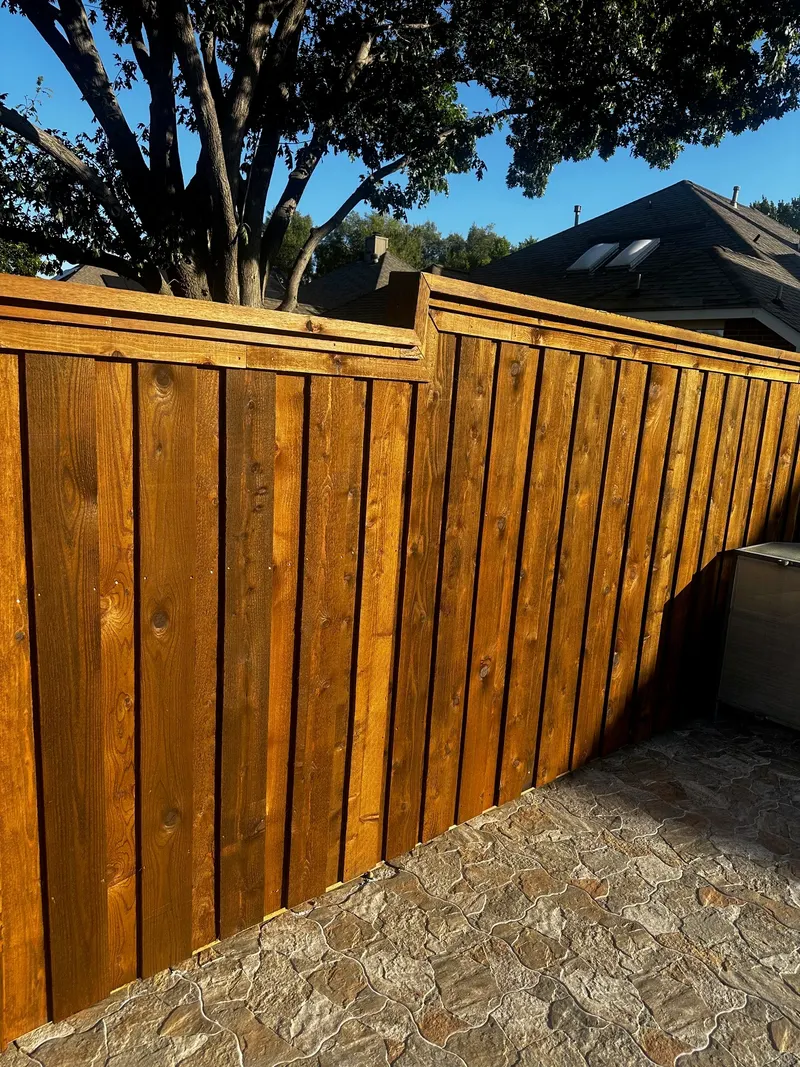
Board-and-batten reaches the same result another way: wide boards butted together with a narrow batten covering each joint. It reads as more tailored and suits traditional homes. Our full comparison is in the board-on-board guide linked above, so we will not repeat the details here. Whichever you choose, ask each bidder to name the style in writing along with the picket width and thickness, because a bid that says only “privacy fence” could mean either one.
Is a picket fence a good choice for a front yard?
Yes, where a front yard fence is allowed. A low, open picket fence marks the yard and frames the house without walling it off, which is usually what cities and HOAs want at the street.
Front yards are the most regulated part of a lot. Many cities limit height and require a front fence to be partly open, and some neighborhoods do not allow one at all. The numbers vary by city and by deed restriction, so we confirm them before design. Our guides to fence height rules in Dallas and the Park Cities and front yard fences in Preston Hollow and the Park Cities cover what we have verified.
A picket fence is not a containment fence for a large dog and gives no privacy. Homeowners who want more presence at the street often choose ornamental iron instead.
- Picket top: Pointed, rounded, flat or French gothic. Match the formality of the house.
- Spacing: Tighter spacing looks richer and keeps small dogs in; wider spacing looks lighter.
- Line: A straight top is classic; a scalloped or arched line between posts is more decorative.
- Finish: Paint looks crisp but needs more upkeep than a penetrating stain.
Is a lattice-top fence a good idea in Texas?
It can be, if the lattice is built as a framed panel and you accept that it needs more care than the fence below it. Thin stapled lattice does not last in Texas sun.
A lattice topper adds height and softness without the weight of a solid wall. It lets light and air through the top of the fence and gives vines something to climb. It is a good answer when you want screening above eye level but do not want the yard to feel boxed in. Check the total height against your city and HOA limits, because the topper counts toward it.
The honest downsides: lattice has many small surfaces, so it weathers faster and takes longer to stain. Heavy vines hold moisture against the wood and add wind load. Ask for lattice made from full-thickness cedar strips set in a frame with a cap over it. If the real goal is screening and the fence height is capped, there are other ways to get it, covered in backyard privacy when fence height is limited.
Should fence pickets be dog-eared, flat-top or arched?
Choose flat-top with a cap for the cleanest look and the best protection, dog-eared for a simple uncapped fence, and arched tops where you want the fence to be a feature.
A dog-eared picket has its top corners clipped. It is the default on an uncapped stockade fence because clipped corners are less likely to split. A flat-top fence finished with a cap and trim board is a step up: the cap covers the picket ends and sheds water, as we explain in the guide to rot boards, gaps and top caps.
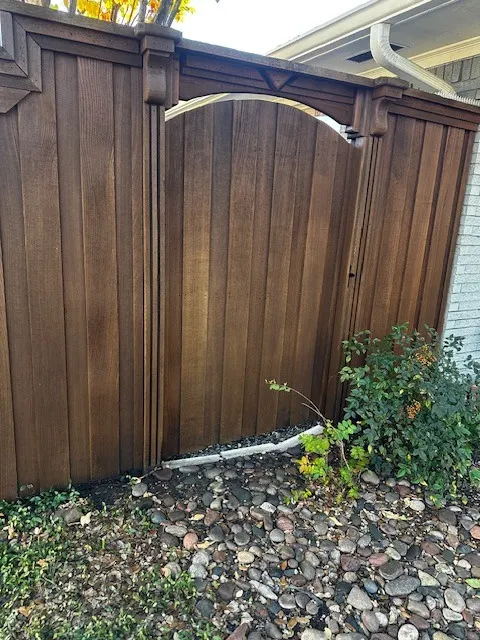
Arched and scalloped tops curve the fence line between posts. They suit Tudor, cottage and traditional homes and look especially good over a walk gate. They take more layout time, so they cost more than a straight line. Our guide to fence styles by home architecture matches top profiles to house styles.
Is a split-rail or ranch-style fence a good fit for a large lot?
For marking a boundary on acreage, yes. For privacy, security or keeping a dog in, no. A rail fence is a visual line, not a barrier.
Split-rail and three- or four-rail ranch fences use far less lumber per foot than a privacy fence, so they are an economical way to define a long frontage. They keep the view open and suit a house set well back from the road. They do nothing for a pool, which needs a code-compliant barrier, and small pets walk straight through unless wire mesh is added.
We should be plain about our own work. Our wood fences are privacy, picket, shadowbox, board-and-batten and horizontal styles, and on larger lots we more often build iron between masonry columns, described in the best fence styles for estate homes. If a rail fence is what your property calls for, ask at the consultation and we will tell you honestly whether it is a fit for us.
How Park Cities Fence & Deck helps
Jack Johnson comes out himself, looks at your property and gives you a free written estimate with a timeline. Wood, iron and masonry are all built in-house, so the advice fits the property. Related services: wood fencing.
Questions people ask next
What fence style goes best with a ranch-style or mid-century home?
A horizontal cedar fence usually suits them best. Long, level boards repeat the low roofline and wide proportions of a ranch or mid-century house. Keep the detailing simple: flat top, minimal trim, a warm semi-transparent stain. A capped board-on-board fence in a plain profile also works. Avoid ornate arched tops and gothic pickets, which belong with traditional architecture.
What is the best fence for total privacy?
A board-on-board cedar fence with a cap and a rot board. The overlapping pickets leave no line of sight even after the wood dries and shrinks, the cap closes the top and the rot board closes the bottom. Board-and-batten gives the same result with a different look. Height is limited by your city and HOA, so confirm what is allowed before you design around a taller fence.
Does a fence with gaps or a shadowbox design handle wind better than a solid one?
Somewhat. Gaps let some air pass, which lowers the pressure on the fence compared with a solid wall of the same height. But the posts decide whether a fence survives a storm, not the picket pattern. Deep footings in concrete, steel posts and sound rails matter far more. A well-built solid fence outlasts a poorly built shadowbox in every Texas storm.
Does the finished side of a fence have to face the neighbor in Texas?
We are not aware of a statewide Texas law that requires it. The rule, where there is one, comes from the city or the HOA, and many require the finished side to face a street or public area. Good manners point the same way. We confirm the local requirement before building. This is general information, not legal advice; a shadowbox or cap-and-trim design looks finished on both sides.
Is a top cap on a fence just for looks, or does it protect the boards?
Both. The cap covers the cut tops of the pickets, where rain soaks into the end grain, and it shades them from direct sun. It also ties the top of the fence together, which keeps the line straighter over time. Because the cap is the most exposed board, it should be stained on the same two-to-four-year schedule as the rest of the fence.
Sources and further reading
- Western Red Cedar Lumber Association (Real Cedar): Why Real Cedar
- Purdue University Cooperative Extension Service and USDA Forest Products Laboratory: Selection and Application of Exterior Finishes for Wood (NCR-135)
General information, not legal advice. Rules change: we confirm the current requirements with your city or HOA before we build.