Wood · Dallas, Texas
Why Is My New Wood Fence Warping, Cracking or Showing Gaps?
Some movement in a new wood fence is normal. Here is how to tell normal drying from a real defect.
 By Jack Johnson, owner of Park Cities Fence & Deck · 8 min read · 1,767 words
In short
A new wood fence warps and shows gaps because the boards are still drying. Wood shrinks across its width as it loses moisture, and a North Texas summer dries it fast. Small gaps, hairline cracks and slight cupping are normal. Twisted boards, loose pickets, soft wood or leaning posts are defects to report.
In this guide
- What wood movement is normal in the first year?
- Is it normal for new fence boards to crack or split?
- Why is my wood fence turning gray or black?
- How do I stop my wood fence from rotting at the bottom?
- Do termites or carpenter ants eat cedar fences in Texas?
- Why is my fence turning green, and how do I remove algae or mildew?
- Why are the nails popping out of my fence boards?
Need this done? See wood fencing.
Wood is not a stable material, and nobody honest will promise that a board will never move. Every picket holds water when it is milled. Once it is nailed to a fence in the Dallas sun, that water leaves, and the board gets a little narrower. What matters is how much it moves, and whether the fence was built to allow for it.
This guide separates normal wood behavior from real problems, then covers the issues that show up later: graying, rot at the bottom, insects, green film and popped nails. If you are still choosing materials, start with cedar, pine and redwood compared for Texas.
What wood movement is normal in the first year?
Expect small gaps between side-by-side pickets, a few hairline cracks and a board or two with a slight cup. All of that is ordinary drying, and most of it happens in the first summer.
How much a fence moves depends on how wet the lumber was when it went up. Green pickets that were tight on install day can open noticeable gaps within weeks. Kiln-dried cedar has already done most of its shrinking before it reaches your yard, which is why we use it. Purdue University and the USDA Forest Products Laboratory note that wood swells and shrinks with the seasons and that flat-grained boards move more than edge-grained ones, so some variation from board to board is built into the material.
If seeing daylight between boards bothers you, the answer is a design choice, not a repair. An overlapped board-on-board fence stays private as the wood moves.
New wood fence symptoms: normal movement or a defect
| What you see | Usually | What to do |
|---|---|---|
| Thin gaps between side-by-side pickets | Normal shrinkage | Nothing, or choose board-on-board for privacy |
| Hairline cracks on the face or at a knot | Normal drying checks | Stain on schedule to slow them |
| One or two slightly cupped boards | Normal | Monitor; replace only if it worsens |
| Boards twisted away from the rail | Defect | Ask the builder to replace them |
| Splits running through a board at the fasteners | Defect | Replace the board and check fastener placement |
| Leaning posts or a sagging bay | Structural problem | Call the builder now |
What this means for you: When in doubt, photograph it and send it to your builder. A good one would rather look than guess.
Is it normal for new fence boards to crack or split?
Small surface cracks, called checks, are normal. Splits that run through the full thickness of a board, or from a nail to the end of the picket, are not.
Checks form because the outside of a board dries faster than the inside. They show up most on the sunny south and west faces and on wide, flat-sawn boards. They do not weaken the fence. A penetrating stain soaks into them and slows the cycle of wetting and drying that makes them grow.
Through-splits usually point to a cause you can name: a fastener driven too close to the end, a picket nailed too tightly across its width so it could not shrink, or thin lumber. Those boards should be replaced. Good practice on a cedar fence build is two fasteners per rail set in from the edges, which holds the picket flat and still lets it shrink. Our cedar fence stain guide explains which finishes soak in deepest.
Why is my wood fence turning gray or black?
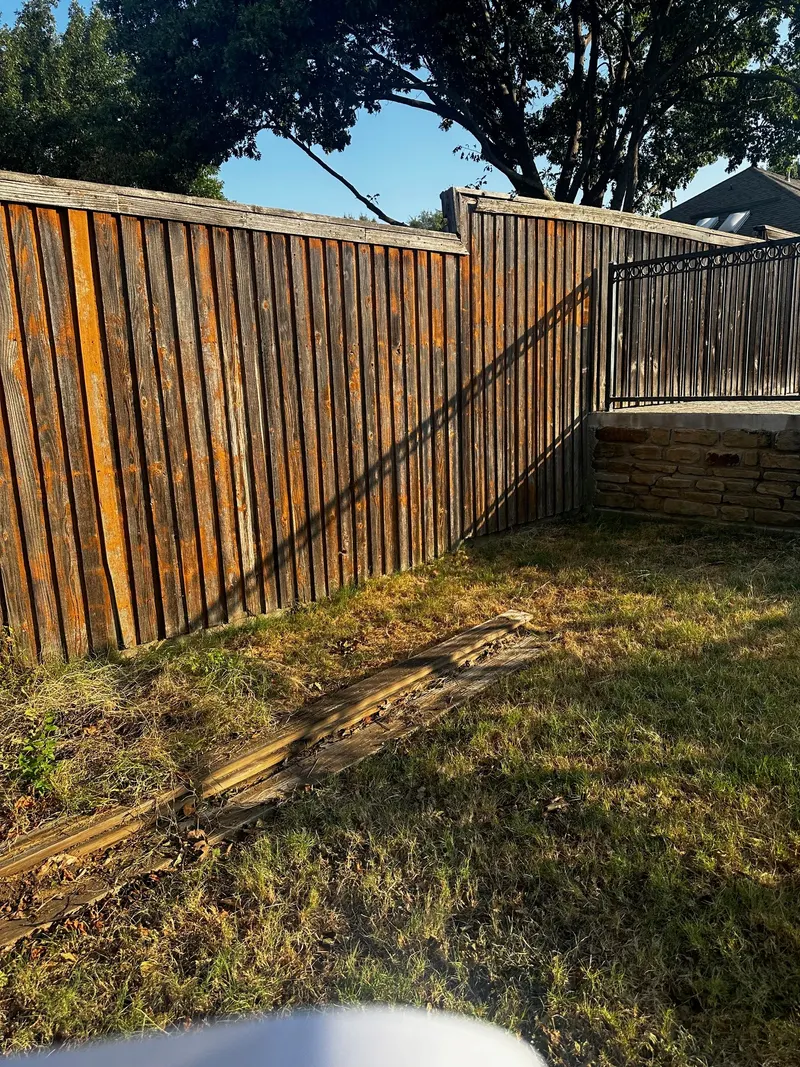
Gray is weathering: sunlight breaks down the surface of unprotected wood and rain washes the color away. Black or dark gray blotches are usually mildew growing on the surface.
Neither means the fence is failing. The extension publication from Purdue and the Forest Products Laboratory explains that a water-repellent finish with a mildewcide keeps wood from graying by inhibiting mildew. It also gives the simplest test for when to refinish: splash water on the boards. If it beads and runs off, the finish is still working. If it soaks in, it is time.
In North Texas that usually means staining every few years, typically two to four. Our power wash and restain service brings a gray fence back, and the guide on when to powerwash and restain covers the timing.
How do I stop my wood fence from rotting at the bottom?
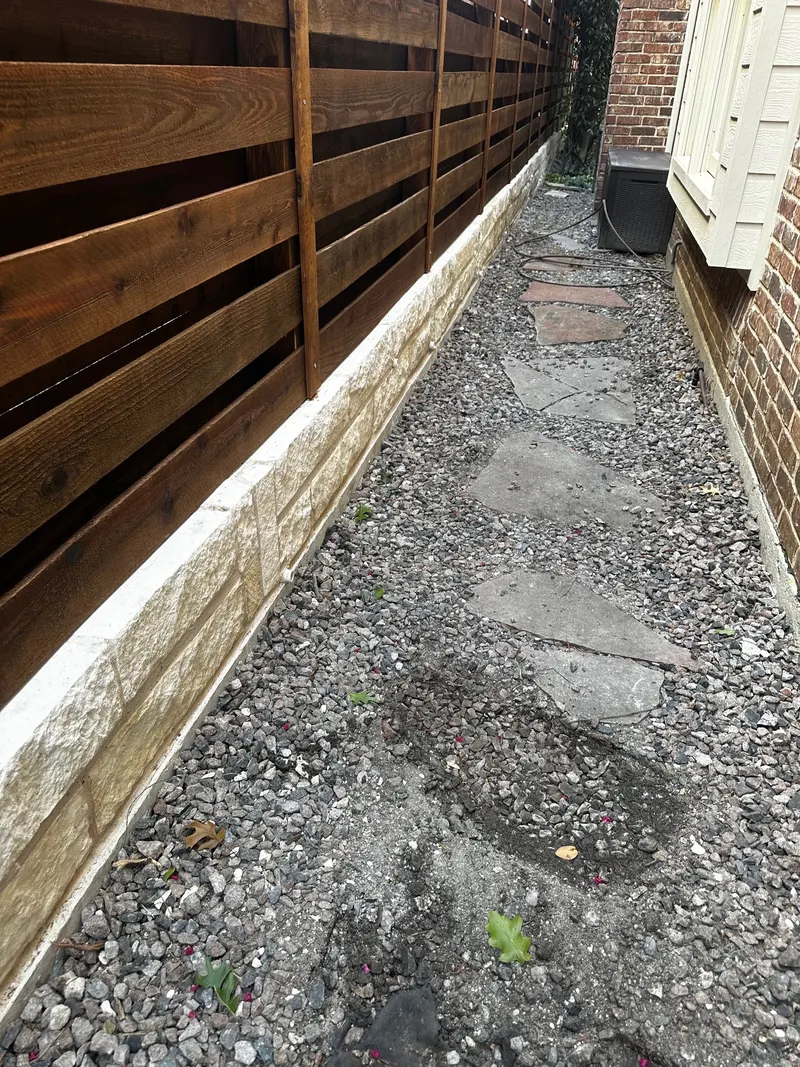
Keep the pickets off the ground and give them a chance to dry. Rot needs wood that stays wet, and the bottom of a fence is where that happens.
The fixes are plain. A pressure-treated rot board under the pickets takes the soil contact. Sprinkler heads should be turned so they do not soak the same boards every morning. Mulch and soil should sit below the cedar, not against it. And posts should be steel or set properly in concrete, as explained in our guide to post depth and concrete in clay soil.
If the bottoms are already soft, do not wait.
- Probe it: Push a screwdriver into the lowest few inches. Sound wood resists; rot gives way.
- Check the posts: Push on each post at shoulder height. Movement at the base matters more than soft pickets.
- Trim and protect: Soft picket ends can often be cut back and a rot board added underneath.
- Know when to stop: If the posts are failing along the run, repair money is better spent on replacement.
Do termites or carpenter ants eat cedar fences in Texas?
Termites can attack any wood fence, including cedar, although cedar heartwood is less attractive to them than pine. Carpenter ants do not eat wood at all. They hollow out wood that is already damp or decayed to nest in it.
Texas A&M entomologists describe native subterranean termites as a statewide concern for homeowners. They live in the soil, need constant moisture, and reach wood either through direct soil contact or by building mud tubes. That is one more reason to keep pickets off the ground. Western Red Cedar is described by its industry association as naturally resistant to rot, decay and insect attack, which is a real advantage, but it is not a guarantee, and the pale sapwood has less resistance than the darker heartwood.
If you find mud tubes on a fence that touches the house, call a licensed pest control company. A fence company fixes the wood; it does not treat the colony. Insect damage found during a repair visit is one of the things we weigh when advising whether to repair or replace an aging fence.
Why is my fence turning green, and how do I remove algae or mildew?
Green film is algae, and it grows where a fence stays shaded and damp: the north side, under trees, or wherever a sprinkler hits every day. It sits on the surface and does not eat the wood, but it holds moisture there.
Clean it gently. The Purdue and Forest Products Laboratory guide says mildew should be removed with a dilute household bleach solution, rinsed thoroughly with fresh water and allowed to dry before refinishing. It also warns never to mix bleach with ammonia or cleaners that contain it. Keep pressure low if you use a washer; too much pressure furs the surface of soft cedar.
Then remove the cause. Trim plants back from the fence, redirect the sprinkler, and restain once the wood is dry. A full wood fence maintenance checklist for North Texas makes this a short job once a year.
Why are the nails popping out of my fence boards?
Nails back out because the wood around them swells and shrinks with every wet and dry cycle, and smooth nails have little grip to resist it. Each cycle works the nail out a little further.
The cure is the fastener, not a hammer. Ring-shank nails or screws hold far better than smooth nails, and they should be galvanized or coated so they do not rust and streak the boards black. Tapping a popped smooth nail back into the same hole rarely lasts. Replace it with a screw or a ring-shank nail set slightly to one side.
A handful of loose fasteners is a small fence repair. Pickets popping along a whole run suggest the wrong fasteners were used throughout, and that is worth raising with whoever built it.
How Park Cities Fence & Deck helps
Jack Johnson comes out himself, looks at your property and gives you a free written estimate with a timeline. Wood, iron and masonry are all built in-house, so the advice fits the property. Related services: wood fencing, fence rehab / repair, powerwash & restain.
Questions people ask next
Should fence lumber be kiln-dried before it is installed?
It is better if it is. Kiln-dried lumber has already lost most of its moisture, so it shrinks and twists less after the fence is built. Green lumber is cheaper and does its drying on your fence line, which is where the gaps and warped boards come from. We build with kiln-dried cedar. Ask any bidder what the moisture condition of their pickets is and get it in writing.
What if I find a problem with the fence after the crew has left?
Photograph it and contact the builder promptly. Reasonable companies separate normal wood movement from defects and replace boards that twist, split through or come loose early on. On our jobs, Jack Johnson walks the finished fence with you, and the workmanship and manufacturer warranty terms that apply are reviewed on your written estimate. See our guide to what to expect from a fence warranty for the questions to ask.
Are my sprinklers ruining my fence?
They can be. A spray head that wets the same boards every morning keeps them damp, washes out stain, leaves mineral stains from hard water and feeds algae and rot at the bottom. Turn the heads away from the fence, switch to drip irrigation in beds along the fence line, and water early so the wood dries in the sun. It is one of the cheapest ways to add years to a fence.
Does extreme summer heat shorten the life of a fence?
Heat and sun are hard on wood, but they shorten the life of the finish before they shorten the life of the fence. Strong sun dries boards quickly, opens checks and burns off stain, especially on south and west faces. A cedar fence in North Texas typically lasts 15 to 20 years. Staining every two to four years is what keeps it at the long end of that range.
How thick should fence pickets be?
Thicker is better within reason. Thin pickets, the kind sold in bulk at the lowest price, cup, crack and split at the fasteners much sooner in Texas heat. A fuller-thickness cedar picket holds a fastener better and stays flatter. Thickness varies by mill and grade, so ask each bidder for the actual measured thickness of the picket they are pricing, not just the nominal size.
Sources and further reading
- Purdue University Cooperative Extension Service and USDA Forest Products Laboratory: Selection and Application of Exterior Finishes for Wood (NCR-135)
- Texas A&M University, Urban and Structural Entomology Program: Native Subterranean Termites
- Western Red Cedar Lumber Association (Real Cedar): Why Real Cedar
General information, not legal advice. Rules change: we confirm the current requirements with your city or HOA before we build.